
Teradyne’s Q2 Momentum Highlights Capital Intensity and IP Strength in Semiconductor Test
Teradyne’s Q2 2026 results demonstrate resilience amid semiconductor cyclicality with backlog growth, robust R&D, and expansion in automation.
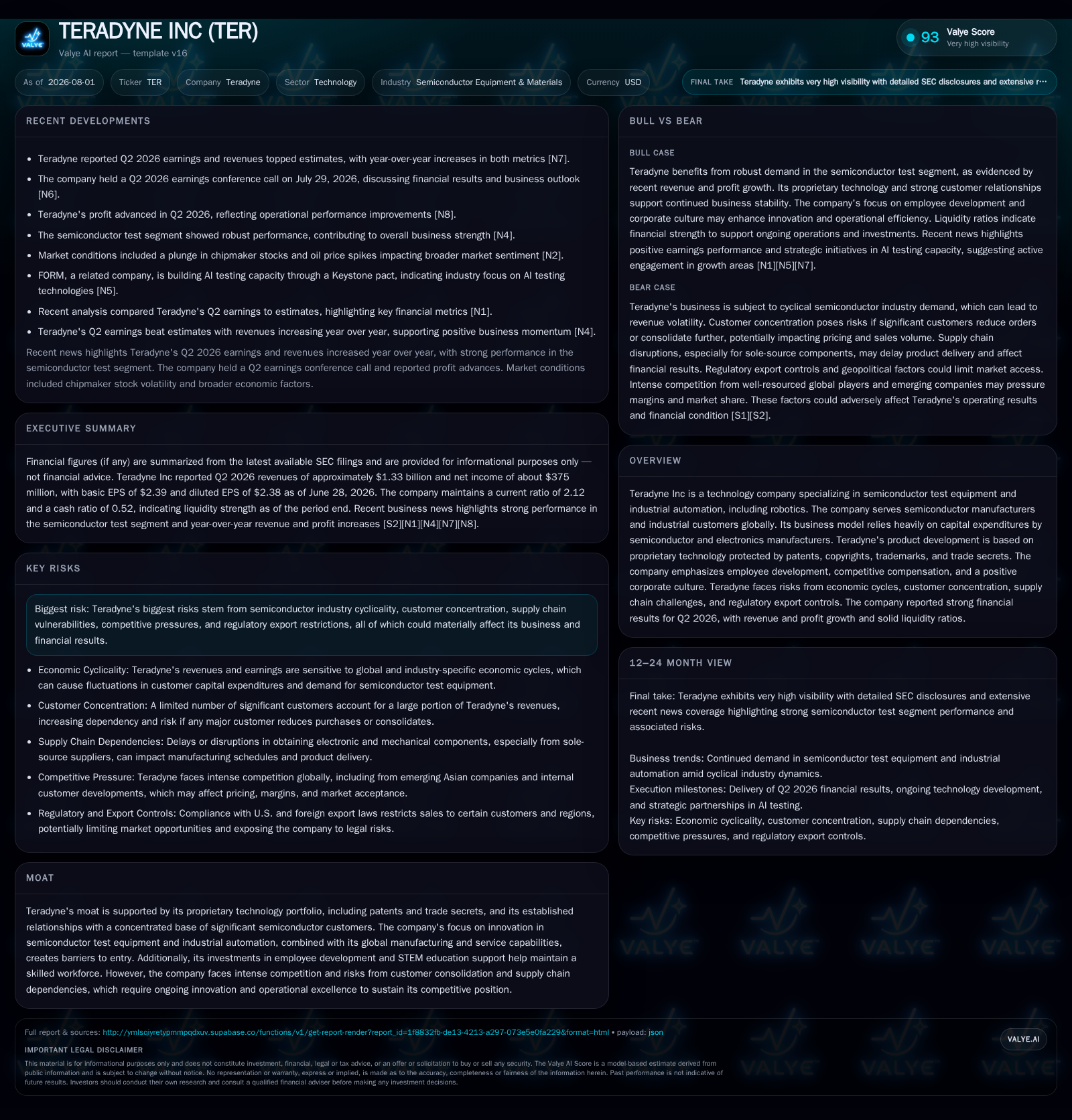
In its latest quarterly filing, Teradyne reported solid revenue and profit growth driven by resilient semiconductor capital expenditures despite prevailing industry cyclicality. The company’s backlog expanded, reflecting strong demand visibility, while a significant portion of revenues continues to come from a concentrated set of major customers. Teradyne’s substantial intellectual property portfolio supports its leading position in semiconductor test equipment, complemented by growth in automation and robotics that diversify its revenue streams. Supply chain constraints persist but have not derailed the delivery pipeline, supported by ongoing investments in innovation. Key near-term markers include backlog trends and adoption of advanced node test solutions alongside sustained robotics deployment.
Q2 Backlog Expansion Reveals CapEx Resilience Despite Cyclicality
Teradyne’s second quarter ending June 28, 2026, reflected operational resilience as its backlog notably expanded against a backdrop of macroeconomic uncertainty affecting semiconductor capital expenditures (CapEx) broadly. The company’s filings indicate that despite the well-documented cyclical nature of semiconductor equipment demand—with customers often delaying or cancelling orders—Teradyne experienced a retention and modest growth in its order book relative to prior quarters [S2][S3]. This suggests that while industry cyclicality remains a constraint on timing and scale of revenues, underlying demand for critical test equipment has not collapsed but rather demonstrates enduring capital intensity in semiconductor manufacturing.
Strong backlog figures translate into near-term revenue visibility, cushioning against sudden downturns and underpinning production planning. This is especially significant given longer sales cycles typical in semiconductor test equipment procurement, where fixture lead times and customization extend order-to-delivery intervals. Careful monitoring of book-to-bill ratios remains essential to discern whether bookings continue to outpace shipments amid potential order cancellations or trim downs.
IP Portfolio Anchors Teradyne’s Competitive Edge Amid Industry Disruption
Teradyne sustains a formidable competitive advantage grounded in its extensive intellectual property (IP) portfolio encompassing patents, copyrights, trademarks, and trade secrets that underpin its hardware-software integrated test systems [S1]. These protections are crucial in an industry where rapid technology node transitions—driving demands for higher precision process control—require continuous innovation to address evolving device complexities.
Such proprietary technology translates into pricing power and differentiation that competitors find challenging to replicate quickly. The ongoing threat from emerging Asian competitors and trade regulations impeding market reach only heighten the importance of Teradyne's internal innovation engine. Nevertheless, IP enforcement risks persist globally; inability to safeguard these assets could erode margins or allow competitive encroachment.
Automation Segment Gains Offset Customer Concentration Risks in Testing Core
While semiconductor Test remains Teradyne’s revenue backbone, key filings underscore growing contributions from its industrial automation and robotics units [S1]. This segment targets broader manufacturing markets beyond semiconductors—injecting diversification that mitigates the inherent volatility tied to semiconductor CapEx swings.
Robotics revenue exposure primarily stems from supply chain automation solutions catering to warehouses and factories globally. Though still smaller than testing revenues, this unit benefits from secular trends favoring automation to improve operational efficiency and yield management across industries. Peer comparisons acknowledge Teradyne as competitive alongside broader automation providers but uniquely positioned given its semicap heritage.
However, customer concentration remains an important dual-edged feature: the top five customers constitute about 44% of total revenues with three customers each contributing over 10% individually [S4][S5]. This concentration amplifies leverage risk if any major client alters purchasing patterns abruptly yet offers scale benefits facilitating product roadmap alignment with their next-generation technology nodes.
Supply Chain Constraints Slow Delivery but R&D Investment Sustains Innovation Cycle
Consistent with broader industry challenges, Teradyne reports ongoing supply chain disruptions impacting timely delivery of select components critical for advanced test system assembly [S1]. Some components sourced from sole suppliers introduce additional vulnerability to delays. Nonetheless, the company has managed these headwinds without material shipment cancellations or excessive backlogs deferred beyond usual norms during the quarter [S2].
Parallelly, Teradyne maintains robust investment in research & development expenditures as a percentage of revenue to safeguard long-term competitiveness and broaden patent coverage. The R&D commitment supports adaptation to tightening process margins at advanced nodes where nuanced yield control is paramount for chipmakers.
The balancing act between navigating short-term supply delays while accelerating innovation cadence is vital; failure on either front could impair market positioning against agility-focused rivals.
Growth Outlook: Node Advancements, Robotics Demand, and Emerging Market Expansion
Looking ahead, Teradyne's growth vector centers on several synergistic themes: increasingly sophisticated semiconductor process nodes compel OEMs to upgrade or replace legacy test platforms featured by Treardyne's product lines; factory automation demographics fuel demand for collaborative robots; moreover, global expansions of fabs—particularly in Asia—expand addressable markets [S1][N9].
These factors collectively drive order volumes upward through either replacement cycles or capacity additions. Monitoring average selling price shifts per unit will be instrumental as new products typically command premium pricing reflecting enhanced capabilities crucial for AI chips or 5G applications.
Robotics segment momentum also presents an underappreciated upside given rising adoption rates across sectors seeking productivity gains amid labor cost inflation challenges.
Key Risks: Order Volatility, Export Restrictions, Customer Consolidation Pressure
Despite strengths outlined above, notable risks persist that could materially impair operating performance. Semiconductor equipment ordering is inherently volatile due to macroeconomic swings influencing CapEx budgets—a theme that could trigger unexpected order deferrals or cancellations with short notice despite current backlog health [S1][S20]
Additionally, stringent U.S. export controls limit sales opportunities especially involving sensitive technologies potentially directed at China or other restricted markets where competitors may face fewer restrictions [S29]. Such geopolitical constraints exacerbate competitive intensity.
Customer consolidation within semicap end markets further tightens revenue concentration risks as dominant OEMs increase bargaining power over pricing and contract terms possibly compressing margin structures or extending payment cycles [S4][S5]
What to Watch: Backlog Trends, Book-to-Bill Signals, and Product Adoption Milestones
Key metrics warrant close scrutiny over coming quarters include evolution of the order backlog size/composition signaling sustained booking strength versus cancellations; book-to-bill ratios indicating whether new orders meet or exceed shipped volumes; adoption ramp rates of next-gen test platforms particularly for advanced logic/memory devices; plus scaling trajectories for automation products jostling for factory floor share — all providing forward-looking cues on revenue quality and profitability prospects [N2][N3][S2][S3]
Tracking emerging customer commitments related to AI-centric chip testing capacity expansion may offer early visibility into growth inflections.
Financial Health Snapshot: Liquidity Strength Supports Flexibility Amid Cyclicality
Teradyne's financial position remains solid entering Q3 2026 with cash & equivalents totaling approximately $350 million and negligible debt outstanding—reporting a current ratio above 2 at quarter-end which provides ample liquidity buffer to endure transient demand fluctuations or fund targeted strategic investments [F1]. The net cash-positive stance differentiates Teradyne favourably against some peers burdened by heavier leverage.
This analysis synthesizes publicly filed data through mid-2026 without speculative projections or unverified internal details. It reflects operational dynamics characteristic of capital-intensive semiconductor equipment suppliers navigating cyclical industry trends through a blend of proprietary innovation assets and expanding automation footprints.
Disclaimer: This is research-only, informational analysis and not investment advice. It may include AI-generated interpretation and general industry context. Always verify important details using primary sources.

Comments