
Balchem Corp Strengthens Specialty Chemical Resilience Amid Regulatory Evolution
Balchem’s latest 10-Q reveals the operational and financial implications of tightening EPA regulations on ethylene oxide emissions, reinforcing its niche competitive position in specialty chemicals.
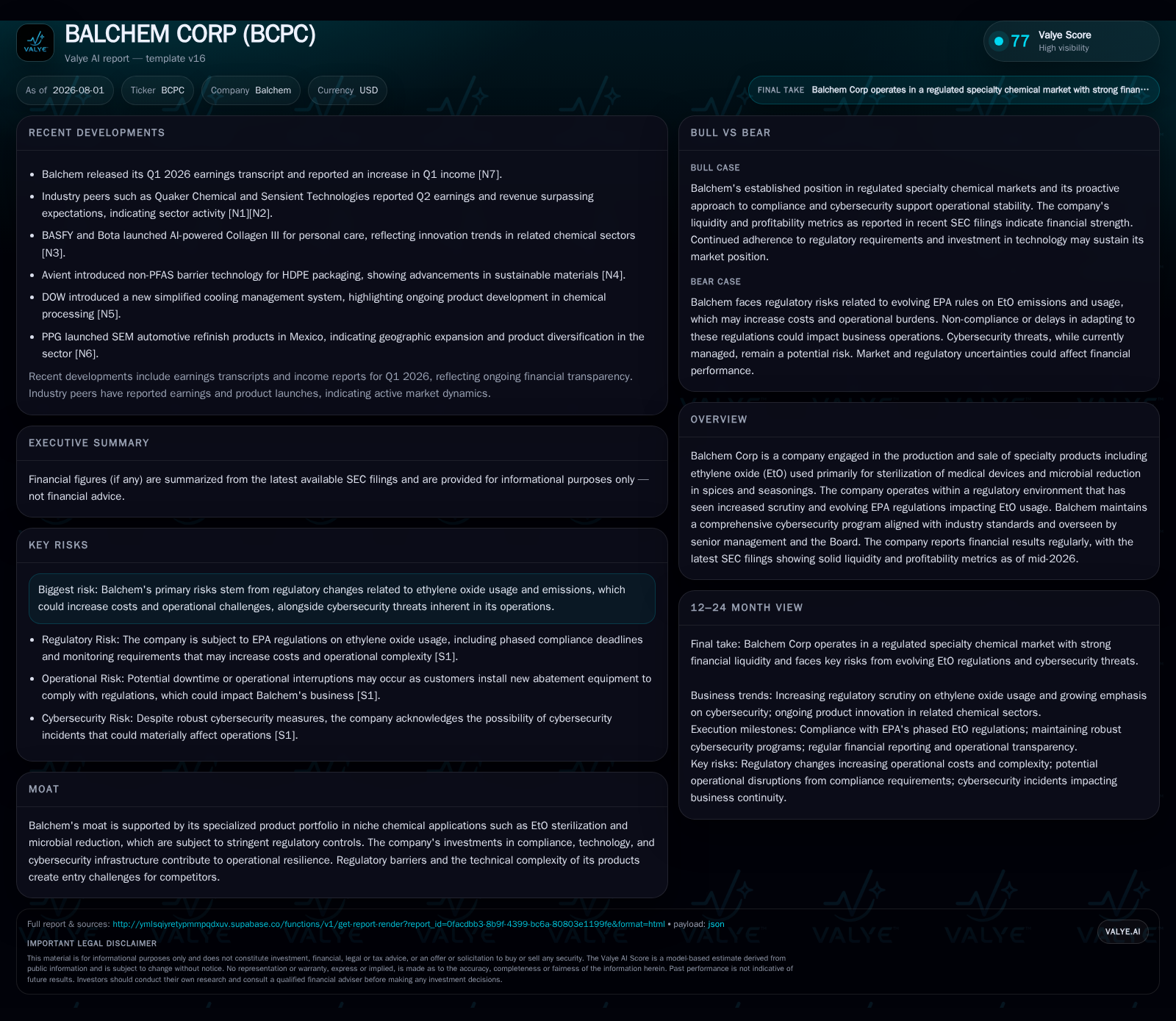
Balchem Corp's July 31, 2026 quarterly filing highlights ongoing regulatory pressures surrounding ethylene oxide (EtO) emissions compliance, driving increased capital and operating costs. The company’s specialty chemical business centers on EtO applications crucial for healthcare sterilization and microbial reduction in food, supported by high regulatory barriers that protect its competitive moat. Growth is fueled by expanding healthcare sterilization demand, stricter environmental regulations boosting need for compliant products, and innovation in formulation safety and efficacy. Key risks include potential production downtime from compliance upgrades and rising regulatory costs. Balchem’s strong liquidity and robust cybersecurity governance underpin its ability to navigate these challenges while maintaining margin stability.
Regulatory Pressures Shaping Near-Term Operations
Balchem's latest quarterly report dated July 31, 2026 [S2] underscores the sustained impact of intensifying EPA regulations on ethylene oxide (EtO) use. The EPA’s January 2025 Interim Decision re-registered EtO for medical device sterilization but imposed phased deadlines—ranging from months to a decade—for emissions abatement upgrades and annual worker exposure data reporting [S1]. These mandates have compelled some customers to temporarily halt operations to install abatement equipment, elevating Balchem’s capital expenditures and ongoing operating costs related to compliance [S1]. Given the recognized health risks from chronic EtO exposure at low levels, regulatory compliance incident frequency and capacity utilization are critical KPIs Balchem must manage meticulously.
This evolving regulatory environment represents a structural shift rather than transient pressure [S23]. Balchem’s strategic engagement with stakeholders to influence risk assessments demonstrates proactive risk management aimed at mitigating adverse operational impacts [S1]. Sustained investment in emissions control technology alongside operational efficiency optimization is essential for preserving margins during these cost headwinds.
Specialty Chemical Business Model Anchored in Ethylene Oxide Applications
Balchem's revenue model revolves around manufacturing specialized chemical formulations based on EtO technology for sterilizing medical devices and reducing microbes on spices—markets requiring strict regulatory compliance and technical precision [S1]. Customers are predominantly healthcare sterilizers and food processors who prioritize consistent quality backed by rigorous product registration.
Revenue generation depends on producing customized formulations meeting client-specific quality standards, creating pricing leverage due to switching risks tied to regulatory adherence [S1]. Volume expansion correlates with production throughput increases as healthcare demand grows alongside tighter safety standards.
Supply chain complexity arises from sourcing high-purity raw materials compatible with hazardous EtO processing, while capacity utilization serves as a vital indicator of operational health; any downtime for abatement equipment installation can constrain throughput and revenue [S2]. Research and development spending reflects efforts to innovate safer formulations that comply with tightening regulations.
Competitive Moat Reinforced by Regulation-Driven Barriers
Balchem’s moat derives substantially from regulatory hurdles combined with the technical complexities of EtO-based specialty chemicals. Significant investments in emissions abatement infrastructure raise entry costs for competitors. Additionally, EPA product registration requirements impose rigorous standards that deter new entrants [S1].
While peers like Quaker Chemical (KWR) or Sensient Technologies (SXT) operate in specialty chemicals broadly, they face less direct exposure to highly regulated EtO applications [N2], [N3]. Balchem's focus on this niche supports stronger pricing power insulated from commoditization.
The company's emphasis on R&D relative to its revenue size further differentiates it by enabling innovation geared toward enhanced efficacy and regulatory compliance—key for long-term sustainability.
Growth Drivers Aligned with Healthcare Sterilization & Food Safety Trends
Increasing global healthcare infrastructure expands demand for medical device sterilization where contamination control is critical [S2]. Simultaneously, stricter food safety regulations boost the need for microbial reduction solutions utilizing compliant specialty chemicals produced by Balchem.
Emerging markets with growing industrial bases present opportunities for geographic expansion supported by tailored products meeting local regulations. Ongoing R&D aims to improve yields and develop safer formulations that reduce environmental impact, potentially enabling new applications or market share gains.
These factors combine with industry-wide trends toward enhanced emissions controls, increasing demand for advanced abatement technologies integrated into Balchem’s operations. Future order backlogs or capacity utilization shifts will signal how effectively these drivers translate into volume growth.
Risks: Compliance Costs, Operational Disruptions & Cybersecurity Challenges
Key risks involve rising compliance costs from EPA mandates that may necessitate costly emission control upgrades potentially causing production halts during retrofits [S1], [S23]. Such downtime negatively affects capacity utilization—a pivotal margin driver.
Expanded worker exposure reporting requirements could increase administrative complexity, indirectly slowing customer adoption cycles impacting order flow.
Cybersecurity is a critical risk given Balchem’s reliance on IT systems for manufacturing automation, supply chain management, and quality assurance [S1]. The company employs a cybersecurity framework aligned with NIST guidelines overseen by senior management to mitigate threats. Any breach could disrupt operations or compromise sensitive data related to regulated chemical production.
Monitoring regulatory compliance incident frequency alongside safety metrics offers early warnings aiding risk mitigation efforts.
Forward-Looking Considerations: Regulatory Milestones & Operational Signals
Investors should watch upcoming EPA deadlines requiring installation of mandated abatement technologies and submission of worker exposure data by all EtO users including Balchem’s customers [S1], [S2]. Successful adherence without significant disruption will be critical for operational stability.
Operational metrics such as order backlog trends will reveal whether regulatory tightening accelerates or restrains demand. Variations in capacity utilization may reflect adjustment challenges during equipment upgrades or shifts in end-market consumption.
Potentially divergent state-level actions beyond federal rules could create regional performance differences warranting detailed geographic analysis in future disclosures.
Financial Profile Discussion: Strong Liquidity Supports Execution Amid Elevated Costs
As of June 30, 2026, Balchem maintains $63.17 million in cash and equivalents against total debt approximating $235.11 million—yielding an estimated net debt near $171.94 million—and a current ratio around 2.66 evidencing solid short-term liquidity [F1]. This financial flexibility facilitates continued capital spending on required emissions abatement infrastructure without straining working capital.
Despite inflationary pressures linked to compliance spending noted in the recent MD&A [S2], operating income margins remain resilient owing to pricing discipline common among environmentally regulated specialty chemical providers [F1]. This positions Balchem well relative to peers navigating similar cost pressures.
The company’s financial strength supports sustained R&D investments necessary for innovation while preserving balance-sheet robustness critical amid evolving regulatory landscapes.
This analysis integrates recent corporate disclosures highlighting how Balchem leverages its specialized EtO-based chemical portfolio within a stringent environmental regulatory framework that simultaneously drives growth opportunities and operational risks. The interplay among escalating regulation, targeted investment in emissions control technologies, cybersecurity governance, and disciplined financial management portrays a company focused on defending its niche moat amid dynamic external conditions. Monitoring compliance milestones alongside capacity utilization metrics will be essential indicators of execution success going forward.
Disclaimer: This report synthesizes public SEC filings with sector expertise solely for research purposes without constituting investment advice.
Disclaimer: This is research-only, informational analysis and not investment advice. It may include AI-generated interpretation and general industry context. Always verify important details using primary sources.

Comments