
Camden Property Trust Reinforces Portfolio Quality Amid Shifting Multifamily Market Dynamics
Camden Property Trust’s Q2 2026 results underscore stable occupancy and active portfolio management balancing growth with risk in a complex multifamily market.
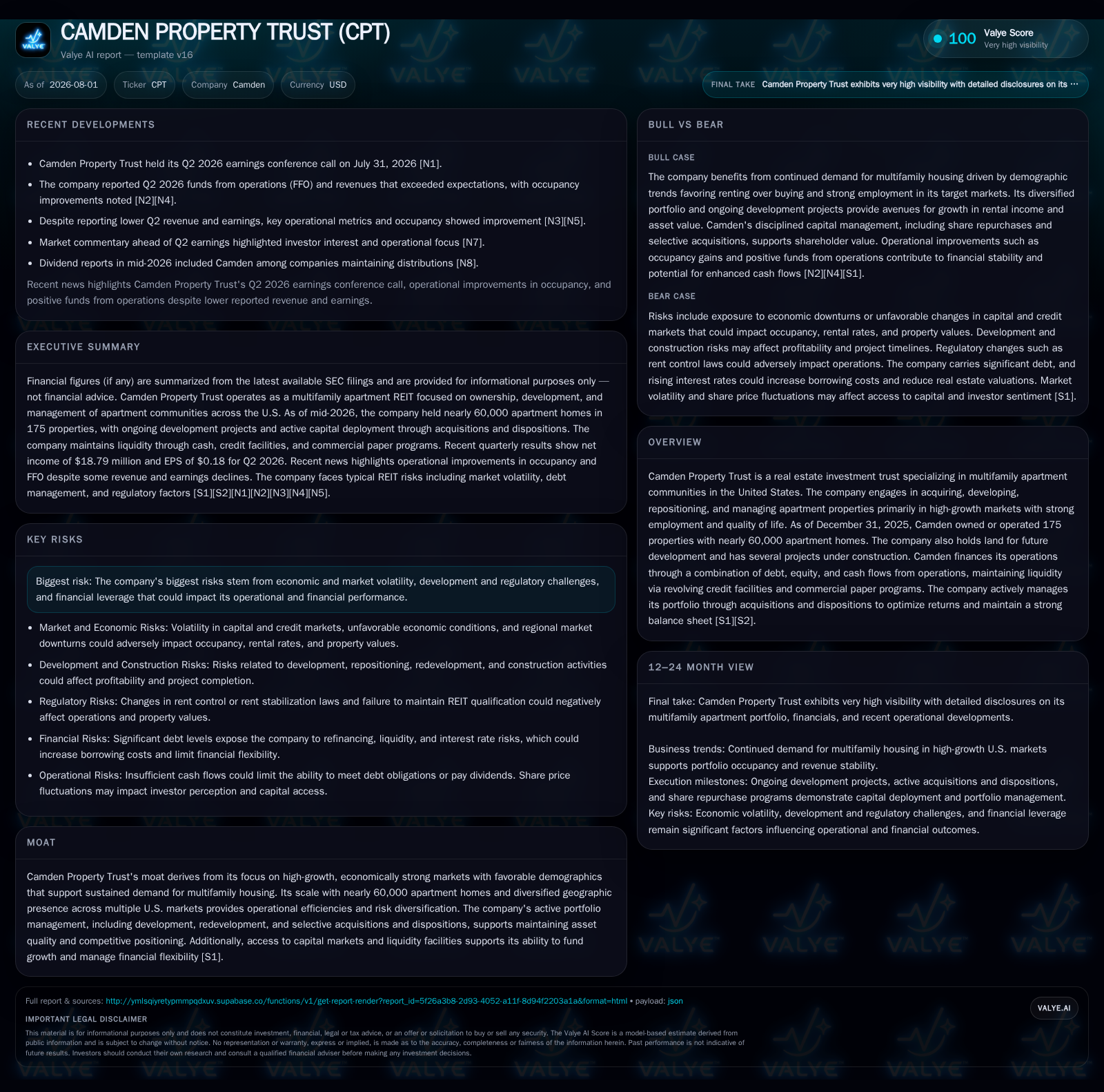
In its latest quarterly filing, Camden Property Trust reported steady operational performance highlighted by resilient occupancy rates and no asset impairments, despite a challenging environment characterized by moderated rent growth and evolving market supply dynamics [S2][N2]. The company’s multifaceted business model leverages a large, diversified portfolio of nearly 60,000 apartment homes across high-growth U.S. markets, complemented by active development and repositioning strategies that sustain net operating income and cash flow stability [S1]. In the context of peers like Equity Residential and AvalonBay Communities, Camden’s geographic diversification and disciplined capital management position it well to navigate rising interest rates and regulatory uncertainties [S1]. Its sizable development pipeline and recurring capital expenditures provide visibility into mid-term growth opportunities while risks from economic cycles and financing cost volatility remain watchpoints [S2].
Q2 Operating Dynamics Reflect Stable Fundamentals and Portfolio Optimization
Camden Property Trust's Q2 2026 SEC filing reveals a continuation of stable operating fundamentals in a multifamily market marked by evolving demand-supply dynamics [S2]. The company reported no impairment charges related to long-lived assets or developments during the quarter compared to prior periods, underscoring the resilience of its portfolio valuation during moderate rent growth conditions. This absence of impairments suggests that Camden's properties maintain fair value levels consistent with market expectations despite volatility across some metro submarkets.
Underlying these results is a sustained occupancy rate supporting net operating income (NOI), benefitting from favorable lease renewal spreads though with moderated upward pressure relative to prior quarters. Management’s commentary aligns with broader industry signals indicating that multifamily demand remains robust in high-growth U.S. metro areas but faces headwinds from increased competition by new supply and restrained consumer affordability. The quarter also saw operational efficiencies upheld through proactive portfolio repositioning activities which reinforce competitive positioning at the property level.
Business Model Resilience Rooted in Diversified Revenue Streams and Asset Quality
Camden’s core revenue engine is its large-scale rental income base derived from approximately 59,921 apartment homes owned or operated across 175 properties nationwide as of year-end 2025 [S1]. The geographic diversification tilts toward markets exhibiting strong employment growth, demographics favoring renters over homeowners, and overall high living standards—all factors fostering ongoing occupancy stability and lease pricing power.
Beyond stabilized rental streams, Camden’s financial profile benefits from ancillary revenues including property management fees from third-party assets as well as transactional gains generated through strategic acquisitions and dispositions designed to optimize portfolio composition. Complementing these income streams is an active development pipeline supported by land holdings that provide optionality for future community expansions or new deliveries. This integrated approach enhances margins by blending recurring cash flows with episodic value creation from repositioning projects which typically drive higher returns than purely passive ownership.
Multifamily Market Structure Context: Competitive Position Against Large REIT Peers
Positioned among major multifamily REITs such as Equity Residential (EQR) and AvalonBay Communities (AVB), Camden condenses core sector strengths like scale economies and geographic diversification while maintaining a differentiated emphasis on high-growth metro areas [S1]. Compared with EQR—which similarly manages large portfolios—Camden’s selective acquisition strategy and focus on markets with manageable supply increments may provide more defensive attributes during sluggish demand periods.
AvalonBay serves as a beneficial benchmark for development execution scale; Camden’s capital expenditure guidance between $113 million to $117 million annually reflects material reinvestment levels that aim to replenish aging inventory through both refurbishments and greenfield projects. Market-wide rent growth trends in key metros directly influence Camden’s lease renewal spreads—a critical barometer of pricing power relative to peers—and signal the importance of local market knowledge for sustained NOI expansion. Capitalization rates (cap rates) underlie property valuations; Camden’s active use of dispositions allows it to manage cap rate risk tactically amidst rising interest rate climates.
Pipeline Progress & Development Spending: Engines for Future Growth
The company disclosed ongoing progress in its development pipeline aligned with disciplined capital spending plans focusing on property repositioning and incremental unit delivery [S1][S2]. Recurring capital expenditures are forecast between $113 million to $117 million for 2026, demonstrating sustained commitment to asset quality upgrades that support rent increases and tenant retention. This balance between developing new units versus enhancing existing stock is strategic; refurbishment projects often afford quicker returns with comparatively controlled risks amid uncertain construction cost inflation.
Pipeline absorption depends materially on local demographic trends and labor market strength which historically have underpinned Camden’s chosen metropolitan footprints. Regulatory challenges such as zoning restrictions or potential rent controls also shape timing and scale decisions in the redevelopment segment. Collectively, this investment stream provides a tangible mid-term growth driver distinct from stabilized property cash flow.
Risks Heightened by Interest Rate Sensitivity and Regulatory Uncertainties
Camden acknowledges exposure to macroeconomic factors notably rising interest rates which can elevate borrowing costs while simultaneously compressing asset values via cap rate expansions [S1]. This dual pressure influences both operating margins—through increased financing expenses—and portfolio valuations affecting net asset value perceptions.
Regulatory environments impose additional uncertainty; local rent control statutes or changes in housing policies can constrain price-setting flexibility directly impacting revenues. Construction cost inflation further exacerbates risk profiles on developmental projects potentially delaying timelines or eroding expected returns. While management maintains compliance with financial covenants—including those related to its unsecured revolving credit facility—continued vigilance around debt maturities aligned with liquidity access is prudent given ongoing market volatility [S2]
Monitoring Forward: Key Metrics And Milestones To Watch Through Next Reporting
Key performance indicators warranting close observation include lease renewal spreads which reveal tenant willingness to accept higher rents without significant turnover increases. Same-property NOI trajectories provide insight into the underlying health of recurring operations aside from one-time transactional effects. Occupancy trends, especially within newly delivered developments or redeveloped communities, will gauge successful absorption against competing supply.
Progress milestones within the pipeline such as permit approvals, construction starts, completions, and leasing velocity critically influence medium-term earnings potential. FFO (funds from operations) progression adjusted for extraordinary items remains the primary gauge of cash flow generation sustainability underpinning dividend capacity.
Financial Profile Discussion: Capital Structure Health Amid Growth Initiatives
As of June 30, 2026, Camden held approximately $44.7 million in cash and equivalents against total debt nearing $4.85 billion resulting in net debt around $4.8 billion [F1][S2]. The company operates an unsecured revolving credit facility with a maximum bid loan capacity not exceeding $600 million; management reports compliance with all customary financial covenants as of June 30, 2026 [S2].
Derivative instruments form a pivotal component in mitigating interest rate risk exposures; Camden uses interest rate swaps or related hedges aligning known or expected borrowing outlays with anticipated market movements [S2]. These risk management practices enhance predictability of financing costs aiding stable AFFO generation.
Disclaimer: This is research-only, informational analysis and not investment advice. It may include AI-generated interpretation and general industry context. Always verify important details using primary sources.

Comments