
Chipotle’s Q2 2026 Earnings Reinforce Growth Amid Cost Pressures and Expansion
Strong digital momentum and operational initiatives underpin Chipotle’s growth strategy despite margin challenges from inflation.
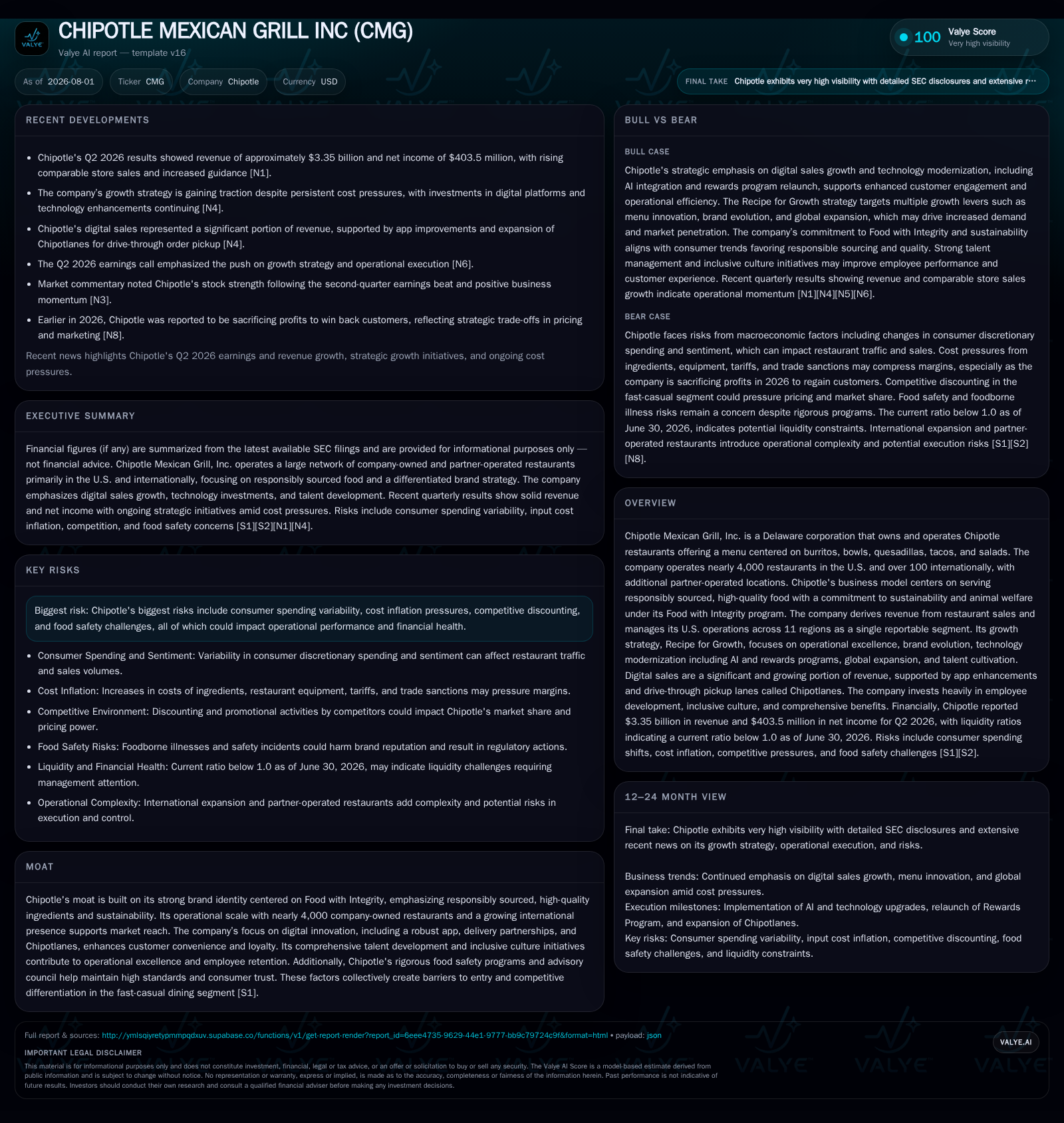
In its latest quarterly filing, Chipotle Mexican Grill demonstrated robust same-store sales growth and progressing unit count expansion, driven by enhanced digital engagement and menu innovation. However, persistent inflationary pressures on food and labor costs continue to compress margins, presenting operational challenges. Chipotle’s Recipe for Growth strategy, emphasizing technology modernization, global scaling, and talent development, supports durable competitive positioning in the fast casual segment. Key risks remain around food safety, cost volatility, and competitive intensity. Monitoring digital sales penetration, restaurant ramp efficiency, and cost containment will be critical to assessing near-term performance.
Recent Operating Update: Q2 2026 Performance
Chipotle Mexican Grill's fiscal second quarter ended June 30, 2026, revealed a continuation of positive same-store sales (comps) growth driven by increases in guest traffic as well as average check size improvements through menu innovation and pricing strategies [S2][N3]. The company reported operating results that surpassed market expectations, sparking notable share price gains echoed in recent market commentaries [N3][N4].
Digital sales channels remain integral to Chipotle's revenue mix, comprising a growing percentage bolstered by strategic app enhancements, AI-driven personalized marketing, and expanded delivery partnerships facilitating frictionless customer experiences [S1][S6]. These technology investments align with their Recipe for Growth strategy focused on modernizing the business model and reengaging the loyalty program to solidify guest retention.
The company's footprint continued its expansion trajectory with approximately 3,938 company-owned restaurants across the U.S. complemented by around 104 international stores plus partner-operated units [S1]. This scale underpins supply chain leverage advantages and broad market penetration critical in the capital-intensive fast casual segment.
Meanwhile, inflationary headwinds are evident. Rising labor costs—stemming from competitive wage environments—and commodity price increases notably in beef, avocados, and produce components challenge margin stability despite proactive supplier negotiations and forward contracting [S1][S10]. The company has incrementally adjusted menu pricing; however, balancing price elasticity remains nuanced given consumer discretionary spending variability.
Business Model Nuances: Monetization Mechanics & Strategic Strengths
Chipotle generates revenue predominantly through direct sales at company-operated stores with digital ordering channels significantly enhancing volume without proportional incremental overhead [S23]. Consumers pay at point-of-sale for freshly prepared menu items emphasizing burritos, bowls (tortilla-less burritos), tacos, quesadillas, and salads—all crafted from responsibly sourced ingredients under its Food with Integrity program.
The integration of drive-thru pickup lanes branded as "Chipotlanes" reflects operational excellence initiatives to increase throughput and reduce order fulfillment times—key metrics influencing customer satisfaction in fast casual dining [S23]. Digital platforms not only enable order placement but also feed into data analytics that guide targeted marketing campaigns facilitated by AI capabilities introduced per recent management statements [S24].
The company’s focus on sustainability—eschewing artificial flavors or preservatives—adds differentiation from quick service chains like Taco Bell or McDonald's which compete primarily on scale and price points rather than ingredient provenance or ethical sourcing claims [S20]. This distinction cultivates brand loyalty among consumers valuing transparency and quality.
Industry Structure & Competitive Landscape
The broader fast casual restaurant industry is characterized by high consumer sensitivity to food quality, convenience, price competitiveness, and brand trust. Chipotle operates at the retail endpoint of a complex value chain where farming practices directly affect raw material availability and cost structures. Its insistence on fresh produce grown under environmental stewardship raises exposure to climate variability but enhances differentiation versus peers like Panera Bread or Sweetgreen.
Competition includes both other fast casual brands emphasizing premium offerings and traditional quick service chains leveraging aggressive discounting tactics [S20]. Additionally, third-party delivery platform reliance introduces margin pressure as fee structures can surpass collected delivery charges limiting profitability on off-premise orders [S20]. Supply chain disruptions or supplier failures could further impact ingredient availability or costs negatively.
Growth Drivers: Technology & Global Expansion
Key drivers identified include accelerating digital sales penetration through continual enhancement of the app experience and launch of AI tools enabling personalized offers which increase average order sizes and frequency of visits [S24][N6]
Menu innovation plans targeting emerging dietary preferences (e.g., plant-based options) also intend to broaden occasions beyond core meals—a strategic evolution aimed at capturing incremental guest segments [S24].
Geographic expansion remains pivotal; selectively scaling both company-owned stores in proven U.S. regions while leveraging partner-operated models internationally enables risk-mitigated access to new markets aligning with brand positioning [S24]. Talent development programs designed to improve hiring effectiveness contribute towards operational excellence pillars underpinning rapid store ramp-up cycles.
Risks & Constraints: Margin Pressure & Brand Vulnerabilities
Food safety continues as an existential risk given Chipotle’s reliance on fresh produce subject to contamination vectors; historical outbreaks have had outsized impacts on brand trust necessitating significant resources dedicated to preventive controls [S1][S28]. Elevated employee turnover risks amid tight labor markets may inflate wage expenses further exacerbating margin squeeze.
Macroeconomic uncertainty poses downside demand risk as consumers may trade down or reduce frequency of discretionary spend during downturns impacting guest traffic trends—a key top-line driver alongside average check growth [S26]. Aggressive competitor discounting or promotional campaigns could erode pricing power while also pressuring premium positioning.
Regulatory developments regarding new food safety rules or ingredient labeling could increase compliance costs affecting operational flexibility. Moreover, negative social media amplification of any adverse incidents can swiftly magnify reputational damage beyond immediate financial remediation ability [S28].
What to Watch Next: Execution Milestones & Operational KPIs
Future performance assessment should focus closely on same-store sales trajectory juxtaposed with guest traffic data dissected by channel (digital versus dine-in). Margins need monitoring for signs of stabilization amidst ongoing inflationary backdrop. New restaurant opening cadence versus profitability ramp curves will gauge unit-level economics sustainability.
Progress in digital transformation initiatives will be measurable via app user activity metrics, rewards program engagement levels, and order fulfillment time improvements. Supply chain resilience indicators such as food cost percentage stability despite inflation pressures will signal mitigating success.
Additionally worth observing is management commentary regarding labor cost management amid evolving wage markets as well as any disclosures about food safety incidents or regulatory challenges impacting operations.
Financial Profile Discussion
Chipotle enters the latter half of 2026 with a robust balance sheet reflected by cash balances of approximately $228 million as of June 30 while carrying no reported debt at year-end 2025 [F1]. This conservative leverage position enhances financial flexibility for capital expenditures related to new restaurant builds and technological modernization projects.
Current ratio stands at roughly 0.72 driven by elevated current liabilities offsetting nearly $941 million in current assets as of mid-2026—a typical feature for retail operators managing inventory payable cycles tightly [F1]
An additional $1.3 billion share repurchase authorization announced recently underscores confidence in free cash flow generation capabilities putting capital back into shareholder returns while maintaining investment capacity in growth initiatives [S3][S6]
Overall profitability remains dynamic with reported operating income near $1.9 billion at calendar year-end but subjected to margin compression risks due to inflationary pressures discussed above—all tempered by pricing power stemming from brand strength.
This analysis synthesizes public filings alongside industry context without providing investment advice or guidance predictions. The operating environment for Chipotle remains shaped by evolving consumer preferences toward quality-focused quick dining experiences balanced against macroeconomic uncertainties requiring vigilant execution monitoring going forward.
Disclaimer: This is research-only, informational analysis and not investment advice. It may include AI-generated interpretation and general industry context. Always verify important details using primary sources.

Comments