
Eaton Reports Q2 Gains in Electrical Segments While Preparing Mobility Spin-Off with Dana
Robust infrastructure demand and recent acquisitions boost Eaton’s power management footprint as it advances a complex Mobility separation amid regulatory and supply chain challenges.
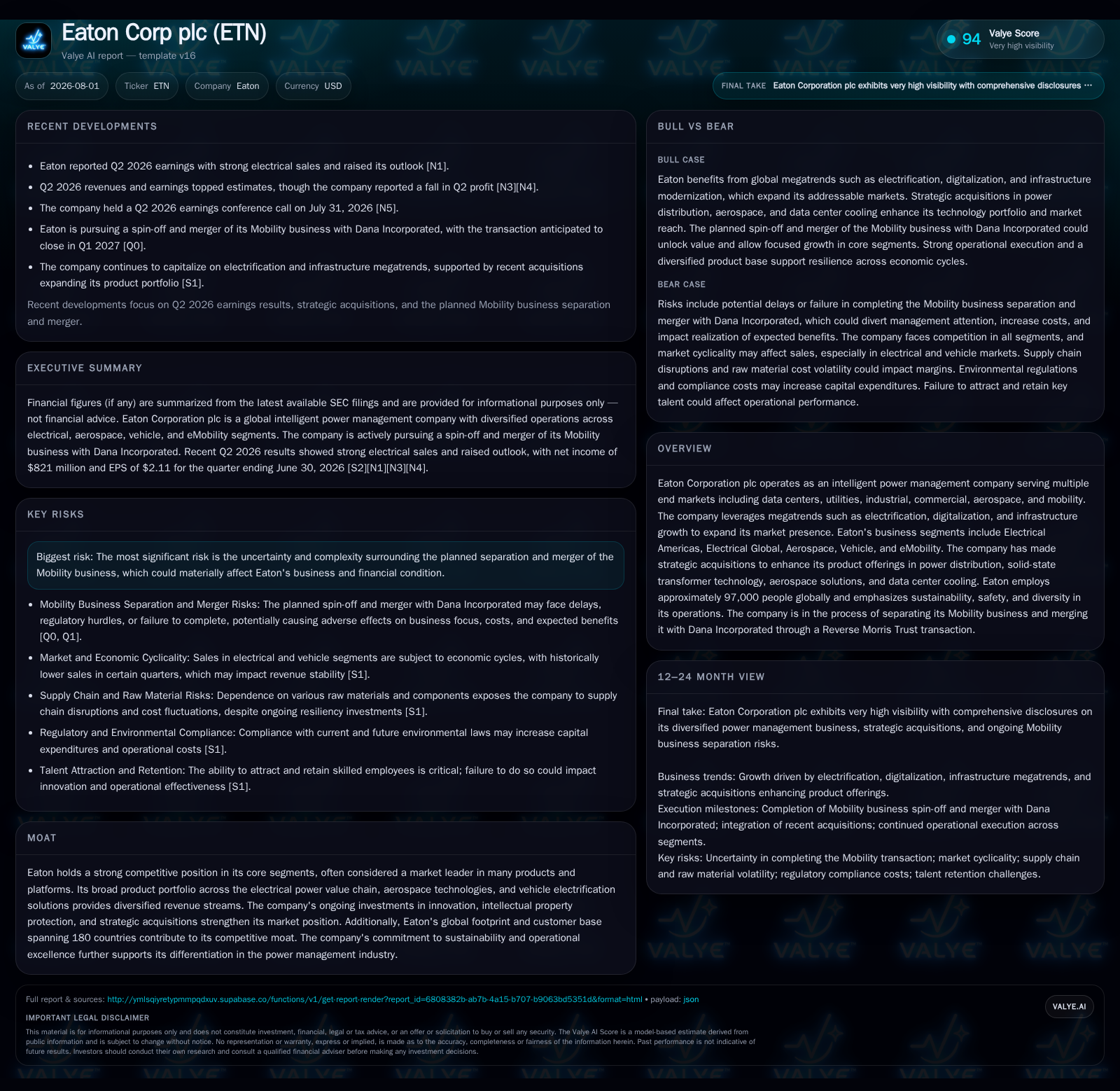
In its latest Q2 filing, Eaton Corporation plc highlighted robust performance in its Electrical Americas and Global segments, driven by expanding infrastructure modernization and electrification demand. The company is advancing a strategic separation of its Mobility business via a Reverse Morris Trust transaction with Dana Incorporated, signaling a focus on sharpening operational focus despite execution risks. With acquisitions bolstering its data center cooling and aerospace portfolios, Eaton is carving out durable competitive advantages across multiple power management markets. Challenges remain from the transaction complexity and supply chain volatility, but ongoing innovation and megatrend alignment position Eaton for sustained growth.
Recent Operating Update
Eaton Corporation plc’s latest quarterly filing for Q2 ended June 30, 2026 reveals a solid operating performance led by continued strength in its electrical power management businesses. The company reported results that exceeded consensus expectations primarily due to robust sales momentum across the Electrical Americas and Electrical Global segments serving utilities, industrial customers, and data centers [S2][N1]. This reflects Eaton’s growing role in infrastructure modernization projects fueled by global electrification megatrends.
Concurrently, Eaton disclosed progress toward the planned separation of its Mobility business — encompassing Vehicle and eMobility operating units — via a Reverse Morris Trust transaction with Dana Incorporated anticipated to close in Q1 2027 [S2][S3]. While this strategic move aims to streamline Eaton's portfolio focus on core electrical and aerospace technologies, it introduces execution complexities and timing uncertainties given the need for shareholder approvals and regulatory clearances. Management acknowledged these risks explicitly in the updated risk disclosures but remains committed to realizing long-term shareholder value from the split [S2].
Business Model Analysis
Eaton operates as an intelligent power management provider with diversified revenue streams derived from designing and manufacturing hardware products plus integrated systems that manage electrical power across sectors including utility grids, data centers, industrial plants, commercial buildings, aerospace platforms, and mobility solutions [S1]. The company monetizes through direct product sales of components like power distribution equipment and converters; system integration contracts for large infrastructure customers; aftermarket services including maintenance; and increasingly via advanced platform technologies such as solid-state transformers critical for future energy storage applications.
The business is organized into five main segments: Electrical Americas (focused on North American grid modernization), Electrical Global (serving international markets), Aerospace (delivering aircraft efficiency components), Vehicle (providing safety and performance vehicle technologies), and eMobility (supporting the transition to electric vehicles) [S1][S8]. This multi-segment structure enables Eaton to balance cyclical end-market exposures while leveraging its engineering capabilities across interconnected domains.
Recent acquisitions—Fibrebond for modular data center solutions; Resilient Power Systems for accelerating solid-state transformer commercialization; Ultra PCS enhancing next-generation aerospace electronics; and Boyd Thermal adding liquid cooling technology for hyperscale data centers—strengthen Eaton’s innovation pipeline directly aligned with key customer demands in electrification and digitalization [S1]. These bolt-ons illustrate strategic prioritization of high-growth adjacencies within the broader industrial hardware sector.
Industry Structure & Competitive Position
Within industrial hardware and electrical equipment manufacturing—a sector characterized by capital intensity and highly technical product development—Eaton competes alongside firms specializing in power distribution equipment (e.g., Schneider Electric), aerospace component suppliers (e.g., Honeywell), vehicle electrification providers (e.g., BorgWarner), and data center infrastructure vendors. Competitive advantages hinge on breadth of product portfolio coverage across critical points in the power value chain; geographic reach servicing customers across roughly 180 countries; proprietary engineered solutions driving quality differentiation; and strong aftermarket services that enhance customer retention.
Eaton holds market leadership or highly competitive positions in many of its electrical power management platforms thanks to continuous innovation investments fostering intellectual property protection. In aerospace technologies specifically targeting more electric aircraft platforms demanded by commercial airlines and defense agencies, Eaton benefits from long equipment qualification cycles creating barriers to entry [S1].
The Mobility segment brings exposure to evolving vehicle safety, efficiency enhancements for combustion engines alongside rapid growth prospects from EV components. However, this segment’s divestiture refocuses Eaton toward higher-margin scalable business lines tied more directly to electrification infrastructure megaprojects.
Growth Drivers
Long-term growth prospects are underpinned by several structural industry tailwinds:
- Global Electrification & Decarbonization Initiatives: Governments' increasing commitment to reduce carbon emissions propels demand for upgrade projects in electric grids managed by Eaton's Electrical segments.
- Data Center Expansion & Cooling Needs: Rapid cloud service adoption necessitates advanced power distribution architectures coupled with thermal management systems like those enhanced by Boyd Thermal acquisition.
- Renewable Energy & Smart Grid Technologies: Integrating variable renewables requires innovative components such as solid-state transformers commercialized via Resilient Power Systems acquisition.
- Aerospace Modernization: Next-generation platforms emphasize fuel efficiency & sustainability where Eaton’s aerospace tech delivers incremental product win opportunities.
- Vehicle Electrification: Although being spun off soon via Dana deal, this sector will see rising adoption globally pushing reform of traditional automotive tech.
- Megaproject Infrastructure Spending: Large-scale investments mainly in North America create capacity utilization improvements aiding margin stability.
- Digitalization & Industrial Automation: Software-enabled control systems part of Eaton's portfolio support customers’ operational excellence goals.
- Aftermarket Services: Lifecycle management offerings provide recurring revenue streams supporting cash flow stability.
KPIs such as order backlog levels particularly in Electrical segments; book-to-bill ratios signaling near-term demand health; gross margin trajectory reflecting mix towards higher-value modular solutions; R&D expenditure rates supporting innovation success rate; geographic revenue diversification balancing emerging versus developed markets all serve as critical operational indicators to track going forward.
Risks & Watchpoints
Foremost risk relates to the pending mobility separation involving a complex Reverse Morris Trust carve-out combined with Dana Incorporated’s assets [S2]. Any delays or failure to obtain timely stockholder/regulatory approvals could delay or disrupt anticipated benefits realization impacting financial condition materially. Further risks include potential distraction of senior management focus during execution alongside litigation possibility associated with transaction terms outlined openly [S2].
Supply chain exposures particularly fluctuations in prices/accessibility of metals such as copper/nickel integral to electrical/electronic products could pressure margins if passthrough mechanisms falter amid inflationary backdrops. Cybersecurity risks targeting operational technology environments remain an ongoing concern though the company dedicates executive oversight detailing layered mitigation frameworks [S1]. Regulatory compliance complexity intensifies given cross-border operations involving environmental standards plus export controls relevant especially within aerospace sectors.
Macroeconomic sensitivities also persist with capital spending patterns among utilities/industrial customers exhibiting cyclicality influenced by GDP growth trajectories. Integration challenges stemming from multiple recent acquisitions require careful synergy capture tracking lest benefits dilute.
What To Watch Next
Key near-term milestones include regulatory clearance progress toward closing the Mobility business spin-off combined with monitoring any updated earnings guidance reflecting next-quarter effects from this transition phase. Segment-specific revenue progression post-resegmentation will clarify organic growth sustainability particularly within Electrical Global given recent acquisitions influence. Innovation pipeline developments around scaling solid-state transformer deployments or liquid cooling product launches will be pivotal signals for sustaining competitive edge.
Financial metrics such as incremental gross margin expansion or operating income growth excluding Mobility units will inform margin durability while order backlog trends validate underlying demand robustness amid changing market dynamics.
Financial Profile Discussion
As of June 30, 2026 balance sheet metrics indicate cash & equivalents at $483 million against total debt approximating $18.5 billion placing net debt near $18.0 billion [F1], reflective of capital structure typical within capital-intensive industrial sectors balancing investment needs against leverage capacity. The current ratio stands at a moderate 1.24 suggesting adequate short-term liquidity buffers relative to current liabilities [F1]. Future refinancing needs appear manageable given a staggered senior notes maturity profile submitted in filings earlier this year [S3]. Free cash flow generation post-Mobility separation will be an important metric underpinning credit profile resilience amid investment cycles required for R&D intensity maintaining technological leadership.
This analysis synthesizes salient information from Eaton’s latest SEC filings alongside industry context highlighting both strategic strengths and inherent risks accompanying transformative corporate actions typical within capital goods conglomerates navigating megatrends like electrification. By focusing on segment-level insights as well as transaction developments grounded strictly on the most recent primary sources cited herein without undue speculation or assumptions beyond stated facts provides an informed lens suited for detailed internal diligence purposes.
Disclaimer: This is research-only, informational analysis and not investment advice. It may include AI-generated interpretation and general industry context. Always verify important details using primary sources.

Comments