
Carter’s Q2 2026 Growth Reflects Omnichannel Strength and Brand Portfolio Focus Amid Macro Pressures
Carter’s latest quarter shows resilience through strategic brand management and omnichannel operations despite geopolitical and inflationary headwinds.
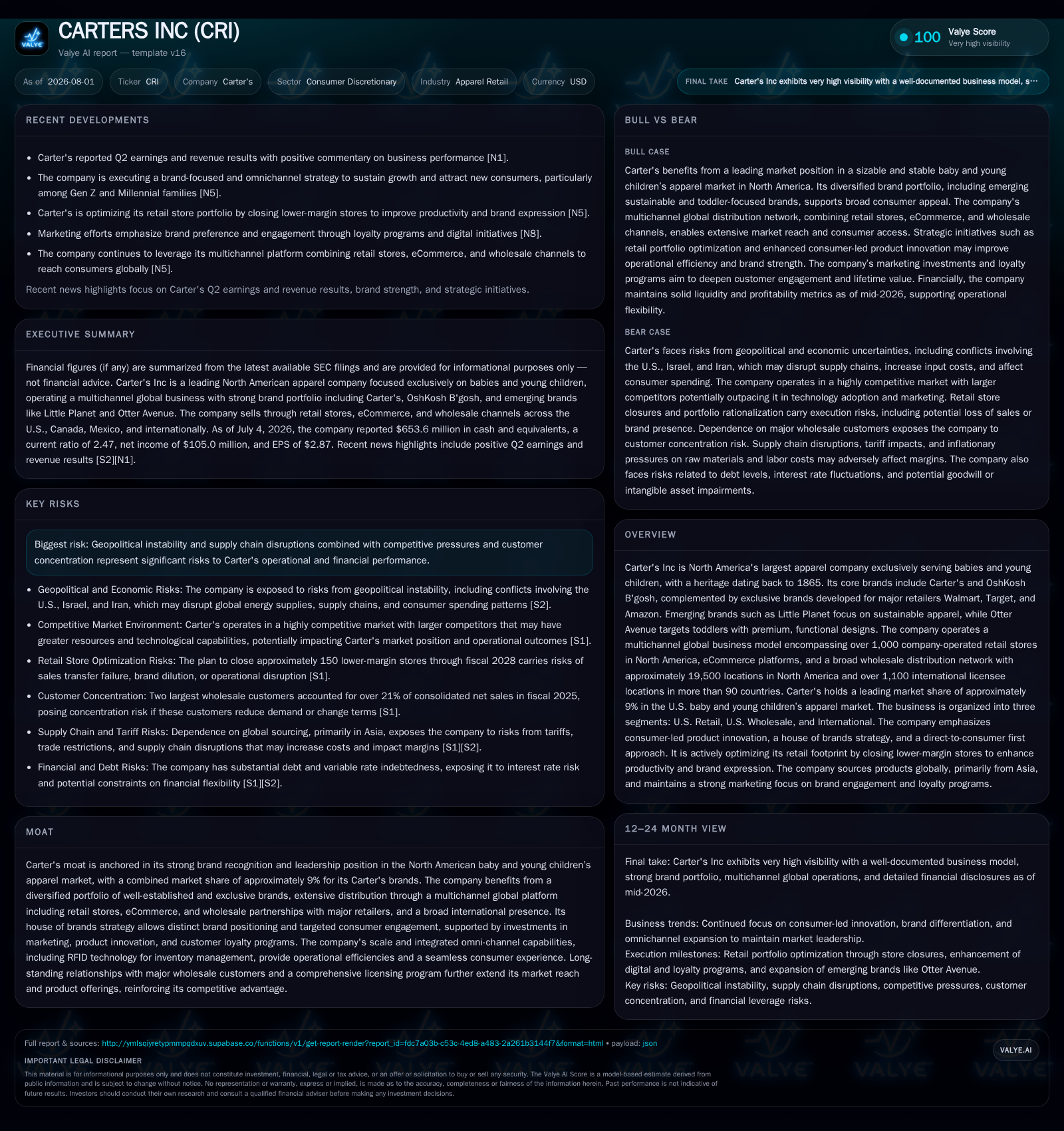
Carter’s Inc reported a strong Q2 2026 performance, beating earnings and revenue estimates driven by its diversified brand portfolio and omnichannel retail strategy. The company continues to navigate supply chain risks and geopolitical uncertainties impacting global sourcing costs but leverages its market share leadership in the U.S. children’s apparel segment. Carter’s distinct brands targeting various consumer segments, combined with expanding eCommerce and wholesale channels, underpin steady growth while margin pressures persist from inflation and logistics challenges. Financially, Carter’s maintains a solid liquidity position with a current ratio of 2.47 and net cash on hand, supporting ongoing investments in innovation and retail capabilities.
Recent Operating Update
Carter’s Inc reported fiscal Q2 results ending July 4, 2026 that exceeded both earnings and revenue expectations [S2][N1]. This performance anchors the company’s ability to sustain top-line growth despite intensifying macroeconomic headwinds including geopolitical instability in the Middle East following recent U.S.-Israel coordinated strikes against Iran [S2]. While direct operations in the Middle East are limited, Carter’s global supply chains face pressure from higher energy prices and logistics costs linked to regional conflict escalation. Consumer demand is also modulated by broader economic uncertainty affecting discretionary spending on children’s apparel [S2]. Nevertheless, operational execution centered around brand strength and multichannel distribution showed resilience.
Business Model
Carter’s business model centers on designing, marketing, and selling apparel for babies through young children (up to size 14), primarily in North America but increasingly internationally via licensees. Revenue streams are diversified across company-operated retail stores (over 1,000), wholesale channel partnerships (~19,500 North American points of sale), eCommerce platforms including mobile apps, plus licensing outside North America spanning more than 90 countries with over 1,100 locations [S1]
The brand portfolio includes iconic Carter’s and OshKosh B’gosh labels alongside exclusive private labels developed specifically for mass-market retailers Walmart (Child of Mine), Target (Just One You), and Amazon (Simple Joys) [S1].
Emerging brands such as Little Planet emphasize organic fabrics certified under Global Organic Textile Standard (GOTS) targeting growing consumer demand for sustainable baby apparel at premium price points above core offerings. Otter Avenue targets toddlers with functionally designed products encouraging independence while blending style elements. This diversified house of brands approach enables targeted positioning across demographic segments — value-conscious parents shopping mass retail versus eco-conscious or premium buyers — thereby widening market coverage without brand dilution.
Revenue mechanics hinge on sell-through velocity at retail stores and wholesale accounts plus online platforms. Pricing strategy balances preservation of average selling prices against inflationary input cost increases. Consumer loyalty programs complement marketing efforts to improve repeat purchase frequency within young families.
A key operating lever is omnichannel capability integration that delivers seamless inventory visibility across physical stores and digital channels supported by RFID-enabled inventory management systems implemented enterprise-wide starting fiscal 2025 [S22]. This technology enhances inventory turnover ratios by reducing out-of-stocks or excess markdowns due to oversupply in certain channels
Industry Structure & Competitive Position
Within the $29 billion U.S. market for baby and young children's apparel as of late 2025 — driven by birth rate demographics favorable to sustained category demand — Carter's commands an approximate 9% share for its core Carter's-branded lines combined with related exclusives held at major retailers [S1]. OshKosh complements this leadership with about a 1% share focused on playwear.
This dominant position is buttressed by substantial scale advantages: a broad brick-and-mortar footprint combined with a deep wholesale penetration that reaches tens of thousands of retailers. Such extensive penetration provides distribution leverage missing from smaller or newly launched specialty competitors.
Strategic competitor groups span specialty children’s apparel retailers like The Children’s Place or Gap Inc.’s children’s segments; mass merchandiser private labels competing largely on price; eCommerce-first children's brands carving niche premium or sustainable spaces; and international licensees extending brand reach globally under local adaptation.
The combination of multi-brand offerings tailored to distinct consumer segments — including sustainable or toddler-functional niches — sets Carter’s apart from peers relying on more homogenous product mixes. Technological investments in omnichannel infrastructures further bolster operational efficiencies critical in an industry characterized by seasonal assortments needing rapid inventory clearance.
Growth Drivers
Several growth vectors underpin Carter's strategic vision:
- Ecommerce Expansion: Increasing percentage of total sales now from digital platforms supported by mobile app enhancements yields higher transaction frequency and broadens geographic reach beyond store footprints.
- Brand Innovation: Launches like Little Planet answer evolving consumer preferences for sustainability-backed products commanding premium pricing; Otter Avenue taps toddler functionality with fashion-forward designs appealing to Millennial/Gen Z parents.
- International Licensing: Extending footprint via more than 1,100 franchise/licensee locations in over ninety countries diversifies revenue sources beyond North America.
- Wholesale Channel Partnerships: Deepening relationships with Walmart, Target, Amazon through exclusive line development secures distribution dominance while enabling access to new shopper cohorts.
- Omnichannel Integration: Enhancing customer experience via seamless buying options supports customer retention metrics amidst shifting shopping behavior patterns.
- Product Line Extensions: Adjacent categories such as accessories or baby essentials provide incremental wallet share opportunities within existing consumers.
- Consumer Loyalty Programs: Leveraging proprietary data analytics fosters personalized marketing enrichment driving repeat purchase lifetime value effectiveness.
Risks & Watchpoints
Carter's faces several operational constraints:
- Geopolitical & Supply Chain Uncertainty: Conflicts involving U.S., Israel, Iran lead to energy price spikes impacting freight costs; disruptions along Asian supplier networks pose risks given vendor concentration mainly in Vietnam/Bangladesh/Cambodia/India (~75% sourcing spend) with residual China exposure (<3%) [S19][S2].
- Inflationary Pressures: Rising raw material costs combined with labor wage growth challenge margin preservation; limited pricing power vis-à-vis socially sensitive consumers may cap rate increases [S1][S2].
- Consumer Discretionary Spending Volatility: Economic uncertainty compresses household expenditure on non-essential goods including apparel; shifts in consumer sentiment could reduce overall category growth [S2].
- Competition: Strong competitor presence both from established specialty kids’ retailers as well as private label brands forces continuous product innovation investments.
- Retail Footprint Management: Maintaining optimal store locations with lease negotiation flexibility is critical amidst changing traffic patterns due to ecommerce proliferation.
- Regulatory Compliance & Product Safety: Any product recalls or IP litigation could dent reputation along with costly liabilities [S6].
- Supply Chain Vendor Concentration: Dependency on a few major suppliers exacerbates disruption exposure.
Monitoring these risk factors involves watching gross margin trends relative to inflation impacts; same-store sales growth excluding eCommerce gains; inventory turnover rates reflecting supply chain agility; plus progress on newly launched brand reception among target consumers.
What to Watch Next
Near-term milestones include:
- Further quarterly earnings announcements validating margin recovery amid cost pressures.
- Progress updates on expansion initiatives internationally through licensee channels with geographic segmentation clarity.
- Adoption metrics for emerging brands like Little Planet and Otter Avenue indicating resonance beyond established core customers.
- Enhancements or rollouts in omnichannel technological infrastructure improving inventory management efficiency.
- Wholesale partner contract developments especially for exclusive private label collections supporting Walmart/Target/Amazon relationships.
- Tracking geopolitical developments affecting logistics costs or supply availability given recent Middle East conflicts.
Investor interest will likely focus on sustained same-store sales growth differentiated from online channel dynamics plus margin trajectory considering input cost inflation next quarters.
Financial Profile Discussion
At quarter-end July 4, 2026, Carter's held cash & equivalents totaling approximately $653.6 million with current assets of about $1.47 billion and current liabilities near $596 million, resulting in a current ratio of approximately 2.47, indicating strong short-term liquidity coverage [F1]. Total debt was approximately $575 million as of January 3, 2026, yielding a net cash position of about $78.6 million at that time [F1].
Dividend resumption post-pandemic suspension reflects confidence in cash flow generation though share repurchases have been paused since Q3 fiscal 2024 indicating capital discipline during uncertain macro cycles [S7]
Overall financial health appears adequate to support ongoing strategic priorities amid industry cyclicality and external risks laid out earlier.
This analysis is based solely on publicly disclosed documents up to July/August 2026 without offering investment advice.
Disclaimer: This is research-only, informational analysis and not investment advice. It may include AI-generated interpretation and general industry context. Always verify important details using primary sources.

Comments