
Adamas Trust Leverages Loan Origination and Diversified Mortgage Assets to Enhance Income Stability
Adamas Trust combines a diversified portfolio of Agency and non-Agency mortgage assets with an expansive loan origination platform and active risk management to navigate interest rate and credit challenges inherent in mortgage REITs.
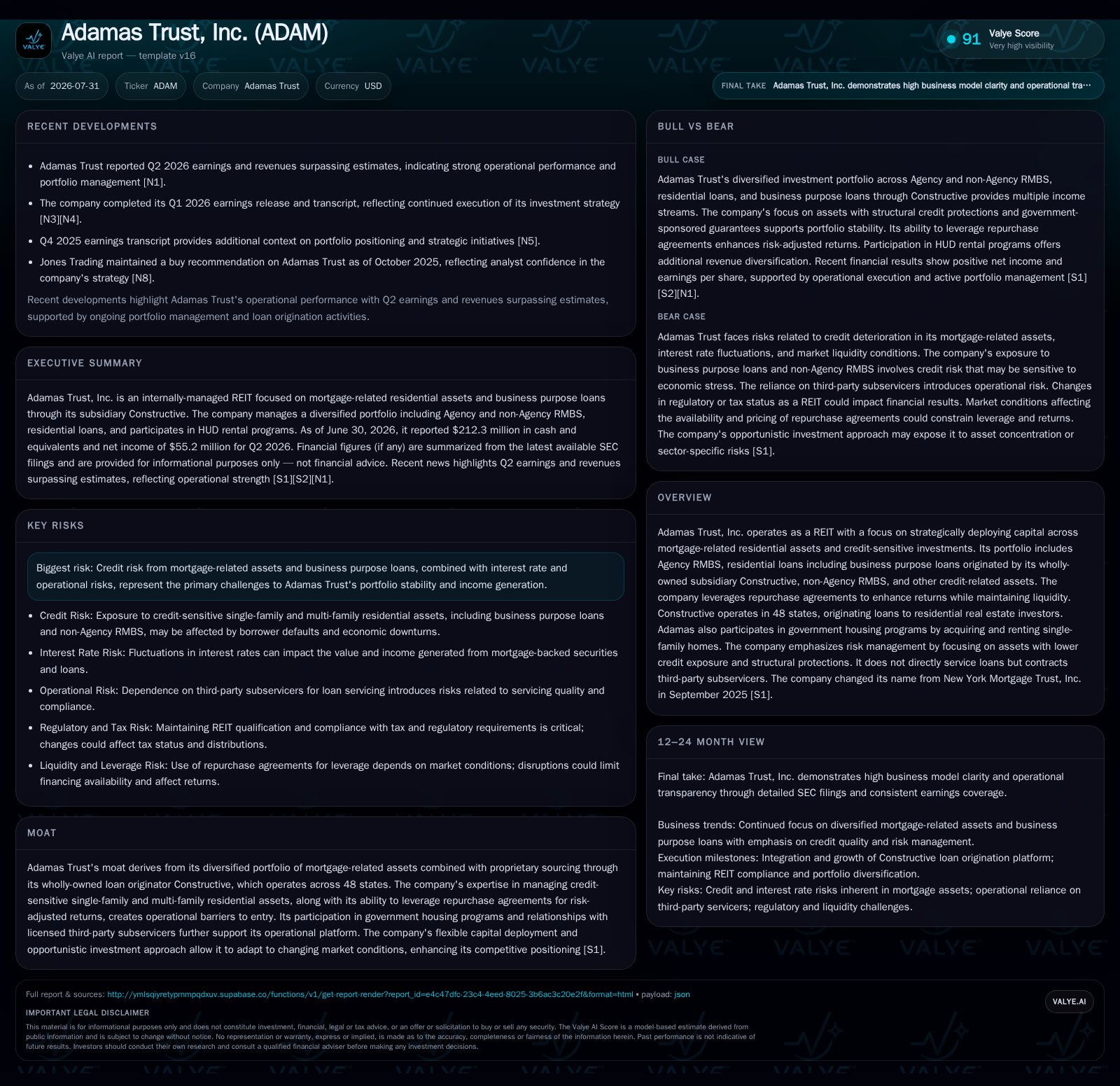
In Q2 2026, Adamas Trust, Inc. reported earnings and revenues surpassing consensus estimates, driven by a well-diversified portfolio spanning Agency RMBS, non-Agency RMBS, and residential loans originated through its subsidiary Constructive Loans, LLC. The company’s use of repurchase agreements and securitizations provides leverage that amplifies net interest income but also introduces liquidity sensitivities tied to collateral valuations. Active management of interest rate exposure through derivatives and disciplined asset allocation supports stable income generation. Risks remain around margin calls, prepayment variability, and credit exposure, yet the firm’s participation in government housing programs and broad loan origination footprint underpin its growth potential.
Recent Operating Update
Adamas Trust, Inc. (NASDAQ: ADAM) reported second-quarter 2026 results exceeding market expectations with solid revenue and net income performance [N1]. The latest SEC Form 10-Q filed on July 31, 2026 details continued diversification across Agency RMBS guaranteed by GSEs such as Fannie Mae and Freddie Mac, non-Agency RMBS, and residential loans originated by its wholly owned subsidiary Constructive Loans, LLC operating in 48 states [S2]. This direct origination capability enhances portfolio yield potential by providing access to business purpose loans—short-term, investor-focused residential real estate financing—that can be sold or retained strategically [S1].
The July 29, 2026 Form 8-K reiterates the company’s capital structure comprising common stock and multiple series of cumulative redeemable preferred stock traded on NASDAQ, reflecting a diversified financing base supporting portfolio investments [S3]
Business Model Analysis
Adamas Trust operates as a mortgage REIT generating income primarily from the net interest spread between yields on residential mortgage-related assets—Agency RMBS backed by government-sponsored enterprises and credit-sensitive residential loans—and the cost of leverage financing these assets. The company employs financial leverage mainly via repurchase agreements collateralized by its mortgage assets to enhance returns while accepting liquidity risk tied to collateral valuation fluctuations.
Constructive’s role as an internal originator of business purpose loans targeting residential real estate investors is strategic; it supplies proprietary loan flow that complements passively acquired securities. This capability allows selective retention of higher-yielding credit-sensitive loans which can augment overall portfolio returns relative to peers reliant solely on Agency RMBS [S1]
Participation in government housing programs through acquisition of single-family rental (SFR) properties diversifies cash flow sources beyond securitized instruments. These rental properties are managed by third-party servicers, mitigating operational servicing risks while contributing stable income streams.
The company outsources all loan servicing functions to licensed third-party subservicers, maintaining focus on capital deployment and asset acquisition rather than servicing operations.
Industry Structure and Competitive Position
Mortgage REITs like Adamas operate at the nexus of residential mortgage finance markets and debt capital markets [S1][S2]. Their profitability depends critically on managing interest rate risk arising from duration mismatches between floating-rate liabilities (e.g., repurchase agreements) that reprice quickly versus slower repricing fixed or adjustable-rate mortgage assets. Adamas employs a suite of derivatives including interest rate swaps, caps, swaptions, Treasury futures, and options for dynamic hedging without applying hedge accounting; this approach leads to mark-to-market volatility recognized immediately in earnings but allows flexible risk mitigation aligned with changing market conditions
Peers such as Annaly Capital Management and AGNC Investment Corp. operate similarly but may differ in portfolio mix emphasis or origination capabilities. Adamas’ competitive advantage lies in Constructive’s broad geographic penetration (48 states), offering proprietary deal sourcing that supports credit-sensitive asset allocation alongside traditional Agency securities.
Moreover, Adamas’ involvement in government housing programs via rental property acquisitions provides diversification benefits not uniformly available among peers focused solely on securities-based portfolios.
Growth Drivers
Growth is driven by increasing demand for business purpose loans fueled by active investor participation in residential real estate markets. Constructive’s extensive origination platform positions Adamas to capitalize on this demand while selectively retaining loans that enhance yield.
Market dislocations can create opportunities for acquiring credit-sensitive non-Agency RMBS or expanding loan origination scale. Advances in risk management techniques—especially derivative hedging—and maintaining access to diverse short- and long-term financing channels under favorable terms support sustainable spread expansion.
Government housing programs add ancillary growth avenues through stable rental cash flows integrated with securitized credit exposure.
Favorable REIT tax treatment incentivizes consistent dividend payments that underpin shareholder value creation.
Risks and Watchpoints
Margin call risk is a significant concern given reliance on repurchase agreements secured by volatile collateral; sudden declines in asset prices could trigger liquidity requirements for additional collateral or forced asset sales [S4][S8][S18]. Counterparty willingness to renew financing facilities remains critical.
Interest rate sensitivity persists due to repricing mismatches; floating-rate liabilities adjust faster than many assets resulting in potential compression of net interest income during certain rate environments [S1][S2][S18]. Prepayment speed variability further influences yields as early borrower refinancing shortens earning periods on premium assets unexpectedly
Credit risk from non-Agency RMBS and business purpose loans warrants ongoing scrutiny amid potential housing market stress or rising defaults.
Operational risks related to loan quality at Constructive are partially mitigated by contractual repurchase reserves but remain contingent liabilities.
Volatility in capital markets could affect access to equity or debt funding needed for refinancing obligations or growth initiatives.
What to Watch Next
Upcoming quarterly earnings will shed light on ongoing loan origination trends at Constructive and the impact of prepayment behavior on portfolio yields.
Monitoring derivative fair value adjustments will provide insights into hedging effectiveness and interest rate risk exposure.
Liquidity metrics such as margin call frequency or changes in repurchase agreement availability post-June 2026 will indicate financing resilience.
Capital allocation progress against the remaining $188 million authorized share repurchase capacity will signal management’s valuation confidence alongside dividend policy updates.
Regulatory changes affecting REIT qualification or government housing program participation could have structural impacts warranting attention.
Financial Profile Discussion
As of June 30, 2026, Adamas Trust reported approximately $212 million in cash and equivalents against total debt near $668 million resulting in net debt around $456 million—a moderate leverage profile consistent with mortgage REIT norms utilizing secured financings like repurchase agreements supplemented by longer-term securitizations [F1]
Operating income for the year ended December 31, 2025 was about $138 million with net income slightly higher at $149 million reflecting effective expense management relative to revenue generation under prevailing market conditions [F1]
Dividend distributions align with REIT requirements while an active common stock repurchase program underscores a commitment to shareholder returns [S6].
The company maintains compliance with covenants embedded within senior notes maturing through 2031, mitigating refinancing risks through transparent disclosures [S10][S16]
Liquidity management incorporates daily forecasting paired with layered derivative hedges designed to reduce earnings volatility from interest rate shifts or collateral valuation swings—critical for sustaining cash flows necessary for REIT status compliance [S18]
This analysis synthesizes publicly available filings including the company’s latest quarterly report filed July 31, 2026 ([S2]), annual report dated February 20, 2026 ([S1]), recent event filings ([S3]), financial data ([F1]) alongside sector knowledge applicable to Mortgage REITs. No investment advice is offered herein.
Disclaimer: This is research-only, informational analysis and not investment advice. It may include AI-generated interpretation and general industry context. Always verify important details using primary sources.

Comments