
ROPER TECHNOLOGIES INC Advances Growth with Decentralized Innovation and Acquisition Dynamics
Roper Technologies demonstrates robust Q2 2026 performance driven by autonomous business units and strategic acquisitions amidst increasing regulatory complexity.
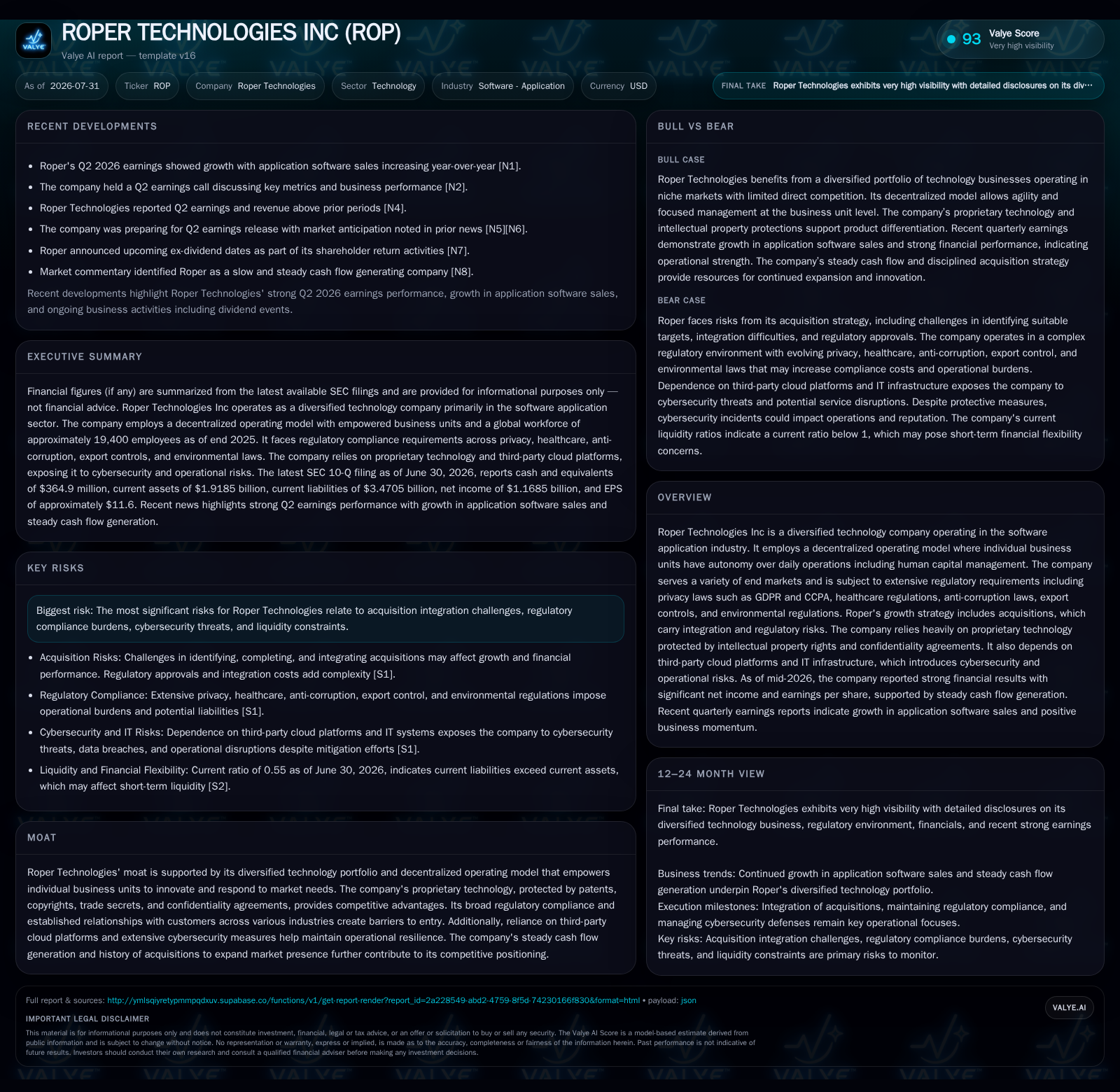
Roper Technologies reported strong second-quarter results for 2026, beating revenue and earnings estimates and raising its full-year outlook. The company’s decentralized operating model empowers individual business units with substantial autonomy, fueling innovation and agility across diverse markets. Growth continues to be propelled by a mix of recurring SaaS revenues bolstered by acquisitions, although integration challenges and regulatory compliance costs are notable operational risks. Roper also faces dependency on third-party cloud providers and evolving data privacy regulations that impact product development and cost structures.
Q2 Momentum Underscored by Operational Autonomy and Acquisition Pipeline
multiple independent units pursuing parallel strategies.
Revenue Quality Anchored by Diverse Recurring Streams Across Regulated End Markets
At its core, Roper derives revenue from a diversified portfolio of SaaS-based applications serving highly regulated industries such as healthcare, finance, energy, and transportation. The business model leverages recurring revenue mechanisms including subscriptions with varying contractual terms augmented by maintenance services and professional services like training and implementation support [S1]. This translates into a defensible annual recurring revenue (ARR) base offering predictable cash flows. Regulatory compliance—spanning GDPR in Europe, the California Consumer Privacy Act (CCPA), HIPAA in healthcare, and emerging regulations around AI usage—imposes notable cost pressures on product development cycles and delivery models but simultaneously creates barriers that favor entrenched incumbents like Roper with established infrastructures [S11][S19]. Customer retention metrics implicit in stable renewal rates are essential indicators of sustaining pricing power amid competitive alternatives. Compliance demands institutionalize switching costs as customers require trust in data security and regulatory adherence.
Industry Fragmentation Favors Niche Expertise Amid Platform Provider Dependencies
Roper operates within fragmented niche software segments rather than competing head-to-head with pure-play SaaS giants. Many of its products address specialized workflows requiring deep domain expertise embedded into proprietary technology guarded by patents and trade secrets [S16]. This fragmentation underpins its moat but also limits economies of scale. The company relies heavily on third-party cloud infrastructure providers such as AWS, Microsoft Azure, Google Cloud, and Oracle Cloud for hosting critical enterprise applications [S7]. While outsourcing infrastructure enables scalability without massive capital expenditure, it brings operational risks including service disruptions, pricing volatility, and supply chain vulnerabilities. Cybersecurity threats pose ongoing hazards to both Roper’s internal IT environment and customer-facing platforms given the sensitive nature of regulated data sets handled. Maintaining state-of-the-art security posture is both a competitive necessity and regulatory imperative.
Growth Levers Centered on SaaS Adoption, Vertical Expansion, and M&A Synergies
Organic growth is driven by increased enterprise adoption of cloud-based SaaS offerings aligned with digital transformation initiatives across industries. Vertical market penetration deepens through solutions tailored for compliance-heavy sectors where integrated SaaS can replace legacy on-premises systems [S1]. Concurrently, geographic expansion occurs through targeted acquisitions that bring complementary technology suites or regional footprints. These transactions broaden market access and create cross-selling opportunities across customer bases. However, successful realization of synergies remains contingent upon effective integration practices due to the decentralized infrastructure which disperses accountability while requiring centralized oversight during post-merger phases [S10]. The integration of new technologies along with legacy platforms adds complexity to development roadmaps but extends Roper’s competitive breadth.
Key Risks: Integration Bottlenecks, Regulatory Complexity, and Cloud Dependency
The largest operational risks disclosed pertain to integrating new acquisitions effectively while preserving daily business unit agility. Integration processes involve harmonizing disparate IT systems, aligning corporate cultures, maintaining customer service levels, and realizing anticipated cost savings—all potential points of failure that could materially affect earnings trajectories if mismanaged [S10][S28]. Regulatory compliance challenges increasingly consume resources as privacy laws (e.g., GDPR), health-related mandates (e.g., HIPAA), anti-corruption statutes (FCPA), export controls, environmental regulations, and new AI governance frameworks multiply in scope globally [S4][S11][S12][S19]. These generate product development overheads alongside legal exposure if violations occur. Additionally, dependence on external cloud platforms introduces risk from service outages or abrupt price increases potentially compressing gross margins or impairing customer satisfaction metrics. Cybersecurity remains an evolving threat vector affecting brand equity as well as operational continuity.
Outlook Signals and Milestones: Monitoring Retention, Billings Growth, and Compliance
Looking forward, key measurable indicators will validate Roper’s growth narrative or reveal warning signs. Changes in net revenue retention rate will spotlight whether existing customers expand usage or churn amid intensifying competition or regulatory hurdles. Billings growth from recurring contracts provides early signals of underlying demand strength before revenue recognition catches up given subscription accounting norms. The pace at which recently acquired businesses clear integration milestones affects confidence in future earnings contributions from M&A activity [N7][S2]. Furthermore, progress implementing compliance frameworks—particularly adapting to AI-specific regulations—as well as sustaining uninterrupted service delivery via third-party clouds will remain vital gauges of operational robustness.
Financial Profile Discussion: Liquidity Constraints Amid Elevated Leverage
As of June 30, 2026, Roper Technologies held approximately $365 million in cash and equivalents against current liabilities of about $3.47 billion, resulting in a current ratio near 0.55, indicating tight near-term liquidity [F1]. Total debt stood near $9.3 billion as of December 31, 2025, with net debt around $8.9 billion [F1]. This leverage level reflects the company's history of acquisitions and intangible asset base. While stable operating cash flows help service debt obligations, the low current ratio underscores potential constraints on capital deployment absent additional financing or asset sales [F1]. Ongoing monitoring of covenant compliance remains important given the leverage profile.
This analysis synthesizes recent filings along with sector-native industry knowledge to frame Roper Technologies’ trajectory as it balances decentralized innovation against the structural challenges posed by acquisitions and regulatory complexity within a fragmented software application ecosystem. It highlights near-term performance success anchored in resilient recurring revenues while drawing attention to risks that could affect sustaining this momentum.
Disclaimer: This document is an analytical report summarizing publicly available information for informational purposes only without any investment research view or advice.
Disclaimer: This is research-only, informational analysis and not investment advice. It may include AI-generated interpretation and general industry context. Always verify important details using primary sources.

Comments