
Thermo Fisher Scientific Leverages AI and Bioproduction Growth in Q2 2026 Expansion
Thermo Fisher's latest quarterly results highlight sustained innovation, service expansion, and strategic positioning in the life sciences tools and services industry.
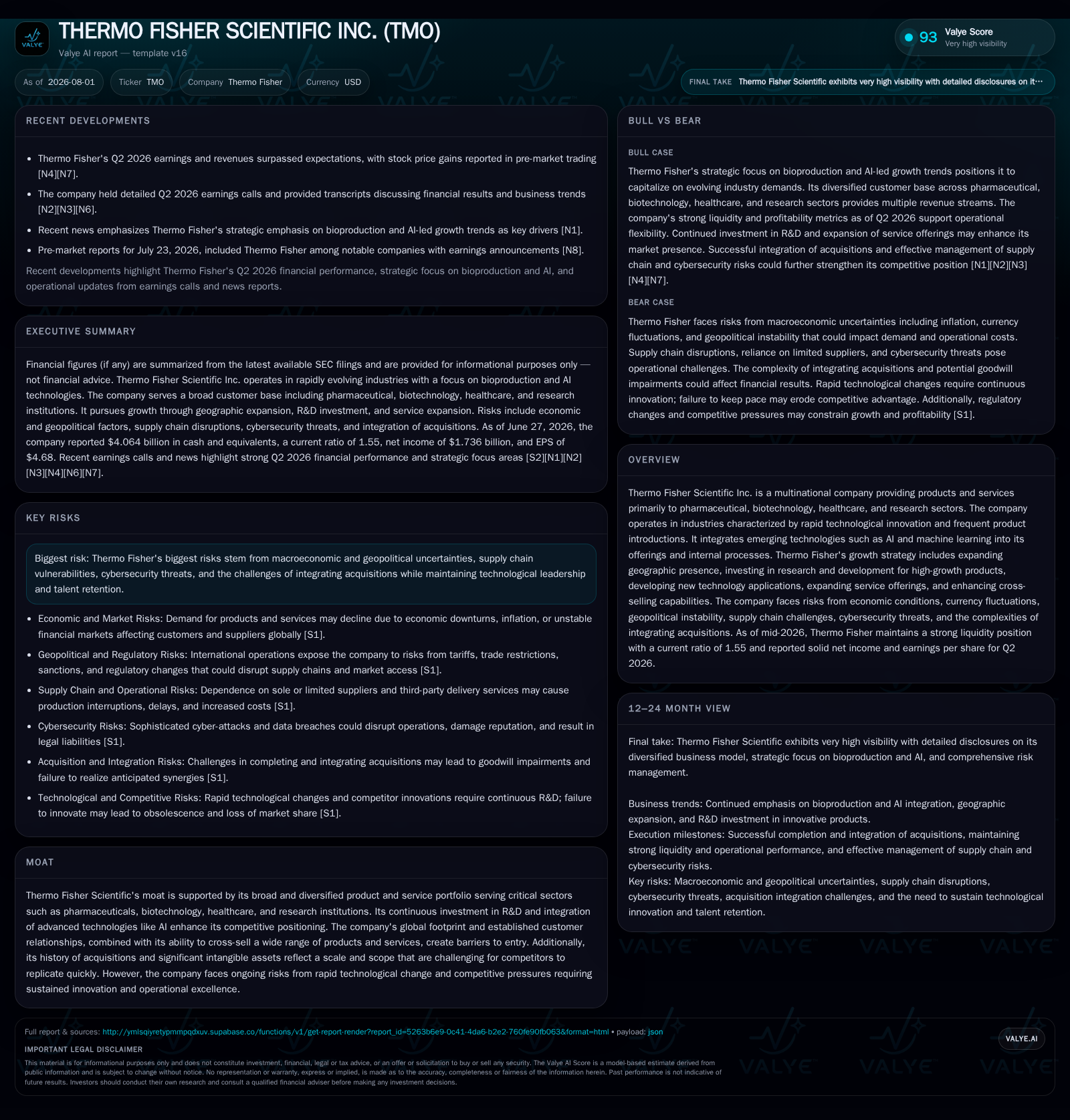
In Q2 2026, Thermo Fisher Scientific sustained momentum through new product launches integrating artificial intelligence and machine learning, alongside expanded bioproduction and contract manufacturing services. The company's broad portfolio across analytical instruments, reagents, diagnostics, and CRO services underpins its resilient growth despite inflationary pressures and geopolitical risks. Effective cross-selling and geographic diversification further strengthen Thermo Fisher’s moat, even as heightened regulatory compliance demands and supply chain complexities present ongoing challenges. Financially, the company maintains solid liquidity with a current ratio of 1.55 and manageable leverage amid significant debt from acquisitions.
Recent Operating Update
Thermo Fisher Scientific’s Q2 2026 report underscores continued strength in revenue growth supported by innovation in AI-augmented instruments and expanded bioproduction capabilities [S2]. Earnings surpassed expectations driven by product launches that integrate machine learning into analytical platforms and laboratory automation solutions. The company also reported robust volume increases in contract manufacturing and clinical trial service segments amidst growing outsourcing trends in pharmaceutical development [N1][N8]. These developments position Thermo Fisher favorably within a rapidly evolving life sciences environment.
The quarter featured an emphasis on scaling new technology applications while maintaining cost discipline amid inflationary pressures across supply chains. Currency translation effects remained positive due to U.S. dollar weakness against key currencies but introduced volatility risks heading forward given international sales account for a substantial portion of total revenue [S1]. The company continues to invest heavily into R&D programs focused on precision medicine diagnostics and digital laboratory ecosystems.
Business Model Overview
Operating within the life sciences tools and services industry, Thermo Fisher generates revenue primarily through the sale of scientific instruments (such as mass spectrometers, chromatography systems), reagents and consumables essential for laboratory workflows, as well as software platforms that optimize research analytics [S1]. Complementing this hardware-centric base are high-value services including contract research organization (CRO) offerings supporting clinical trials, clinical diagnostic solutions ensuring regulatory compliance, and bioproduction services facilitating pharmaceutical manufacturing under good manufacturing practices (GMP)
Revenue mechanics are a hybrid of direct sales to pharmaceutical companies, biotechnology firms, healthcare institutions, academic research entities, and government laboratories. Contract lengths vary by service suite but often feature multi-year agreements with renewal options providing visibility into booking volumes. Cross-selling is a strategic lever where bundled offerings enhance customer ”stickiness” while improving margin profiles through higher aftermarket consumables sales — a segment historically commanding better profitability than instrumentation alone.
Pricing receives some upward pressure from specialized reagent formulations and advanced diagnostics critical for cutting-edge therapies but faces headwinds from competitive commoditization in basic lab consumables [S1]. Overall margin stability hinges on successful innovation cycles introducing differentiated products while managing supply chain costs.
Industry Structure and Competitive Position
Thermo Fisher solidifies its market leadership through scale advantages unmatched by many peers including Danaher Corporation (diversified life sciences tools), Agilent Technologies (analytical instruments), Charles River Laboratories (contract research), Illumina (genomic sequencing), and PerkinElmer (analytics & diagnostics). Its wide footprint across instruments, consumables, software, CRO services and biomanufacturing creates multiple entry barriers by integrating customers’ value chains end-to-end — a notable competitive moat.
The industry landscape is marked by rapid technological shifts — especially via AI and laboratory automation — demanding continuous investments in R&D at an intensity measured routinely against revenue [S4][S8]. Regulatory environments with FDA/EUA approvals impose lengthy timeframes for product commercialization heightening upfront costs but also reinforce incumbency due to certification-related switching costs
Emerging markets present growth opportunities albeit tempered by geopolitical risks, legal instability, exchange rate fluctuations, and infrastructure development pace [S1][S29]. Against this backdrop, Thermo Fisher’s geographic diversification mitigates localized economic downturns but requires agile supply chain execution given complexity in sourcing raw materials sensitive to global market volatility [S26].
Growth Drivers
Key growth drivers include increasing global R&D expenditures fueled by intensified drug discovery pipelines in pharma/biotech sectors. Rising demand for precision medicine propels uptake of diagnostics and associated instruments tailored to personalized therapies. Bioproduction capacity expansions drive contract manufacturing services as pharmaceutical companies outsource complex biologics production requiring GMP compliance [N8][S1]
Adoption of AI/machine learning accelerates efficiency gains in laboratory workflows enhancing data quality for customers which in turn supports pricing power on novel platform launches. Regulatory changes necessitating enhanced testing or subsidies also drive demand for newer testing products supportive of compliance mandates.
Cross-selling efficacy grows as Thermo Fisher deepens relationships extending beyond initial instrument purchases into recurring reagent supplies, software subscriptions for informatics solutions, and lifecycle clinical development support — cumulatively expanding share-of-wallet with large corporate customers. Expansion into emerging markets taps rising healthcare infrastructure spending although growth rates remain uneven geographically.
Risks and Watchpoints
Macroeconomic concerns such as sustained elevated inflation elevate input costs challenging margin expansion despite pass-through efforts [S1]. Supply chain fragility persists stemming from sole or limited source dependencies on components critical to manufacturing certain instruments or reagents; any disruption could materially impact delivery timelines [S9][S26].
Regulatory complexity introduces risks especially around FDA inspections or delays impacting clinical trial service revenues or product market access; failure to maintain GMP standards can trigger substantial remediation expenses or reputational harm with cascading customer effects [S4][S8][S14]. Cybersecurity remains an ongoing threat vector particularly due to Ther-mo Fisher’s extensive data footprint coupled with AI-driven systems intensifying IP protection challenges plus risk exposure from misuse or inadvertent error by internal/external actors [S11][S23][S19].
Integration of acquisitions is a crucial watchpoint given goodwill over $49 billion; synergies need realization through effective operational alignment or else financial impairments may follow with negative earnings implications [S9]. Talent retention in highly specialized scientific fields is challenged by fierce competition constraining innovation velocity — particularly as AI-related skills become increasingly vital to product development teams [S26]. Currency volatility could distort reported results given large foreign operations subject to translation risks affecting net income margins beyond operational performance variability.
What to Watch Next
Key milestones include progress announcements on Clario acquisition integration—expected to augment the clinical trial service portfolio—and any forward guidance updates related to new product launches embedding next-generation AI enhancements announced during recent quarters [N8][N3]. Tracking order backlog changes alongside renewal rates within CRO contracts offers insight into underlying volume durability versus cyclical noise.
Supply chain lead times through H2 2026 will be closely monitored amid ongoing global logistics challenges; extensions there can foreshadow broader margin headwinds ahead. Currency trends against USD will remain significant given international sales weight potentially obscuring organic growth visibility if adverse moves occur unexpectedly.
Monitoring regulatory inspection outcomes especially related to pharma services platforms is critical—any warning letters or corrective action plans may presage delayed orders or compliance cost escalations involving all segments. Finally, competitor actions specializing in genomic instrumentation or lab automation will frame pressure points around innovation cycle timing relative to Thermo Fisher’s investment levels.
Financial Profile Discussion
As of June 27, 2026 quarter-end (latest available), Thermo Fisher held cash & equivalents totaling approximately $4.06 billion while carrying total debt near $42.6 billion resulting in net debt of about $38.5 billion—a common profile given its acquisitive strategy over recent years [F1]. This leverage level warrants continued focus on free cash flow generation sufficiency to meet interest obligations comfortably alongside scheduled maturities.
Short-term liquidity appears comfortable with current assets at roughly $23.4 billion versus current liabilities near $15.1 billion providing a current ratio of approximately 1.55 indicative of solid working capital management amid business scale [F1]. Operating margins have historically balanced investment needs in R&D (~9-10% of revenue) against disciplined expense control to preserve cash conversion efficiencies consistent with peer diversified life sciences leaders.
Currency impacts provided a notable revenue tailwind last year (+$0.37 billion) but pose future volatility risk consistent with multinational exposure described above [S1]. Capital allocation remains balanced between reinvestment for organic growth via technology development plus selective bolt-on acquisitions intended to expand service breadth or geographic reach rather than purely scale plays ensuring ongoing innovation-driven differentiation.
This analysis synthesizes publicly available quarterly filings combined with detailed sector context inherent to life sciences tools providers without making any investment research views or forecasts.
Disclaimer: This is research-only, informational analysis and not investment advice. It may include AI-generated interpretation and general industry context. Always verify important details using primary sources.

Comments