
Blue Star Foods Drives Vertical Integration with RAS Scaling Amid Liquidity and Customer Concentration Risks
Blue Star Foods Corp. advances its land-based aquaculture expansion while contending with liquidity constraints and concentrated customer exposure.
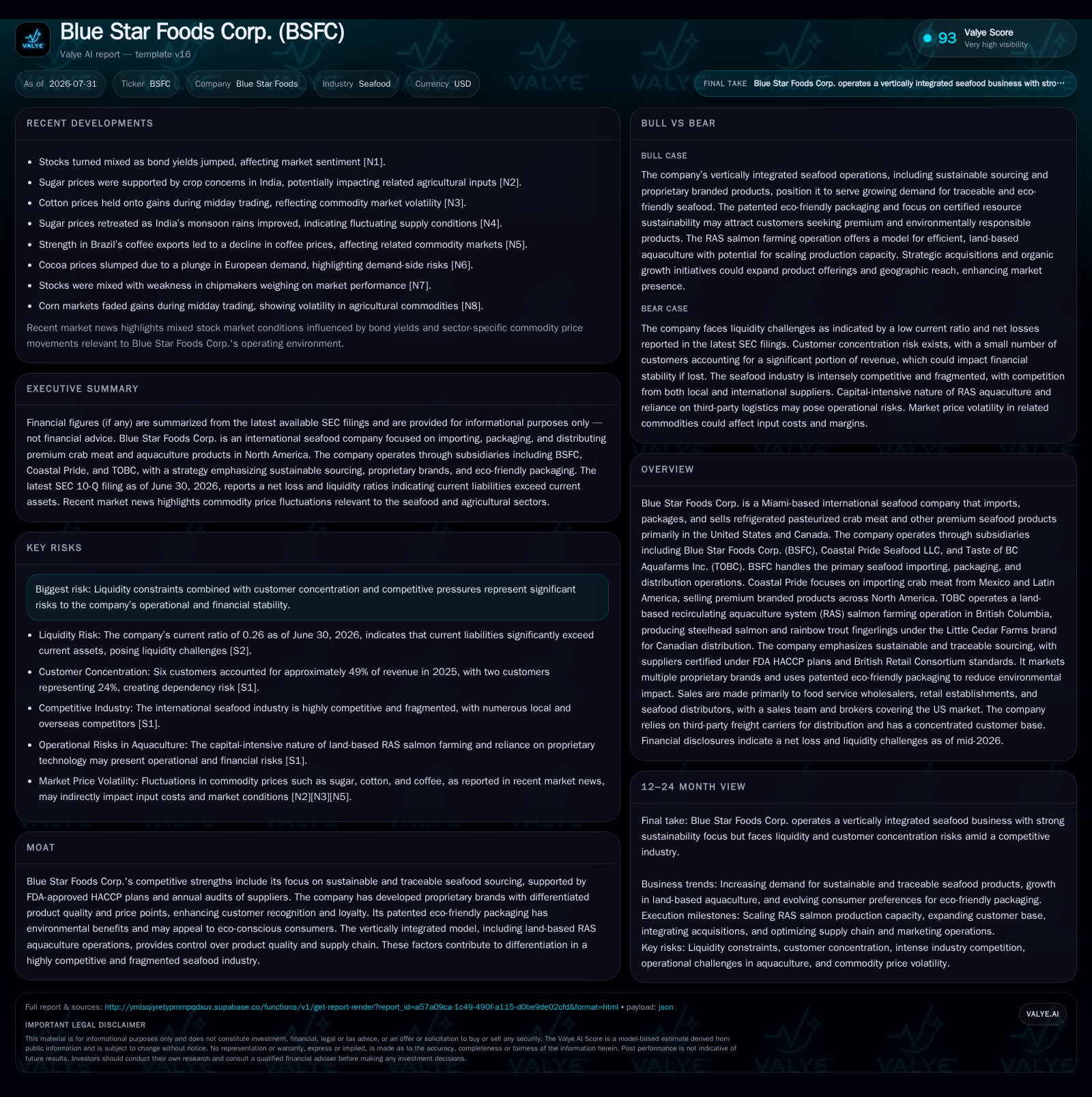
Blue Star Foods Corp. (BSFC) operates as a vertically integrated seafood company combining traditional importation, processing, and distribution of premium crab meat with a developing land-based recirculating aquaculture system (RAS) for steelhead salmon and trout in Canada. The latest quarter shows ongoing focus on scaling its aquaculture capacity alongside strategic acquisitions to broaden species mix and geographic presence. However, significant risks persist around liquidity, customer concentration, regulatory compliance, and commodity price volatility. Sustainable sourcing and proprietary eco-friendly packaging underpin differentiation in a fragmented industry where BSFC aims to leverage brand development and supply chain control to improve margins.
Recent Operating Update
Blue Star Foods Corp. maintained steady progress in its latest quarterly filing ending June 30, 2026 with no newly identified risk factors but reaffirmed its strategic focus on scaling the Taste of BC Aquafarms (TOBC) RAS salmon business toward a targeted production of 21,000 metric tons by 2028 through phased expansions of standardized modular facilities [S2][S1]. This ambitious capacity build-out depends critically on accessing fresh equity and debt financing during ongoing liquidity constraints evidenced by a current ratio of approximately 0.26 and cash resources of only $11,119 at quarter-end [F1]. Meanwhile, the core seafood importing and packaging operations continued under the Blue Star Foods Corp. (BSFC) entity primarily sourcing blue and red swimming crab meat via co-packing relationships from Southeast Asia and Latin America for distribution across the U.S. and Canada [S1][S3]. Management also highlighted pursuit of strategic acquisitions aimed at diversifying species offerings and expanding geographic footprint while embedding sustainability practices into more traditional operations to capture premium pricing advantages [S1][S4].
Business Model
Blue Star Foods operates an integrated seafood value chain encompassing imports, processing, packaging, branding, distribution, and upstream aquaculture production via its subsidiaries Blue Star Foods Corp., Coastal Pride Seafood LLC, and Taste of BC Aquafarms Inc [S1][S12][S17]. The company sources bulk crab meat—particularly Portunus Pelagicus species—from suppliers primarily located in India, Philippines, Indonesia plus Mexico and Latin America through Coastal Pride’s import channels. These products are sold under multiple proprietary brands including Blue Star, Oceanica, Pacifika, Crab & Go Premium Seafood, First Choice, Good Stuff, and Coastal Pride Fresh targeting U.S. food service wholesalers, retailers, and distributors
On the aquaculture front, TOBC operates a land-based recirculating aquaculture system producing steelhead salmon and rainbow trout fingerlings under the Little Cedar Farms brand distributed within Canada. The facility currently holds an annual production capacity near 100 tons but management envisions multiplying this by implementing replicable farm modules scaled to 1,500 tons each as part of an extensive growth plan contingent on external funding availability [S1][S3]. This integration allows BSFC control over upstream fish biomass quality while addressing ecological sustainability concerns increasingly critical to end consumers.
Revenue generation relies on sales volume driven by customer purchase orders rather than long-term contracts; pricing reflects commodity market fluctuations for crab meat combined with premium product positioning enabled by strong food safety compliance—including FDA-approved HACCP plans—and sustainability certifications audited annually [S7][S17]. Distribution relies heavily on centralized inventory storage in Miami with shipments primarily delivered through less-than-truckload (LTL) national carriers rather than owned fleets to manage logistics cost-effectively yet exposing BSFC to external freight variability risks [S12].
Industry Structure & Competitive Position
The international seafood industry is highly fragmented with considerable competition from local fisheries operators as well as large multinational processors like High Liner Foods in North America or Marine Harvest (now Mowi) on the aquaculture side. Key differentiators include supply chain sustainability credentials, traceability standards, product innovation (such as eco-friendly packaging patented by BSFC), brand recognition in premium segments, cold chain logistics efficiency, and operational scale.
BSFC competes against established crab meat importers such as Phillips Foods Inc., Tri Union Frozen Products (Chicken of the Sea Frozen Foods), Harbor Seafood Inc., alongside emerging land-based aquaculture producers including Atlantic Sapphire and Nordic Aquafarms competing in ecologically sensitive markets by leveraging cutting-edge RAS technologies [S7]. However, BSFC's relatively modest scale compared to these peers poses challenges in achieving cost parity or broad market penetration particularly as it remains heavily dependent on a handful of large customers accounting for nearly half its revenue base—a notable concentration risk implying revenue volatility if key relationships weaken or are lost [S7].
Growth Drivers
Growth at BSFC is anchored in three primary avenues: organic volume expansion within existing import brands through broader customer acquisition; scaling of TOBC’s RAS salmon farming capacity via replicable modular farms unlocking significant increases in fish biomass output; plus strategic acquisitions designed to expand species diversification (beyond crab meat and steelhead salmon) into untapped geographies or adjacent product categories aligned with sustainable resource utilization principles [S1][S4]
Increasing global demand for animal protein alongside rising consumer emphasis on traceable sustainable sourcing fuels underlying market opportunities especially in developed North American markets where premium branded seafood commands margin premiums supported by certifications like BRC audits coupled with FDA-approved food safety processes held by their suppliers [S17]. Additionally, BSFC’s patented eco-friendly packaging addresses growing consumer preference for environmentally responsible products reducing carbon emissions versus metal cans by substituting innovative pouch technology thus enhancing retailer shelf appeal while aligning with global sustainability trends [S4].
Efficient cold chain logistics management enables BSFC to maintain freshness crucial for refrigerated pasteurized crab meat products—a key determinant of yield rates at processing—while incremental expansion of salesforce reach coupled with broker networks helps generate pull-through demand at retail outlets maximizing inventory turnover rates essential for perishable seafood products distributed via LTL freight carriers [S12].
Risks & Watchpoints
Significant risks remain impediments to Blue Star Foods’ growth trajectory. Liquidity constraints evidenced by the very low current ratio (0.26) combined with minimal cash reserves ($11K) necessitate successful capital raises; failure here threatens continuity given ongoing demands for working capital related to inventory purchasing cycles and costly RAS expansions requiring heavy upfront capex commitments [F1][S8]. Customer concentration risk features prominently—six customers generated ~49% revenue in 2025—rendering the topline sensitive to contract renewals or order size changes from these few accounts [S7].
Commodity price volatility for crab meat directly impacts gross margin stability since feedstock costs can fluctuate widely based on ecological conditions affecting fish biomass populations which are inherently unpredictable given biological variability exacerbated by climate change trends [S5]. Regulatory compliance complexities pose continual challenges across jurisdictions including risk management around food safety recalls or import restrictions that could disrupt supply chains or lead to costly enforcement actions such as fines or injunctions impacting operating income [S5][S13].
Legal disputes further deepen uncertainty regarding TOBC operations where ongoing litigation over freshwater aquaculture licenses challenges secure ownership rights critical to facility operation continuity while lease termination proceedings add strain pending court outcomes potentially affecting fish biomass throughput during delays—any loss could truncate production expansion timelines putting pressure on projected sales growth from farmed steelhead salmon volumes [S3]
The inherently capital-intensive nature of RAS farm scale-up demands reliable access to equity or debt markets alongside operational excellence vaccinating against contamination incidents that could damage product reputation or lead to costly shutdowns undermining planned margin improvements targeting profitability break-even beyond current losses recorded at operating income -$2.34 million for full-year 2025 [F1]. Competition from larger vertically integrated firms with deeper pockets reduces pricing flexibility along multiple points in the value chain exposing Blue Star Foods’ brands and products to substitution risks especially from alternative protein sources gaining traction among health-conscious consumers.
What To Watch Next
Short-to-mid term milestones pivotal for assessing Blue Star Foods’ execution include securing sufficient capital infusion enabling construction of next-generation RAS modules targeting initial 1,500 metric ton capacity increments; progress updates on license adjudication coupled with lease dispute resolutions essential for uninterrupted production continuation at TOBC facilities; quarterly revenue trajectory signaling diversified customer penetration beyond concentrated base; cash flow improvements indicating working capital normalization post-growth investment cycle; margin shifts reflecting increased product mix premium penetration driven by proprietary branding efforts leveraging eco-friendly packaging innovation; plus updates on any further strategic acquisition announcements expanding species lineup or geographic reach beyond North America fundamentals outlined currently [S1]
Additionally monitoring commodity price trends impacting imported crab meat costs alongside regulatory changes influencing trade tariffs or food safety enforcement will be essential operational barometers informing gross margin sustainability outlooks.
Financial Profile Discussion
Liquidity metrics highlight considerable imbalance: total current assets stood near $1.09 million versus substantially higher current liabilities approximating $4.23 million yielding a precariously low current ratio (~0.26) [F1]. This short-term solvency gap accentuates working capital pressure possibly exacerbated by elongated inventory holding periods inherent in seafood cold chains complicated further by imported supply cycle variability.
Though last reported total debt was moderate at $350K (2023 year-end vintage), net indebtedness approximates $339K after accounting for limited cash balances emphasizing leverage is manageable but delicately positioned given growth capital needs not reflected herein.[F1] The absence of dividend payouts aligns with stated reinvestment priorities focused on firm expansion requiring outsized equity market engagement presenting dilution risk flagged repeatedly among company disclosures.[S22]
Monitoring subsequent quarters for improvements in cash flow from operations alongside successful milestone achievements related to modular farm development will add clarity whether BSFC manages transition towards positive earnings trajectories or requires additional funding rounds presenting shareholder dilution considerations.
This analysis synthesizes publicly available filings without offering investment advice. Readers should evaluate company statements alongside sector dynamics comprehensively before drawing conclusions about Blue Star Foods’ prospects.
Disclaimer: This is research-only, informational analysis and not investment advice. It may include AI-generated interpretation and general industry context. Always verify important details using primary sources.

Comments