
Vince Holding Corp. Strengthens Direct-to-Consumer Profitability Amid Supply Chain and Tariff Challenges
Vince Holding Corp. reports improved DTC segment profitability in Q1 2026 driven by omni-channel sales growth, while managing liquidity and cost pressures.
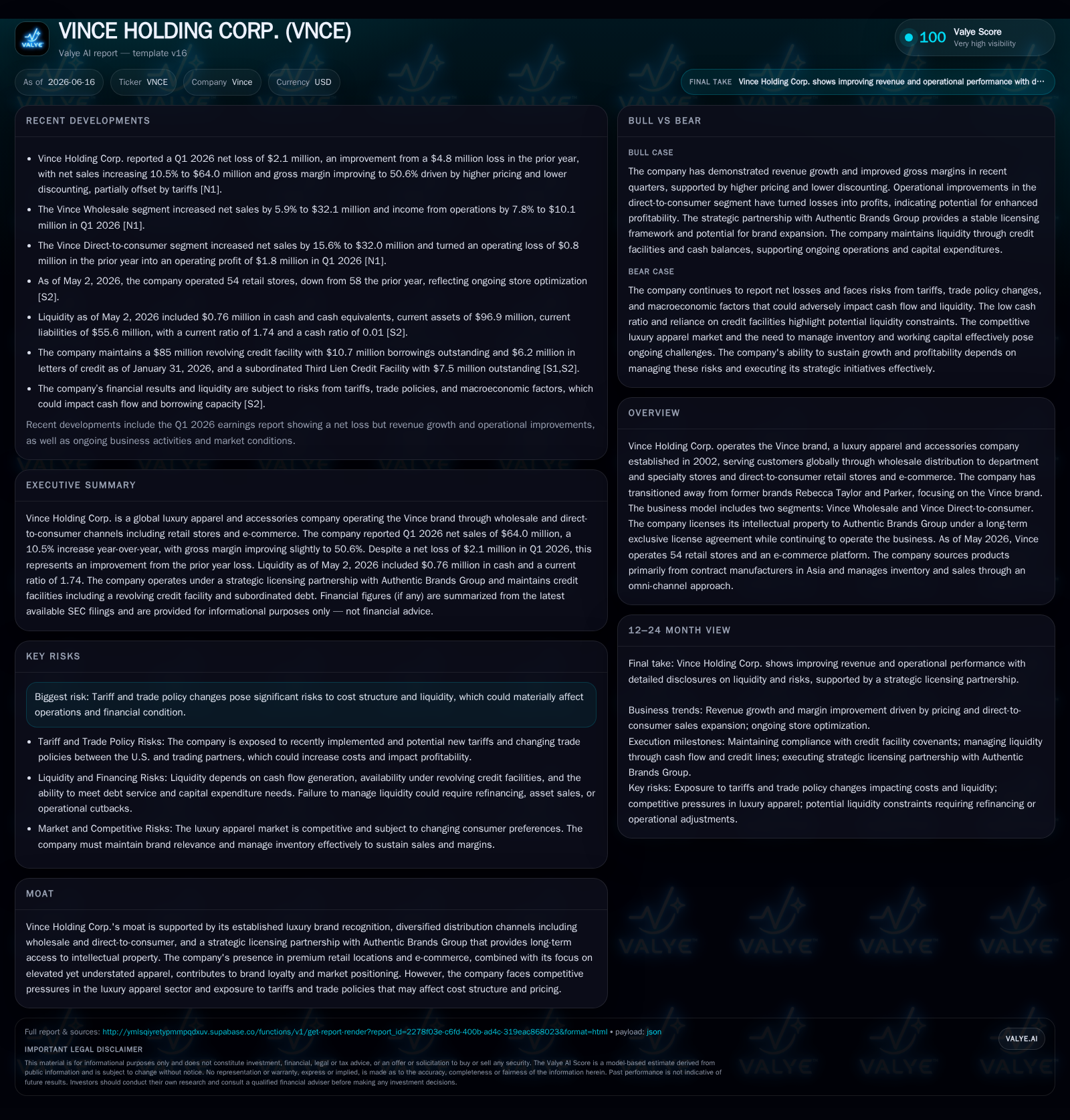
In its latest quarterly report filed June 16, 2026, Vince Holding Corp. showcased a significant turnaround in its direct-to-consumer segment, shifting to positive operating income amid increased net sales. The company continues focusing exclusively on the Vince brand with operations spanning wholesale and direct retail channels, including 54 stores and e-commerce. While benefiting from a strategic licensing partnership with Authentic Brands Group, Vince faces ongoing risks from tariffs and supply chain volatility impacting operating costs and liquidity. The company maintains a solid liquidity position supported by its revolving credit facility but must navigate restrictive covenants and elevated debt levels as it invests in retail and digital expansion.
Recent Operating Update
Vince Holding Corp.'s latest quarterly filing dated June 16, 2026 ([S2]) reveals a meaningful operational improvement primarily in the direct-to-consumer (DTC) segment. For the three months ended May 2, 2026, the Vince DTC segment moved from a loss of $0.8 million in the year-ago period to an operating income of $1.85 million. This turnaround was driven largely by an increase in net sales within the segment. The increase reflects enhanced customer engagement across both physical retail stores—42 full-price plus 12 outlet locations—and its e-commerce platform (vince.com), embodying an integrated omni-channel retail approach.
Alongside improved profitability, SG&A expenses increased marginally by 4.3% year-over-year driven mainly by approximately $1.2 million higher employee benefit costs and an $0.8 million rise in marketing and advertising outlays, partially offset by decreased legal expenses. Such cost increases suggest investment in customer acquisition and brand building activities supporting sales growth.
The company's liquidity position remains adequate but merits attention: cash & equivalents stood at approximately $762,000 against total debt near $29 million as of May 2026 ([F1],[S2]). Access to an $85 million senior secured revolving credit facility maturing June 2028 provides substantial financial flexibility. Borrowing costs vary with SOFR-based rates linked to borrowing utilization levels under this facility ([S2]). Notably, the company relied on revolving credit borrowings totaling $9.4 million during Q1 FY26 to support operations ([S2]).
Business Model Overview
Vince Holding Corp.'s business model centers on premium lifestyle apparel and accessories under the Vince brand, established in 2002 as a luxury label focused on understated yet elevated ready-to-wear designs for men and women ([S1],[S2]). The company operates through two main segments:
- Vince Wholesale: Sales to department stores and specialty retailers globally.
- Vince Direct-to-Consumer: Retail stores plus e-commerce platform handled as one integrated channel.
Since early 2023, Vince has strategically exited prior owned brands Rebecca Taylor and Parker through intellectual property sales and has concentrated resources fully on the Vince brand ([S1],[S2]). Enhancing this focus is a licensing transaction completed in May 2023 whereby Vince contributed intellectual property rights to an Authentic Brands Group (ABG) subsidiary while securing an exclusive long-term license arrangement ([S1],[S2]). This relationship provides brand stewardship continuity while potentially leveraging ABG's global scale for marketing and distribution synergies.
Revenue generation hinges on product design aligned with seasonal trends marketed via wholesale accounts targeting premium retailers alongside owned retail stores that also underpin brand control and consumer experience quality. The omni-channel strategy integrates inventory management across physical stores and digital platforms to meet evolving shopper behaviors favoring seamless channel interaction ([S1],[S2]). Contract manufacturing predominantly in Asia supports flexible production but exposes the business to tariffs and trade policy risks.
Industry Structure & Competitive Position
The luxury apparel market emphasizes brand equity built around design prestige, quality craftsmanship, and strong consumer loyalty fueled by curated retail experiences both online and offline. Vince's niche lies in "effortless everyday style," differentiating it from flashier or fast-fashion competitors. Its dual-segment presence spreads channel risk yet demands effective coordination between wholesale partner expectations and direct consumer engagement efforts.
Compared broadly within peers such as PVH Corp., Oxford Industries, or lululemon—a peer group strong in multi-channel distribution—Vince lacks the scale but benefits from specialization via its licensing model with Authentic Brands Group which ensures IP robustness while enabling capital-lite brand management aspects otherwise difficult for smaller companies ([N5],[N6],[N1]).
Retail footprint optimization is ongoing; reducing non-core assets following the divestiture of other brands likely sharpened management focus on unit-level store economics with attention to same-store sales (including e-commerce). Comparable sales are reported inclusively of digital commerce due to their integrated nature bolstering more holistic performance visibility ([S1],[S2]).
Growth Drivers
Key growth drivers for Vince include:
Omni-channel Direct-to-Consumer Expansion: Growth in online sales coupled with selective store enhancements strengthens value capture directly from end consumers with better margin profiles.
Wholesale Partnerships: Premium wholesale channels offer broad market access albeit at thinner margins but important for brand reach beyond own-store limitations.
Strategic Licensing Partnership: Collaboration with ABG secures long-term IP rights fueling marketing muscle and potential new product licensing or geographical expansion initiatives.
Product Innovation & Brand Development: Seasonal collections keeping pace with luxury fashion trends support sustained demand amid competitive dynamics.
Retail Store Optimization: Streamlining store base towards profitable locations improves overall productivity; outlet stores complement full-price network serving discounted demand segments without tarnishing luxury positioning.
Tariff Mitigation Initiatives: Proactive measures addressing rising supply chain cost pressures induced by tariffs help contain margin erosion effects.
Risks & Constraints
Despite progress, Vince faces several risks warranting monitoring:
Supply Chain & Tariffs: Reliance on Asian contract manufacturers exposes cost structure vulnerability to tariff escalations or retaliatory trade measures inducing inventory valuation complexities ([S4],[S10]).
Liquidity & Leverage Risks: While liquidity appears sufficient relative to obligations, raising debt service costs amid covenant restrictions constrain financial flexibility especially if operating results falter ([F1],[S2]).
Seasonality & Fashion Cycles: Volatile consumer tastes require agile inventory planning; markdown cadence can pressure gross margin if misaligned.
Competitive Intensity: High competition from established luxury brands alongside fast-fashion entrants challenges pricing power; maintaining distinctiveness is critical.
Regulatory & Compliance Exposure: Including labor laws affecting international sourcing; any adverse changes could impact operational costs or reputation.
What To Watch Next
Upcoming milestones include tracking comparable sales trends (particularly within DTC as indicative of brand health), margins evolution amid tariff environments, inventory turnover metrics reflecting product cycle efficiency, store productivity gains or closures shaping footprint rationalization outcomes, as well as liquidity status post upcoming covenant assessment dates (~July 21, 2026) where dividend restrictions may ease contingent on fixed charge coverage ratios ([S2]). Continual monitoring of licensing partnership efficacy—brand marketing investments versus tangible sales uplift—will be valuable given their strategic importance.
Financial Profile Summary
At quarter-end May 2026, Vince Holding showed cash reserves near $0.76 million against total debt roughly $29.1 million yielding a net debt position approximating $28.3 million ([F1]). Operating income improvements notably from the DTC segment underscore operational leverage potential despite elevated SG&A expense absorbing marketing investments ([S2]). The company’s capital expenditures remain focused on retail store enhancements averaging around $4 million annually reflecting moderate expansion/redevelopment pace ([S1]). The senior secured revolving credit facility maturing mid-2028 underpins financial flexibility though carries covenants restricting discretionary payouts until summer 2026 anniversary conditional on liquidity ratios ([S2]).
Disclaimer: This analysis is prepared for informational purposes based strictly on publicly available regulatory filings and news sources without offering investment advice or research views.
Disclaimer: This is research-only, informational analysis and not investment advice. It may include AI-generated interpretation and general industry context. Always verify important details using primary sources.

Comments