
Perimeter Solutions Leverages Fire Safety and Specialty Products amid Wildfire Season Variability and Recent Acquisitions
Perimeter Solutions' diversified industrial portfolio balances wildfire-driven fire safety demand with growth from specialty chemical and medical machinery sectors.
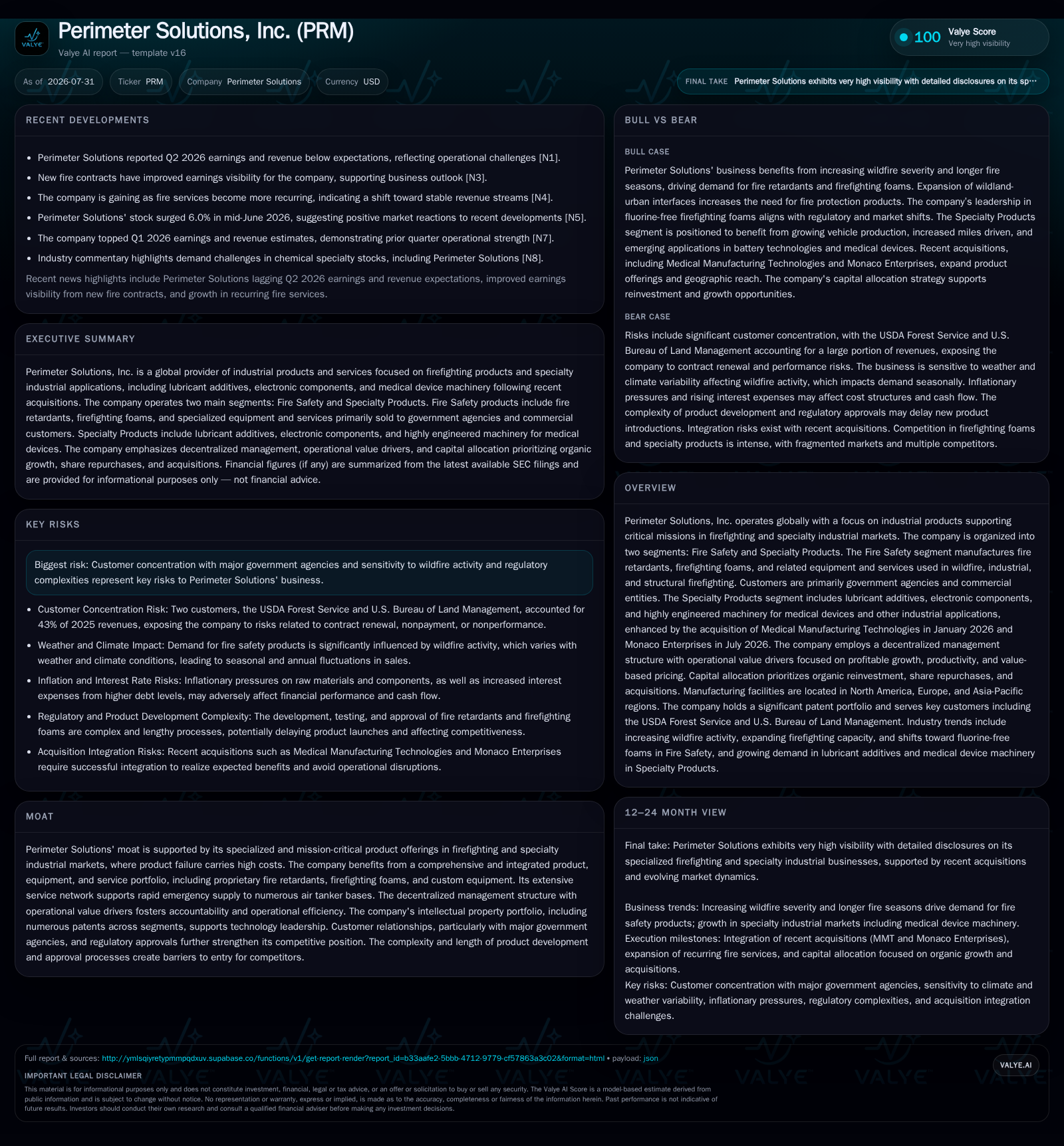
In Q2 2026, Perimeter Solutions advanced its dual-segment strategy by generating a 31% revenue increase driven by higher sales in both Fire Safety and Specialty Products. The firm’s decentralized management and capital allocation priorities support operational productivity and acquisitions, notably Medical Manufacturing Technologies acquired in early 2026. Despite wildfire season variability and concentrated government customers influencing demand cyclicality, Perimeter leverages technology leadership and regulatory approvals as a moat. Ongoing integration of recent acquisitions and managing legal/regulatory exposures remain key watchpoints.
Recent Operating Update
uarterly dynamics illustrate resilience against wildfire-related seasonality while highlighting integration effects of expanded specialty offerings.
Business Model Overview
Perimeter Solutions operates two distinct yet complementary segments: Fire Safety and Specialty Products. The Fire Safety segment manufactures proprietary fire retardants that chemically alter vegetation to reduce flammability, complemented by firefighting foams, related customized equipment such as aerial retardant dispensing systems, ground-applied units, and extensive services supporting tactical wildfire suppression efforts [S1][S22]. Customers are predominantly high-reliability government agencies like the U.S. Forest Service (USFS) and Bureau of Land Management (BLM), which together represented approximately 43% of consolidated revenue in 2025 — highlighting substantial customer concentration risk but also profound strategic alignment with essential public safety missions [S5][S22]. Contracts mix on-demand orders often without minimum guarantees reflecting wildfire unpredictability.
Specialty Products comprise lubricant additives critical for industrial oils (P2S5 compounds), electronic components for advanced infrastructure applications, plus newly integrated highly engineered machinery for medical device manufacturing—obtained via the January 2026 purchase of MMT and July acquisition of Monaco Enterprises respectively [S1][S3]. This diversification broadens exposure beyond seasonal firefighting markets into recurring industrial processes with longer development cycles but potentially steadier demand linked to end-user industries like automotive lubricants and medical procedure volumes.
Monetization hinges upon selling specialized proprietary chemical formulations coupled with complex equipment solutions typically under negotiated contracts or supply agreements reflecting recurring usage or full deployment cycles. Pricing leverages value-based methodologies justified by mission-critical safety requirements where product failure costs are exceedingly high. Operational variables driving revenue include volume tied directly to wildfire occurrence intensity for fire safety products versus capacity utilization rates and new product adoption pace in specialty segments.
Industry Structure and Competitive Position
The industrial specialty chemicals and equipment sector demands deep technical know-how in formulation chemistry combined with rigorous regulatory compliance regimes given environmental implications—firms like Chemours or Albemarle focus similarly on specialty chemicals while more direct competitors include fire safety product suppliers akin to Tyco International's offering in firefighting foam markets or Lubrizol in lubricant additives.
Perimeter's moat is underpinned by integration across chemical products, custom firefighting equipment tailored for aerial or ground application platforms, rapid response logistics servicing over fifty air tanker bases globally, plus recognized certifications such as qualification on the USDA Forest Service Qualified Products List—a difficult standard involving extensive toxicity, performance, corrosion resistance testing—and ongoing collaborative R&D programs with end customers for product innovation [S5][S9]. This contrasts with commoditized foam producers facing price competition absent integrated service offerings or comprehensive regulatory clearances.
The company's decentralized management style delegates autonomy to general managers accountable for delivering margin-enhancing operational productivity improvements alongside pursuing profitable new business opportunities—combining rigorous overhead cost control with agility to meet evolving end market needs [S1][S2]. This model facilitates tailoring approaches across geographies where 76% revenues derive domestically with meaningful North American governmental customers complemented by European (10%) and Canadian (~7%) operations [S5][S8].
Growth Drivers
Structural demand drivers prominently include increasing frequency and severity of wildfires coupled with expansion of wildland-urban interface areas placing more homes at risk enhancing reliance on retardant deployments annually; parallel growth emerges from increased aerial firefighting fleet capacities necessitating sustained supply chains for retardants and supporting equipment [S1][S5]. Regulatory shifts mandating safer firefighting foams away from legacy PFAS-containing formulations also encourage ongoing product innovation favoring incumbents capable of quicker reformulations meeting stricter EPA/USDA standards.
In Specialty Products, expansion into regulated medical device machinery via MMT broadens footprint into markets benefiting from procedural volume growth tied to aging populations and technological advancement cycles requiring precise manufacturing solutions—this diversifies away from commodity lubricant additives vulnerable to EV adoption dampening traditional internal combustion engine oil usage [S1][S9]
Risks and Constraints
The business remains sensitive to pronounced seasonality inherent in wildfire activity as geographic location shifts year-to-year can cause quarterly revenue volatility challenging forecasting accuracy; contracts lacking guaranteed minimums exacerbate this unpredictability especially when customer site disruptions delay purchases [S1][S5]. Customer concentration presents material downside if key agencies like USFS renegotiate terms unfavorably or reduce volumes amid budgetary pressures or political shifts.
Environmental regulations pose continuous compliance costs with potential for revocation or modification of operating permits impacting manufacturing continuity—litigation risks relating to aqueous film-forming foam (AFFF) products add reputational uncertainty despite currently deemed non-material financial impacts [S9][S15][S20]. The integration pace of recent medical machinery acquisitions carries execution risk given unfamiliar regulatory environments including FDA quality system standards distinct from chemical manufacturing norms.
Furthermore, rising interest expenses driven by elevated debt load incurred funding acquisitions constrain free cash flow; while liquidity remains adequate supported by $82.8 million cash reserves against $1.225 billion total debt ensuring covenant compliance presently, prolonged macroeconomic volatility could pressure refinancing options or incremental borrowing costs [F1]
What to Watch Next
Key upcoming milestones include tracking sequential organic order trends through wildfire seasons measuring backlog strength signaling steady state recovery post-acquisition integrations especially within MMT-operated machinery divisions where customer onboarding timing influences revenue ramp-ups. Monitoring gross margin trajectory will reveal degree of success offsetting inflationary input cost pressures through price adjustments reflecting value-based pricing strategies rather than discounting amid concentrated purchasing power.
Regulatory developments around PFAS substances will warrant vigilance due to potential tightened legislations affecting foam formulations; similarly pending litigation outcomes tied to environmental claims may impact contingent liabilities disclosures [S1][S2][N1][N2]. Finally, management commentary on potential further tuck-in acquisitions or share repurchase programs will clarify capital allocation discipline adhering to stated prioritization hierarchy favoring high-return organic investments first followed by opportunistic equity buybacks then selective bolt-ons within specialty domains
Financial Profile Discussion
As of June 30, 2026, Perimeter Solutions reported cash & equivalents totaling $82.8 million against total debt approximating $1.225 billion resulting in net debt near $1.142 billion—a leverage profile typical for an industrial specialty firm actively utilizing debt funding for strategic acquisitions such as MMT earlier in the year [F1]. Interest expense rose substantially compared to prior periods reflecting incremental debt issuance costs tied directly to acquisition-related financing activities notably the January 2034 Notes carrying a coupon rate of 6.25% augmenting overall cost of capital burden for near term horizons.
This analysis integrates filed financial disclosures through Q2 2026 alongside industry sector insights without providing investment advice or forecasts. Readers should consider the inherent complexity related to environmental factors affecting operational results plus evolving regulatory demands under continuous observation.
Disclaimer: This is research-only, informational analysis and not investment advice. It may include AI-generated interpretation and general industry context. Always verify important details using primary sources.

Comments