
Bunker Hill Mining’s Restart Hinges on Capital Structure and Environmental Compliance
The company advances its historic polymetallic mine restart amid capital restructuring and Superfund site legacy management.
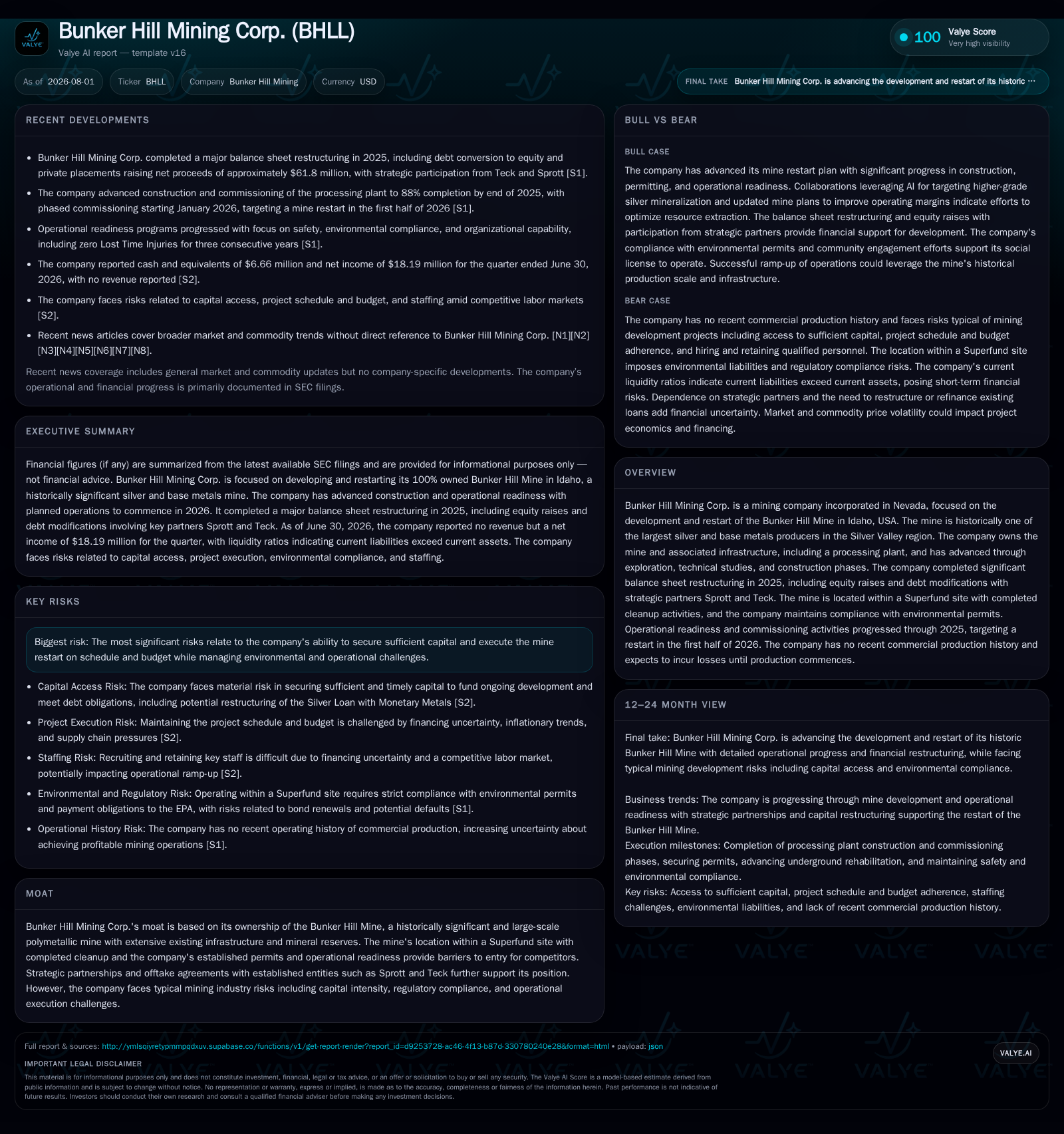
Bunker Hill Mining Corp. is focused on restarting the Bunker Hill Mine in Idaho, leveraging extensive historic infrastructure within a cleaned Superfund site. The company progressed operational readiness through mid-2026, backed by strategic partnerships with Sprott and Teck from a major 2025 capital raise and debt restructuring. However, key risks remain around capital sufficiency to complete restart, repayment or restructuring of its Silver Loan, and maintaining environmental permit compliance. The company operates in the upstream to midstream mining value chain, aiming to produce silver, lead, and zinc concentrates upon mining commencement expected during H1 2026.
Recent Operating Update: Progress Toward Mine Restart
Bunker Hill Mining advanced steadily through its operational readiness program in H1 2026 following extensive construction throughout 2025. The company reported that by year-end 2025 the processing plant construction was approximately 88% complete with commissioning phases initiated in January 2026. Tailings filter press installation proceeded to over half completion supporting the targeted first-half-of-2026 mine restart timeline [S1], [S10]. Underground rehabilitation efforts secured critical access connecting historic workings at key levels including ramp access for initial ore extraction years. Equipment upgrades included a lease-to-own arrangement for Caterpillar underground fleet [S10]. These simultaneous advancements across surface facilities and underground mine infrastructure signal disciplined execution aiming to minimize startup risk.
A noteworthy milestone was the company’s safety leadership culminating in zero Lost Time Injuries (LTIs) for three consecutive years ending 2025—a critical indicator of operational culture in hazardous mining environments. Compliance with all environmental permits was sustained at 100%, crucial given the mine's Superfund designation requiring stringent regulatory adherence [S5]. Community engagement initiatives such as site tours have reinforced local stakeholder confidence.
Despite these positives, recent quarterly filings emphasize persistent financial risks around the company’s Silver Loan facility with Monetary Metals Bond III LLC. The loan requires modification or refinancing to avert default risks that could disrupt planned operations [S2]. Negotiations were ongoing as of July 2026 but lack guarantees of success.
Business Model Analysis: From Historic Asset to Modern Producer
Bunker Hill Mining specializes in the development and planned restart of its flagship polymetallic Bunker Hill Mine located in Idaho’s prolific Silver Valley. The asset base includes both underground mining rights and processing infrastructure formerly utilized when the mine operated heavily between 1885–1981 during which it produced over 165 million ounces of silver plus millions of tons of base metals including lead and zinc [S16]. While historic production offers geological footprint confidence, the company is effectively transitioning from exploration/development phase into midstream extraction and processing segments of the mining value chain.
Revenue generation will arise from concentrate sales comprising primarily silver-lead-zinc products. Monetization leverages existing long-term offtake agreements for base metal concentrates amended recently to cover life-of-mine production rather than just short terms [S14]. This contractual structure mitigates market exposure somewhat but still subjects revenue to commodity price volatility and concentrate grade dynamics.
Operational costs hinge on CapEx finishing construction/refurbishment works and recurring OpEx tied to underground mining cycles along with processing plant operation. Deployment of AI-assisted geological modeling has optimized targeting higher-grade silver mineralization near accessible infrastructure—improving margin potential by focusing mining efforts on richer zones [S5]. Metallurgical testing confirms recoveries exceeding industry averages (89% for silver; ~87% for lead; ~92% for zinc), indicating robust concentrate quality aligning with peer benchmarks such as Hecla Mining's reported recoveries [S5].
However, as a non-producing development-stage miner currently generating no revenues or positive cash flow historically [F1], the company must rely extensively on external financing until commercial production ramps sufficiently. The intricate balance involves managing capital deployment efficiency while avoiding costly delays or overruns common in restart projects.
Industry Context and Competitive Positioning
Operating within the primary silver and base metals mining sub-sector places Bunker Hill amongst peers like Hecla Mining Company and Coeur Mining Inc., who maintain substantial operating histories producing similar concentrates. Unlike these incumbents with active mines generating consistent output, Bunker Hill remains pre-commercial but benefits from inheriting substantial proprietary surface plant assets and underground infrastructure often absent in pure exploration peers.
Their strategic investor consortium including Sprott Streaming & Royalty Corp. (holding nearly 30% direct or partially diluted stake) alongside Teck Resources Limited holding over 10% equity provides not only critical capital but also governance influence [S6]. Such alliances exemplify modern streaming/royalty-financed development models that blend risk mitigation for capital providers with operational upside for developers.
Environmental legacy challenges from the Superfund site designation introduce unique competitive moat elements by creating high entry barriers due to remediation complexity and regulatory oversight [S16]. Maintaining stringent environmental permits without incident evidences management competence that could be leveraged as an advantage versus less established operators seeking similar district-level assets.
Growth Drivers
Primary growth catalyzing factors surround successful execution of mine restart activities enabling transition into production cash flow generation. Rising global demand for silver and base metals driven by industrial applications—including electric vehicles (catalysts require silver) and infrastructure—bolsters project economics if realized during mine ramp-up phases.
Cutting-edge application of AI for geological modeling improves resource targeting reducing waste extraction ratio potentially lowering per-unit cash costs—a significant margin lever given volatile commodity pricing environments [S5]
Strategic partnerships infuse both required capital ($61 million raised via private placements in 2025) and technical expertise facilitating smooth operational scaling [S1]. Offtake amendments extending term to life-of-mine secure longer revenue visibility supporting debt facilities like the revolving standby prepayment facility with Teck valued up to $10 million bearing stepped interest rates dependent on production metrics achievement [S14].
Incremental exploration at adjacent acquired high-grade properties (Ranger Page) offers potential reserve expansion adding optionality beyond initial mine plan horizons [S7]. Continued community engagement fosters social license crucial for regulatory stability moving forward.
Risks and Constraints
Capital sufficiency remains paramount; delays or budget overruns could erode currently available liquidity ($6.7 million cash & equivalents as of mid-2026) against sizeable current liabilities ($23 million) resulting in a suboptimal current ratio (0.49) illustrating working capital pressure [F1]. Uncertainty looms around renegotiating terms or refinancing the restricted Silver Loan from Monetary Metals—the outcome will heavily influence near-term credit health [S2].
Environmental risk persists despite completed cleanup since legacy contamination imposes long-term monitoring responsibilities alongside restrictive permit conditions within a Superfund site—a situation that constrains flexibility and heightens compliance costs relative to greenfield peers [S1],.
Operational execution risks include maintaining momentum through commissioning phases minimizing equipment failure or geological surprises while achieving planned recovery rates at acceptable cost profiles. Failure could delay commercial production indefinitely impacting shareholder value.
Market-side risks revolve around fluctuating silver/base metal prices which directly impact achievable concentrate sales prices affecting projected free cash flows post-production start.
Legal proceedings related to acid mine drainage allegations add an additional layer of contingent liability though current motions dismiss several claims against the company—nonetheless legal outcomes remain uncertain.
What To Watch Next
Short-term focus includes monitoring Silver Loan restructuring talks outcome given this financing instrument's materiality towards sustaining operations beyond initial production phases [S2]. Completion status updates on processing plant commissioning scheduled throughout early to mid-2026 will provide signals on operational readiness progress.
Regulatory reviews especially following any dynamic changes in permits or environmental requirements could alter cost structures or timelines.
Early mining indicators—such as tonnes mined/milled figures announced once production starts—alongside safety metrics like LTIs will serve as critical validations of project execution discipline.
Tracking commodity price movements remains vital since underlying metal prices dictate future cash flow sustainability shaping further financing capacity or reinvestment capability.
Financial Profile Discussion
As of June 30, 2026, Bunker Hill maintains approximately $6.7 million cash balanced against total debt estimated at around $1.4 million from historical disclosures; however working capital remains strained due to current liabilities exceeding $22 million resulting in a low current ratio near 0.49 implying net short-term liquidity pressure if projections are delayed or costs escalate unexpectedly [F1], [S2].
Losses incurred since inception persist reflecting typical pre-production mining companies: operating income loss exceeded $13.5 million in year ending December 31, 2025 illustrating ongoing investment phase expenses without offsetting revenues [F1]. Management has addressed this via substantial equity raises totaling nearly $62 million during two private placement rounds in mid-to-late 2025 featuring cornerstone investments by Sprott Streaming & Royalty Corp. and Teck Resources Ltd., both also providing debt facility amendments improving cost-of-capital profiles through lowered convertible debenture interest rates (down from >7% annually prior amendments to ~5%) [S9],[S11],[S14].
While these steps bolster balance sheet resilience temporarily underpinning completion efforts, much hinges on converting negative free cash flows into sustainable positive operating cash flows once production ramps up post-H1|26 timeline subject to aforementioned execution risks.
This report relies solely on publicly available SEC filings dated through July 31, 2026 () supplemented by numeric facts from company financial disclosures ([F1]). Industry framing draws on general sector knowledge without speculative claims unsupported by direct evidence. No investment research views are provided herein.
Disclaimer: This is research-only, informational analysis and not investment advice. It may include AI-generated interpretation and general industry context. Always verify important details using primary sources.

Comments