
Fresh Del Monte’s Strategic Vertical Integration Spurs Resilience and Growth in Q2 2026
Q2 2026 results reveal how Fresh Del Monte leverages vertical integration and acquisition synergies amid tariff headwinds.
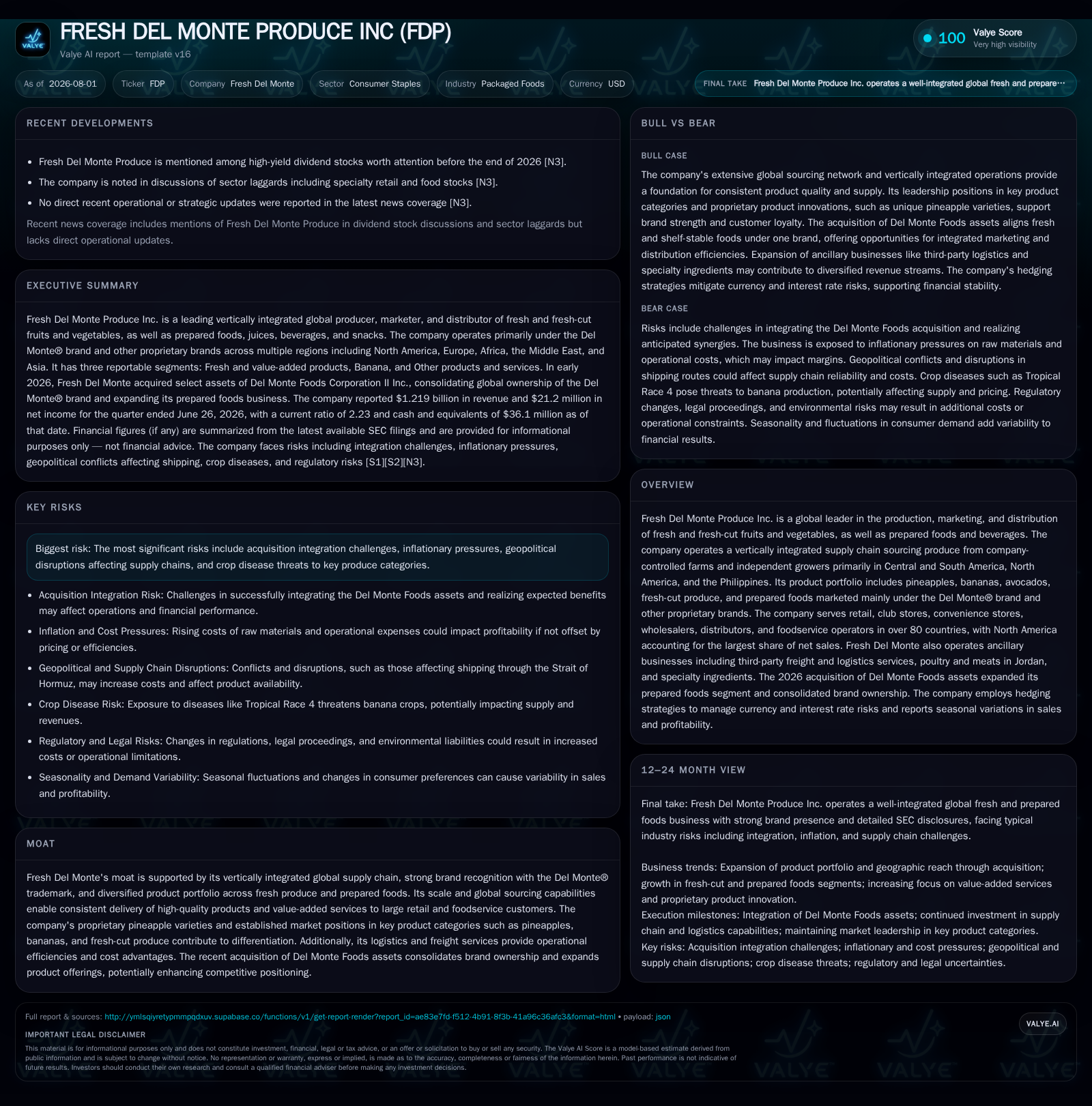
Fresh Del Monte Produce Inc. showcased operational resilience in Q2 2026 by managing inflationary pressures and tariff-related cost increases while progressing with the integration of acquired Del Monte Foods assets. The company’s vertically integrated model, spanning farming to distribution, underpins quality control and supply chain efficiency across a diverse portfolio dominated by branded fresh-cut and prepared foods. Growth is driven by expanding demand for convenient healthy options, with North America remaining the core market. Risks include continued inflationary cost pressures, geopolitical uncertainties affecting sourcing, and the complexity of integrating sizable acquisitions.
Q2 Highlights Reflect Mixed Impacts from Tariffs and Acquisition Integration
Concurrently, the integration of the Del Monte Foods assets — acquired early in 2026 for approximately $285 million plus assumed liabilities — is underway following closing in March 2026 [S1,S3,S10,S20]. This purchase reunites the Del Monte® brand’s fresh produce legacy with its prepared food business after nearly four decades apart. Though not yet fully reflected in quarterly performance metrics or contractual terms, this consolidation is expected to create revenue synergies by aligning branded packaged foods with Fresh Del Monte's existing distribution infrastructure within North America [S1,S3]. The tandem effects of tariff headwinds and acquisition undertakings mark Q2 as an inflection period where near-term margin sensitivity coexists with strategic positioning toward broadening product mix.
Vertically Integrated Operations: Core Competitive Strength Amid Market Complexity
Fresh Del Monte operates an extensively vertically integrated supply chain covering farming (both company-owned and contracted growers mainly in Central/South America and the Philippines), processing (notably fresh-cut fruit/vegetables), packaging, logistics including cold storage/ripening facilities, and marketing predominantly under the Del Monte® brand alongside proprietary labels like UTC® and Rosy® [S1]. This holistic control over value-chain stages supports consistent quality assurance critical in highly perishable categories.
The company's net sales are segmented principally into fresh & value-added products (pineapples, avocados, fresh-cut produce including salads), bananas as a separate unit, and ancillary services such as third-party logistics and specialty ingredient production [S1]. Vertical integration delivers leverage on input costs amid inflationary macro pressures through cost containment in cultivation inputs and supply chain efficiencies. It also enhances responsiveness to seasonality fluctuations by spreading growing locations geographically [S1]. The ability to manage distribution network efficiency across more than 20 North American centers with ripening capabilities reinforces service reliability — a vital metric given perishability constraints.
This integration acts as a defensive moat supporting Fresh Del Monte's leading positions in key fresh fruit categories while underpinning value-added product offerings that command higher margins.
Branded Fresh-Cut Produce Fuels Portfolio Diversification and Channel Reach
A strategic emphasis on fresh-cut produce elevates revenue diversification beyond commodity whole fruits. Fresh-cut products accounted for approximately 20% of total net sales in fiscal year 2025 [S1], highlighted by significant exposure in North America where it comprises roughly two-thirds to three-quarters of fresh-cut fruit and vegetable sales respectively. Additional channels include Europe and Asia with smaller footprints.
These convenience-oriented offerings cater primarily to retail stores (grocery chains), club stores, wholesalers, distributors, and growing foodservice operators seeking ready-to-use healthy options [S1]. The premium nature of branded fresh-cut items allows for better pricing power relative to bulk fruit segments sensitive to commodity price swings.
Moreover, fresh-cut produce's shorter shelf life necessitates superior inventory turnover rates compared with whole fruit lines — an operational focus area tied closely to distribution network efficiency and supply chain lead times controlled by Fresh Del Monte’s vertically integrated infrastructure.
Market Position in Key Categories Supported by Global Sourcing Footprint
Fresh Del Monte claims leading marketing positions in categories fundamental to its scale advantage. It is recognized as the largest marketer of fresh pineapples in the United States as well as a dominant player globally in cornucopias such as bananas — where it ranks third-largest marketer domestically — avocados, and canned fruit segments spanning Europe, Africa, and the Middle East [S1].
The company's geographic diversification extends across critical sourcing hubs: Costa Rica hosts substantial pineapple operations; Guatemala serves as a mainstay banana source; Ecuador contributes notably to the banana supply chain; Mexico accounts for about 11% of North American net sales but carries uncertainty due to evolving trade policies [S1]. This spread buffers against localized adverse weather or crop disease risks intrinsic to tropical farming.
While tariffs currently exempt goods compliant with USMCA agreements (including many Mexican imports), potential shifts in trade policy underscore ongoing vigilance required around sourcing costs impacting gross margin [S1]
Growth Drivers Anchored in Consumer Health Trends and Emerging Markets
Fresh Del Monte's growth thesis aligns organically with expanding global demand for fresh, healthy, convenient food solutions reflecting shifting consumer preferences towards wellness-oriented eating habits. Rising urbanization coupled with increasing disposable income in emerging markets amplifies demand volumes for branded fresh produce and value-added prepared foods.
The company's recent acquisition of prepared food businesses consolidates opportunities for cross-selling across grocery retail chains and foodservice clients leveraging established trademarks such as Del Monte® alongside S&W®, Contadina®, Joyba®, among others [S1,S12].
Capital investments targeting pineapple/banana farm upgrades in Central America alongside expansion plans within fresh-cut processing facilities buttress capacity aligned with projected volume growth drivers [S11]. Additionally, supply chain technology advancements promise improved freshness maintenance through optimized cold-chain logistics – critical for maintaining product quality given perishability constraints.
Risks From Inflationary Pressures, Geopolitical Uncertainty, and Crop Disease
Exposure to ongoing inflationary cost pressures affects all segments including production inputs like labor, fuel for transportation networks, packaging materials, and tariffs impacting imported goods primarily into North America [S1,S2]. While prior price increases have helped counterbalance these expenses so far, failure to sustain selling price adjustments could compress margins if consumer demand proves elastic.
Geopolitical factors imperil supply chains reliant on Central American countries such as Costa Rica or Guatemala due to political instability or regulatory shifts impacting labor availability or export conditions. Similarly vulnerable are crop disease outbreaks affecting fruit yields like Panama disease impacting banana plantations.
Perishability remains an omnipresent risk factor manifesting in inventory shrinkage or spoilage that if unmanaged would reduce inventory turnover ratios critical for operating efficiency.
Finally, integrating the extensive prepared foods portfolio acquired entails execution risk including harmonizing systems/processes while safeguarding customer continuity amid working capital fluctuations noted early post-acquisition [S3,S10].
Execution Milestones: Integration Progress and Managing Supply Chain Dynamics
Closing on March 19, 2026 finalized Fresh Del Monte’s purchase of select assets from Del Monte Foods Corporation II Inc., marking completion of a significant transformational milestone [S3,S20]. The alignment facilitates cross-channel strategy coherence under unified ownership of the Del Monte® trademark across fresh produce and packaged products – a notable strategic repositioning after four decades of brand segmentation
Efforts now concentrate on capturing operational synergies via leveraging existing distribution networks primarily within North America while managing inventory flows given varying production cycles between perishable fresh lines versus shelf-stable canned or refrigerated goods included in new offerings [S3,S10]. Maintaining customer service levels during this transition remains essential.
Supply chain initiatives also focus on narrowing lead times enabled by vertical integration advantages including direct farm-to-distribution center routing minimizing spoilage windows.
Financial Profile Discussion
As of June 26, 2026, Fresh Del Monte's balance sheet shows cash and cash equivalents of approximately $36 million, total debt near $426 million, and net debt around $390 million [F1]. The current ratio stands at a healthy 2.23 times, reflecting solid working capital and liquidity to support ongoing strategic initiatives and seasonal demands [F1]. No material changes in contractual obligations were reported as of this date, indicating a stable capital structure accommodating planned capital expenditures primarily aimed at capacity expansions across core production areas [S11,F1]. This financial position provides a foundation for managing macroeconomic cost pressures and pursuing opportunistic investments or deleveraging depending on cash flow generation going forward.
Disclaimer: This is research-only, informational analysis and not investment advice. It may include AI-generated interpretation and general industry context. Always verify important details using primary sources.

Comments