
Olenox Industries’ Modular Expansion Faces Liquidity and Integration Tests
Latest filings reveal Olenox’s dual challenge of scaling modular construction with proprietary technology while managing significant financial strain and subsidiary restructuring.
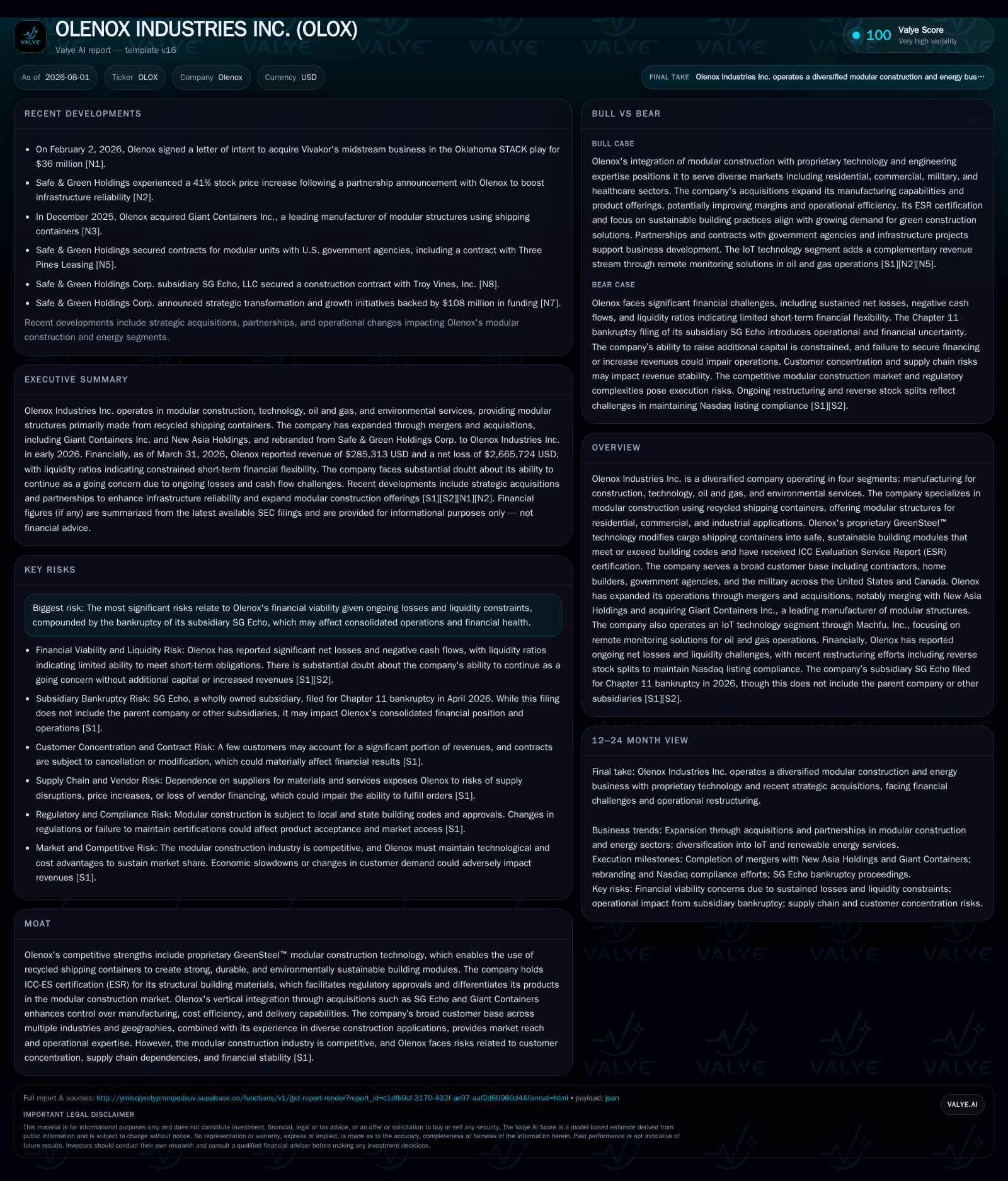
Olenox Industries continues to build out its modular construction business leveraging patented GreenSteel™ technology and strategic acquisitions to gain vertical manufacturing control. However, its latest quarterly report underscores substantial liquidity pressures and operational risks intensified by the bankruptcy of its former supply chain subsidiary SG Echo. The company’s diversified operations across construction, oil and gas, and technology provide growth opportunities but also amplify complexity. Key near-term indicators such as order backlog stability and cash flow generation will be critical to assess execution progress amid ongoing financial distress.
Latest Quarterly Developments Hint at Dual Growth and Survival Challenges
Olenox Industries’ most recent quarterly report filed July 31, 2026 confirms a continuation of previously disclosed risks with no material changes but reinforces the precarious balance between expanding its modular construction footprint and addressing severe liquidity constraints [S2]. The company recorded ongoing net losses while integrating major acquisitions including Giant Containers Inc., which took over supply chain roles formerly held by SG Echo—now bankrupt and under Chapter 11 restructuring [S1][S16][S19]. Cash flow pressures remain acute with limited working capital evidenced by a dangerously low current ratio of approximately 0.05 as of March 2026 [F1], underscoring significant near-term funding needs.
Further signaling financial scrutiny enhancement, Olenox appointed Kimberly Hawley as interim Chief Financial Officer in July 2026, bringing deep experience in energy infrastructure finance and corporate integrations; this management change may stabilize internal controls during complex operational shifts [S3]. These developments create a clear tension: Olenox is advancing its scale via vertically integrated modular manufacturing yet faces existential threats related to financing shortfalls.
Modular Business Model: Proprietary Technology Meets Operational Control
Olenox’s core revenue engine is modular structures manufacturing based on recycled shipping containers adapted through its proprietary GreenSteel™ technology — an engineering approach that sustains structural integrity while maximizing environmental sustainability. These modified cargo container modules serve diverse applications including residential housing, commercial buildings, military storage facilities, and power generation enclosures across the United States and Canada [S1]. The significance lies in Olenox securing ICC Evaluation Service Report (ESR) certification for GreenSteel™, which assures compliance with stringent building codes and facilitates regulatory acceptance critical in the fragmented US construction market.
Historically relying on a royalty licensing model for its residential products until mid-2021 when that exclusive license was terminated, Olenox pivoted back to direct manufacturing under full operational control [S1]. This shift reflects an industry-recognized trend favoring vertically integrated fabrication facilities over licensing due to tighter margin capture and supply chain reliability. The challenge for Olenox is ramping manufacturing capacity utilization quickly enough to meet growing order backlogs while maintaining quality—a key operating KPI for peer firms like Katerra and Modular Building Systems.
Vertical Integration Strategy: Acquisitions Reshape Manufacturing Backbone
The acquisition strategy culminated with the December 2025 purchase of Giant Containers Inc., a seasoned manufacturer specializing in container-based modular structures with longstanding presence in North American markets. This move replaces SG Echo’s former supply chain services following its bankruptcy declaration in April 2026 under Chapter 11 protection amid $4 million accelerated debt obligations [S16][S19][S20]. By internalizing production capabilities through Giant Containers and merging New Asia Holdings subsidiaries, Olenox gains more direct control over component sourcing, design engineering, production scheduling, and delivery logistics.
While vertical integration typically improves gross margins by reducing external supplier markups and strengthens delivery reliability essential under tight project timelines typical in construction contracts, it also amplifies capital expenditures and administrative complexity—material concerns for a company already facing financial strain. Successful synergy realization will depend heavily on seamless operational consolidation across multiple acquired entities within a volatile construction industry context.
Industry Context: Competitive Dynamics in Modular Construction and Energy Services
Olenox’s four-segment business model spans modular construction, technology-enabled monitoring solutions for oil & gas operations, direct oil & gas production assets, and environmental services supporting energy extraction sites. The modular construction industry overall is sensitive to economic cycles affecting real estate investment flows and benefits structurally from trends toward faster building methods with reduced carbon footprints.
Within this niche domain of shipping container modification—a specialty typified by innovative players such as Modular Building Systems Inc.—Olenox differentiates itself through ICC ESR certification-backed GreenSteel™ technology which addresses building code hurdles that can delay competitor projects. Yet it still faces competitive pressures from larger integrated contractors or emerging prefab manufacturers who may lack such certifications but offer scale or pricing advantages.
Energy services exposure adds cyclicality linked to commodity price swings common among Halliburton- or Schlumberger-like peers; meanwhile, IoT-based remote monitoring solutions place Olenox adjacent to industrial tech market segments represented by Honeywell or Siemens—industries marked by rapid innovation but requiring scale economies to break even efficiently.
Growth Catalysts: Sustainability Demand, Government Contracts, and Technology Adoption
Demand drivers include accelerating adoption of environmentally sustainable building materials partly pushed by regulatory incentives for green construction. Olenox’s recycled container modules feed directly into this trend appealing to architects, builders, government agencies (including military installations), who require rapid deployment coupled with code compliance facilitated by firm certifications [S1]. Government infrastructure stimulus programs further underpin potential contract pipelines.
Moreover, Olenox’s technology segment harnesses Internet of Things (IoT) advances offering turnkey solutions for remote monitoring of energy assets—a service increasingly crucial in oil & gas fields seeking cost-efficient surveillance to reduce downtime. Expansion into renewable energy services within the environmental segment aligns with broader energy transition market dynamics promoting clean fuels alongside conventional hydrocarbon production.
Realization of these growth avenues depends on continued booking momentum as tracked by order backlog size and contract renewal rates—critical KPIs reflecting sales pipeline strength versus conversion challenges under current liquidity constraints.
Risk Factors Amplified by Liquidity Bottlenecks and Subsidiary Bankruptcy
Foremost risk is Olenox’s fragile liquidity profile highlighted repeatedly in disclosures: annual net losses approaching $18.8 million for calendar year ended December 2025 compounded by cash burn exceeding $7.8 million operationally that fiscal year [F1][S9]
Additionally, current assets of approximately $1.2 million versus current liabilities near $24.6 million as of March 2026 imply a critically depressed current ratio around 0.05, signaling extreme working-capital stress risking vendor payment delays that could disrupt supply chains vital for meeting delivery commitments in modular construction projects—an industry where timing precision matters greatly [F1]. Concentrated customer bases expose vulnerability if major clients curtail order volumes unexpectedly—a common risk amidst cyclical economic downturns affecting real estate development or energy capex budgets.
Absent meaningful capital inflow or swift jump in profitable contract execution cadence evidenced through positive operating cash flow metrics next quarters might force further operational cutbacks or restructuring—the risk flagged explicitly by auditors doubting going concern viability [S1].[F1]
Forward Indicators: Backlog, Contract Pipeline, and Management Changes to Watch
Investors should keep close tabs on backlog fluctuations reported post-acquisition since backlog figures serve as leading indicators for forthcoming revenues but remain vulnerable to contract suspensions or renegotiations typical in this sector owing to shifting customer priorities or financing conditions [S24]. Equally pivotal will be assessing integration success post-Giant Containers acquisition—possible early signals include manufacturing capacity utilization rates rising without concomitant increases in warranty claims liabilities—a metric often overlooked but impactful on margins.
Meanwhile the appointment of Kimberly Hawley as interim CFO embeds leadership experienced in complex mergers & acquisitions alongside capital markets navigation suggestive of focused management efforts on financial stabilization [S3]. How effectively this new stewardship translates into better liquidity outcomes will crystallize through free cash flow trends.
Financial Profile Discussion: Balance Sheet Strain Amid Capital-Intensive Expansion
Olenox Industries presents a classic case study of capital-intensive expansion straining fragile financial footing. As of Q1 2026 balance sheet data shows total debt around $10.1 million against cash balances near $3 million yielding net debt approximating $7 million—significant leverage given small asset base relative to liabilities coupled with very constrained current assets versus liabilities resulting in near-impossible short-term liquidity coverage ratios (~0.05) [F1].[S2]
Operating losses nearing $19 million annually illustrate difficulty generating sufficient profits necessary not only to service debt but also invest adequately in growth initiatives such as ramping modular production lines or scaling IoT platforms [F1]. These factors jointly underpin auditor concerns about ongoing going concern status disclosed earlier in annual filings [S1], highlighting urgent need for capital raises or operational turnaround.
Two major rounds of reverse stock splits effected since May 2024 underscore attempts to stabilize equity structure amid dilutive financings that echo common challenges faced by smaller modular manufacturers aiming at scale yet hampered by inherent cyclical demand volatility plus material working capital demands from project-based businesses [S5]
Without swift improvement either via profitability gains evidenced through margin expansion at modular manufacturing or successful monetization ramp-up in technology services business units Olenox remains exposed to heightened refinancing risk which could trigger dilution events or forced asset divestitures.
This analysis synthesizes public SEC filings up to July 31, 2026 alongside established sector knowledge to evaluate Olenox Industries' current strategic positioning. This content does not constitute investment advice but serves to inform stakeholders about key operating challenges balanced against growth aspirations grounded in proprietary technology adoption within a highly competitive capital-intensive environment.
Disclaimer: This is research-only, informational analysis and not investment advice. It may include AI-generated interpretation and general industry context. Always verify important details using primary sources.

Comments