
Corteva's Strategic Spin-Off and Innovation Drive Amid Steady Agriculture Inputs Demand
Corteva reports solid Q2 2026 earnings while progressing with the planned seed business spin-off and maintaining strong R&D investment in crop protection.
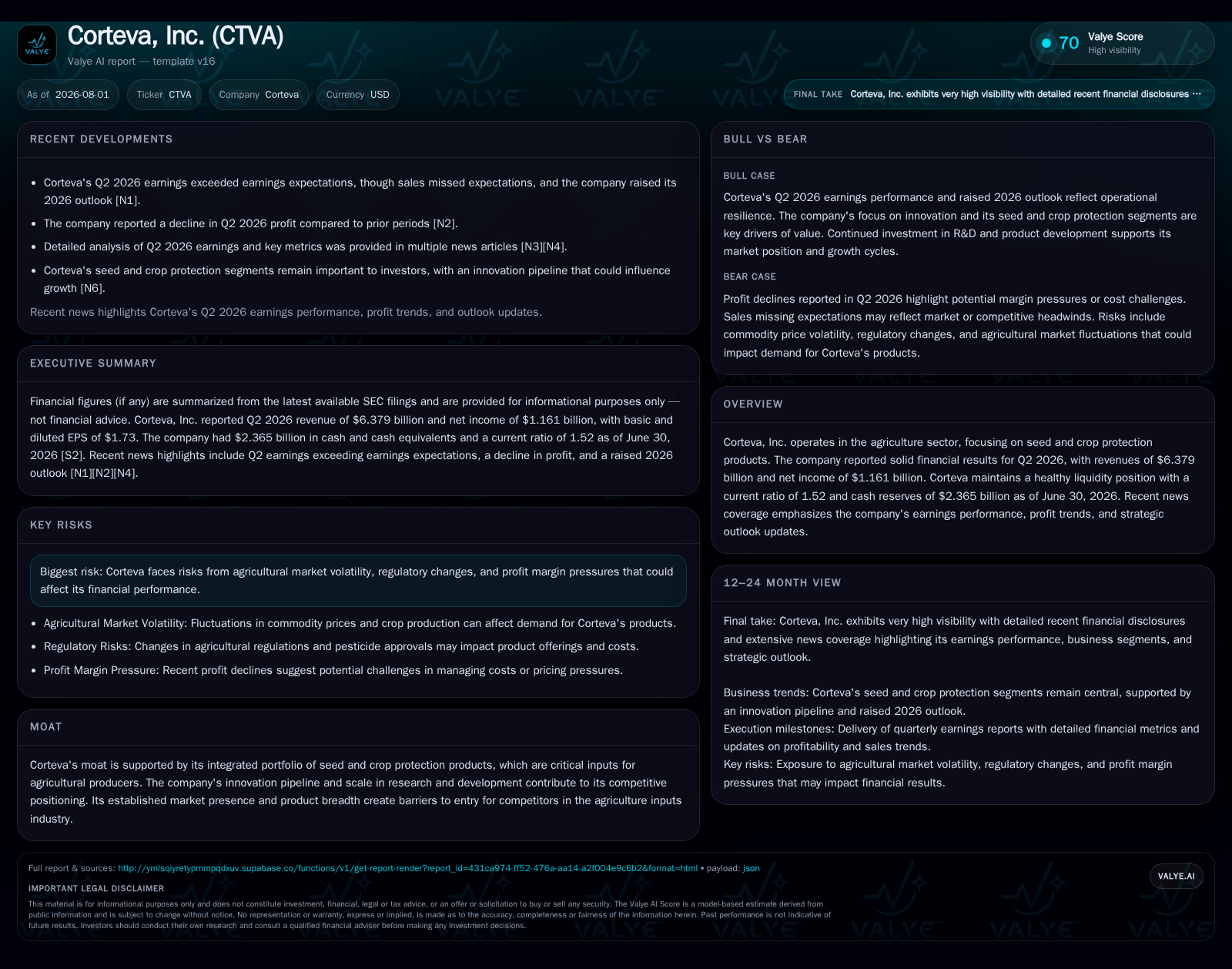
In its latest quarterly filing, Corteva disclosed $6.379 billion in Q2 revenues and $1.161 billion in net income, underscoring steady demand for its seed and crop protection products. The company continues its planned spin-off of the seed business, expected to create two focused public entities, while reinforcing competitive advantages through integrated product offerings and a robust innovation pipeline. Regulatory headwinds and agricultural market volatility remain notable risks, balanced by diversification across key geographies and commitment to sustainable agriculture. Corteva’s liquidity position supports operational flexibility as it navigates a capital-intensive industry landscape.
Recent Operating Update: Q2 2026 Results Anchor Near-Term Outlook
Corteva reported Q2 2026 revenues of $6.379 billion alongside net income of $1.161 billion—a margin profile suggesting resilient demand despite commodity price fluctuations that commonly affect farmer purchasing decisions [S2][N1]. The earnings beat consensus estimates but margins showed signs of pressure due to input cost inflation and competitive pricing dynamics noted in crop protection segments. Importantly, liquidity remains robust with $2.365 billion cash on hand and a current ratio of 1.52 as of June 30, highlighting financial flexibility during ongoing agricultural sector cyclicality [F1].
The quarter also reflected management’s continued focus on strategically preparing for the announced spin-off of the seed business into a standalone public entity named Vylor Inc., designed to foster sharper portfolio focus for both resultant companies [S16][S22]. This separation aims to allow each entity to optimize resource allocation tailored to their respective market demands—seed genetics innovation versus agrochemical product development.
Business Model: Integrated Seed Genetics and Crop Protection Ecosystem
Corteva’s revenue base derives predominantly from selling genetically optimized seeds alongside herbicides, insecticides, and fungicides—critical inputs purchased mostly by commercial farmers through established distributors and cooperatives that serve as primary channels [S1]. Revenue growth depends on hectares planted with Corteva seeds as well as adoption rates of new genetic traits that improve yield resilience under variable climate conditions.
Simultaneously, crop protection sales follow seasonal cycles aligned with crop planting windows; farmers’ demand elasticity is influenced by commodity prices (corn, soybeans), weather uncertainty, and evolving pest resistance patterns demanding newer chemical formulations or biological solutions [S1]. Corteva strategically invests heavily in R&D—allocating significant budget portions to develop next-generation seeds with improved genetics plus proprietary agrochemical formulations addressing both efficacy and sustainability targets
Margins hinge on product mix quality (premium seeds versus commoditized varieties), pricing leverage from patented traits or exclusive chemical compounds, manufacturing efficiency, and supply chain stability to avoid costly stockouts or inventory build-ups.
Industry Structure and Competitive Position
The agriculture inputs industry is capital- and research-intensive with high barriers erected through intellectual property protections around seed genetics patent portfolios and chemical formula registrations subject to stringent legislative approvals. Corteva competes with integrated agribusiness giants like Bayer Crop Science—known for spectrum-wide inputs—and Syngenta (ChemChina), each emphasizing global geographic coverage and diversified product pipelines.
Corteva’s moat is reinforced by its breadth across both seeds and crop protection chemicals which enables bundled offering strategies for growers seeking integrated solutions rather than piecemeal purchases. The split via spin-off could sharpen these focuses but also exposes each company to concentrated risk profiles characteristic of narrower specialization.
Research-driven new product introductions serve as differentiation vectors; ongoing pipeline health akin to biotech breakthroughs directly correlates with longer-term market share gains. Regulatory compliance consistency in major jurisdictions (U.S., Latin America) further strengthens competitive resilience.
Growth Drivers
Several structural factors underpin Corteva’s medium-to-longer term growth prospects:
- Global Population Growth & Food Demand: Rising food consumption requires higher yields per acre where advanced seed genetics play a vital role.
- Seed Trait Adoption: Increasing penetration of genetically modified crops resistant to pests/disease enhances repeat customer retention.
- Rising Crop Protection Usage: With evolving pest challenges due to climate change, demand intensifies for novel herbicides/insecticides.
- Emerging Market Expansion: Agricultural modernization in Latin America and Asia offers new acreage for product deployment.
- Sustainability & Precision Agriculture: Innovations targeting environmental impact mitigation attract subsidies/government support facilitating market acceptance.
These factors translate into measurable KPIs such as volume growth in seeds sold (number of hectares implanted), increase in treated acres using Corteva’s crop protection solutions, R&D spending intensity preserving innovation leadership, successful regulatory clearances enabling new launches, and improving gross margins driven by premiumized product mixes [S1]
Risks and Constraints
Regulatory uncertainty remains prominent; funding cuts or staff limitations at regulatory bodies like EPA or USDA risk elongating approval timelines which can delay commercialization cycles impacting revenue inflows [S23][S26]. Additionally:
- Commodity price volatility affects farmer incomes creating erratic purchasing behavior.
- Patent expirations open doors for generic competition eroding pricing power.
- Environmental regulations increasingly constrain agrochemical usage forcing reformulations increasing R&D costs.
- Supply chain perturbations globally pose raw material shortages affecting production scheduling.
- The complexity inherent in executing the strategic spin-off imposes short-term execution risk including potential loss of key personnel or customer disruption [S27][S28]
What To Watch Next
Key near-term milestones include:
- Progress milestones on the tax-free spin-off completion timeline creating Vylor Inc., closely watched by investors for clarity on operational independence impact [S16][S22].
- Updates on regulatory approval status of new seed traits or crop protection formulations signal pipeline health translating into future revenues [N14].
- Volume trends monitored via quarterly bookings or distributor sell-in data indicating market adoption trajectories especially in emerging markets or major U.S. corn/soybean belts.
- Margin performance reflecting pricing power stability or cost inflation pass-through effectiveness during escalating input cost environments.
Additionally, monitoring competitor launches by Bayer or Syngenta will provide context on Corteva’s relative innovation momentum amid rapid technology cycles intrinsic to this sector.
Financial Profile Discussion
Corteva displays solid financial health supportive of its capital-intensive model: the current ratio stood at 1.52 as of June 30, showing adequate short-term asset coverage over liabilities which is crucial given working capital demands driven by inventory cycles aligned seasonally with planting schedules [F1]. Liquidity reserve totaling $2.365 billion ensures sufficient buffer for capex related to manufacturing assets or potential bolt-on acquisitions enhancing product portfolio breadth or geographic reach.
While total long-term debt figures are historical (approximately $1.53 billion circa early 2019), net debt appears modestly negative given cash holdings exceeding current outstanding debts suggesting flexibility ahead of anticipated corporate restructuring following the spin-off process [F1]. Cost control measures supported operating margins sustainably even with pressures from commodity-linked raw material costs.
This analysis synthesizes publicly filed SEC disclosures through July 31, 2026 ([S1],[S2],[S3]), corroborated with several contemporaneous news summaries ([N1],[N13],[N14]) without speculative forward-looking statements beyond disclosed guidance.
Disclaimer: This is research-only, informational analysis and not investment advice. It may include AI-generated interpretation and general industry context. Always verify important details using primary sources.

Comments