
Blue Owl Capital’s Fee Stability Anchored by Permanent Capital Amid Litigation Risks
Blue Owl Capital maintains robust AUM growth and fee resilience through its diversified alternative asset platforms, while navigating emerging litigation challenges.
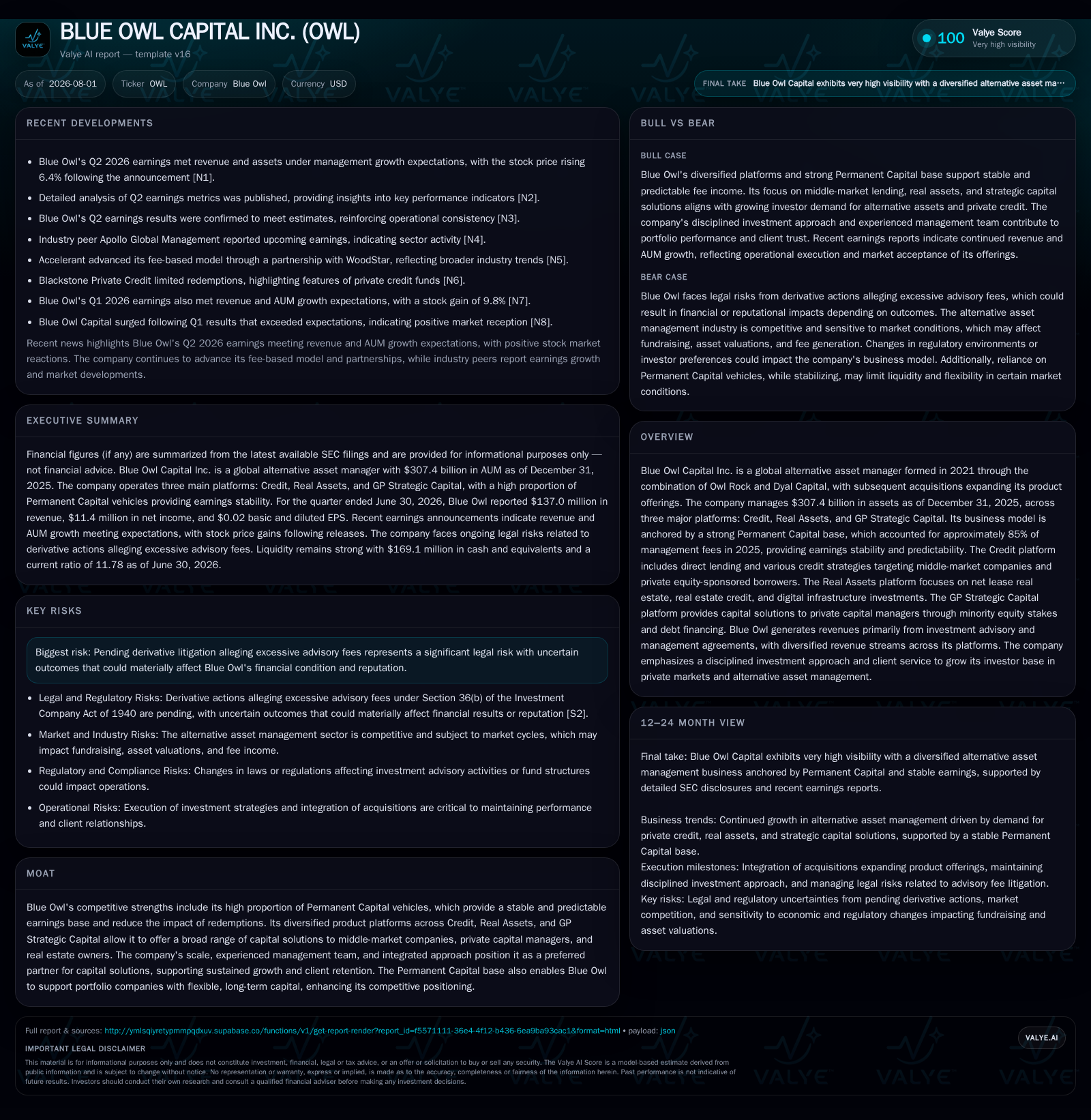
Blue Owl Capital reported stable second-quarter 2026 performance reflecting solid growth in its credit and real assets platforms, driven by recurring fees from a predominantly permanent capital base. The company’s business model leverages diversified capital solutions across private credit, real assets, and GP strategic investments, offering earnings stability that compares favorably with peer alternative asset managers. However, new derivative lawsuits alleging excessive advisory fees introduce legal uncertainties that could affect financial results and reputation. Key growth drivers include embedded fee expansion in current AUM, continued fundraising success, and broadened product offerings through recent acquisitions.
Recent Operating Update
The company’s reliance on Permanent Capital vehicles continues to provide a predictable earnings base, with roughly 85% of management fees coming from these structures as of year-end 2025 [S1]. These vehicles generally feature indefinite terms and substantial lock-up periods, insulating Blue Owl's fee income from redemption pressures that can destabilize other alternative asset managers reliant on traditional fund structures.
On July 30, 2026, Blue Owl announced a quarterly cash dividend of $0.23 per Class A share payable in late August [S3], consistent with its pattern of steady dividend growth aligned to distributable earnings and reinforcing shareholder return discipline [S8].
Notably, the quarter included disclosure of derivative litigation alleging violations of fiduciary duty related to advisory fees collected by Blue Owl’s subsidiaries under Section 36(b) of the Investment Company Act [S2]. The company contests these claims vigorously but acknowledges uncertainty around timing and ultimate financial impact. This litigation adds a layer of legal risk potentially affecting investor confidence if outcomes prove adverse.
Business Model Overview
Blue Owl Capital operates as an integrated alternative asset manager with three core platforms: Credit, Real Assets, and GP Strategic Capital [S1]. It manages over $307 billion in assets under management (AUM), serving primarily institutional clients such as pension funds, endowments, foundations, family offices, insurance companies, high-net-worth individuals via wealth managers, and private wealth clients.
Revenue primarily derives from management fees charged as a percentage of fee-paying assets under management (FPAUM), supplemented by performance fees contingent on investment profits [S1]. The prevalence of permanent capital structures—such as interval funds and non-traded REITs—provides Blue Owl with long-duration fee streams that contrast with shorter-dated traditional closed-end funds whose revenues fluctuate more markedly with fundraising cycles and redemptions.
Blue Owl’s Credit platform centers on private credit including direct lending to middle-market companies sponsored by private equity firms. Complementary strategies cover alternative credit sources underserved by conventional lenders, investment-grade credit tailored for insurance clients emphasizing capital efficiency and regulatory compliance, liquid credit focusing on broadly syndicated loans via CLO vehicles, plus specialty areas like biopharmaceutical investments under “Other” credit strategies [S1].
The Real Assets platform encompasses net lease real estate—exclusively single-tenant properties often held in perpetual structures—real estate credit products focused on lending secured by commercial properties, and digital infrastructure targeting telecommunications towers, cell sites and data centers [S1]. This division has grown through strategic acquisitions such as IPI Partners acquiring digital infrastructure capabilities [S1].
GP Strategic Capital provides minority equity investments into large private capital managers themselves—capital solutions for private equity firms which benefit from Blue Owl's advisory experience and capital deployment expertise [S1]. This platform contributes to diversification across more fee-stable equity stakes versus pure fee-for-service models.
This tripartite platform diversification helps Blue Owl mitigate concentration risks endemic to many alternative asset managers who may rely heavily on one product line or client type. Each platform monetizes assets differently but collectively sustains fee-related earnings (FRE) stability—a key performance metric in the sector reflecting recurring revenue quality and margin resilience.
Industry Structure and Competitive Position
Within the broader alternative asset management ecosystem populated by players like Apollo Global Management, Blackstone Group, and Ares Capital Corporation, Blue Owl's visible strength is its scaled permanent capital footprint comprising roughly $188 billion of FPAUM within total AUM noted at year-end 2025—a substantial base supporting stable recurring fees [S1]
Peer firms vary significantly in their balance between permanent capital strategies versus traditional closed-end funds or hedge fund vehicles. Blue Owl's predominance (>85%) permanent capital revenue contrasts with firms where fund redemptions materially affect financial results quarterly.
Its integrated platform offering spanning private credit (especially middle market direct lending), real estate/net lease specialization augmented recently by digital infrastructure expertise through acquisitions such as IPI Partners enhances product breadth appealing to diversified institutional mandates focused on yield and stable income alternatives.
Despite intense competition for institutional mandates amid macroeconomic uncertainty—where fee pressure is common—Blue Owl’s alignment towards long-term locked-up capital underpins more predictable top-line cash flows relative to industry dynamics reliant on cyclic fundraising success or performance fee volatility.
Regulatory scrutiny over advisory fees remains a shared sector challenge heightened recently by derivative actions naming major managers—including Blue Owl’s subsidiaries—as defendants alleging excessive fees under fiduciary statutes. The outcome can influence reputational standing, pricing power negotiations, and invite heightened disclosure expectations industry-wide [S2],[S6].
Growth Drivers
Growth at Blue Owl is driven primarily by three vectors:
Embedded Fee Growth: With ~$28.4 billion of AUM not yet paying fees but expected to convert fully into fee-paying status upon deployment or contract activation—the company anticipates over $326 million of incremental annualized management fees once fully realized [S1]. This mechanism creates recurring revenue growth without requiring proportionate net new capital raising.
Fundraising Success: Management’s established track record supports continued inflows into permanent capital vehicles from institutional investors seeking alternatives beyond public markets amid low-yield environments globally.
Strategic Acquisitions: Recent deals such as those expanding digital infrastructure (IPI Acquisition), insurance-focused asset management (KAM Acquisition), and healthcare venture strategies (CHI Acquisition) broaden product offerings enabling cross-selling opportunities and higher wallet share penetration within existing client bases while attracting new investor segments [S1],[S23].
Additionally, macro trends favoring alternatives across pension funds aiming for portfolio diversification heighten demand for private credit solutions where Blue Owl maintains differentiated origination capabilities.
Risks / Watchpoints / Growth Constraints
Notwithstanding stable operating fundamentals Blue Owl faces multi-dimensional risks:
- Legal/Litigation Uncertainty: The pending Section 36(b) lawsuits allege breaches concerning advisory fee excessiveness by subsidiary entities – potential financial liability or settlements could be material though timing remains unclear [S2]. Such proceedings also generate reputational risk impacting investor confidence or contract renegotiations.
- Market & Credit Risk: Valuations depend heavily on underlying portfolio health especially within leveraged loans or real estate sectors susceptible to interest rate shifts or economic slowdown impacts.
- Redemption & Liquidity Constraints: While permanent capital reduces near-term redemption risk versus frequent open-ended funds; sizeable redemptions beyond historic norms or regulatory changes impacting lock-up enforcement could disrupt earnings reliability.
- Competition & Fee Pressure: Increasing investor sophistication alongside incumbent competitor scale may compress margins or require enhanced service innovations to retain capital inflows.
- Dependence on Key Personnel: Blue Owl’s business model depends critically on experienced investment teams coordinating complex multi-strategy deployment; talent retention challenges persist across alternatives industry.
- Operational & Regulatory Complexity: Managing multiple global products for diverse investor bases requires robust compliance frameworks; any lapses could elevate regulatory intervention risks.
- Economic Cyclicality: While alternatives generally exhibit structural growth trends; economic downturns influence fundraising velocity and portfolio performance intermittently impacting revenue leverage.
Monitoring derivatives litigation developments alongside quarterly AUM composition shifts will be critical indicators of potential earnings impact or strategic recalibrations ahead.
What to Watch Next
Investors should focus on forthcoming quarterly disclosures updating net new asset flows across all platforms—including conversion progress from non-fee-paying pools—and any commentary around litigation timeline developments [N1],[N2],[N3],[S3]. Fundraising announcements involving new permanent capital vehicle launches or strategic partnership expansions would reinforce embedded medium-term growth outlooks.
Also relevant will be further detail on margin trends in FRE—particularly if arising operating expense inflation pressures alter profitability metrics relative to peer groups—and liquidity position adjustments amid debt refinancing or share repurchase activity [F1],[S7],[S8]. Given rising allocations toward digital infrastructure investments globally validating the IPI acquisition rationale will warrant attention too.
Financial Profile Discussion
As of June 30, 2026, Blue Owl reported cash & equivalents of approximately $169 million with total debt standing near $3.8 billion resulting in net debt around $3.64 billion—indicative leverage consistent with large-scale alternative asset managers relying partially on credit facilities for acquisition financing support [F1]
Management emphasizes operating cash flow generation stemming principally from predictable management fees making periodic revolver draws infrequent except opportunistic acquisitions or working capital timing gaps [S4],[S7]. Dividend policy targets progressive increases aligned with distributable earnings growth underscoring confidence in sustainable cash generation despite external macroeconomic volatility factors [S5],[S8],[N3].
The scale of total AUM ($307 billion+) coupled with high-margin permanent capital FPAUM ($188 billion+) supports high FRE margins which nonetheless face short-term headwinds integrating acquired platforms’ cost bases fully while offsetting potential adverse impacts from legal proceedings should outcomes widen beyond accrual estimates [S1],[F1],[N2].
Disclaimer: This is research-only, informational analysis and not investment advice. It may include AI-generated interpretation and general industry context. Always verify important details using primary sources.

Comments