
Linde PLC Surpasses Growth Estimates with Strategic Pricing and Volume Expansion
Linde’s Q2 2026 results underscore resilience through disciplined pricing, volume growth, and targeted capital deployment amid inflationary pressures.
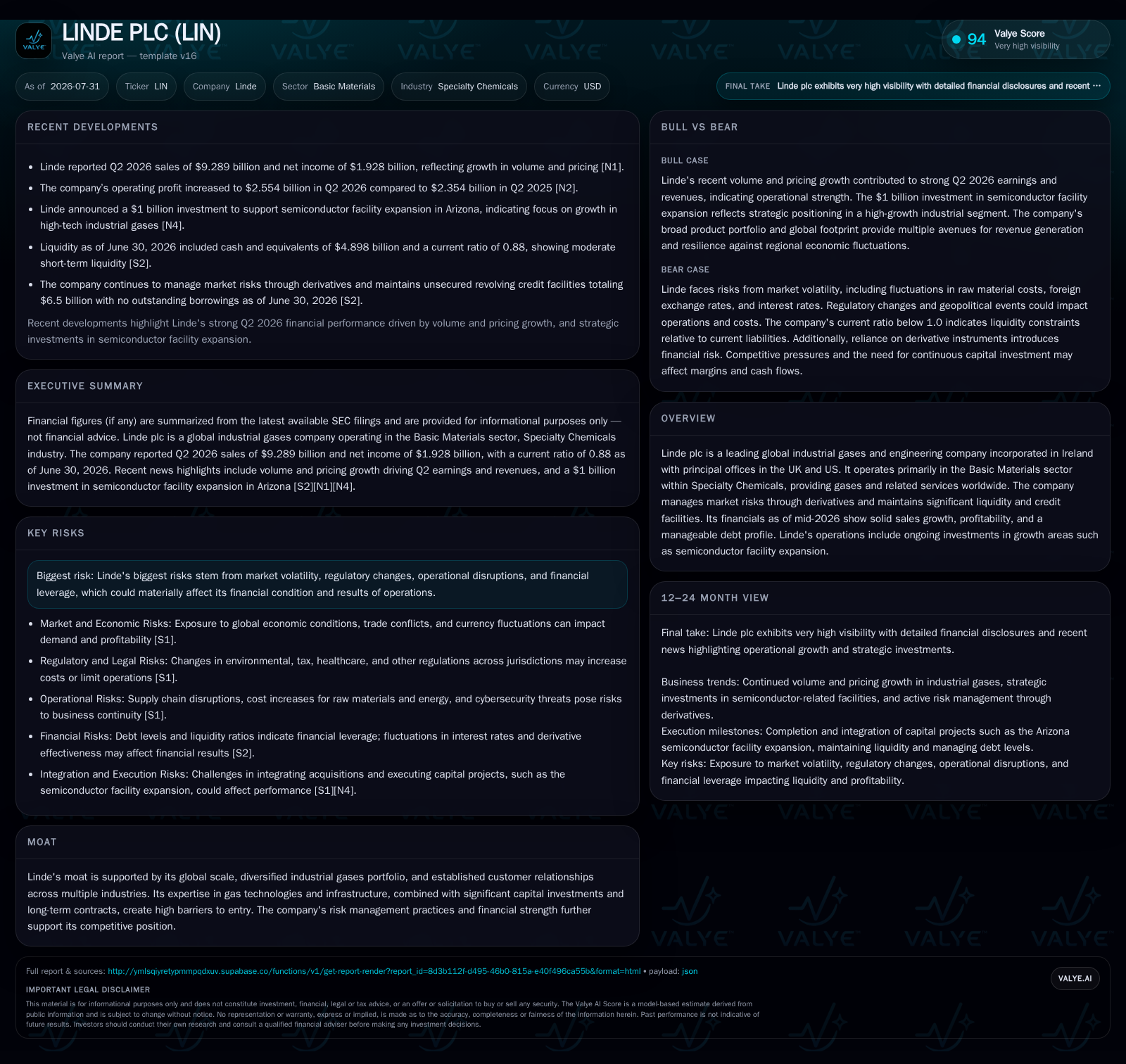
Linde PLC delivered a robust second-quarter performance marked by a 9% sales increase driven by higher price per unit and volume expansion across key industrial end markets. Strategic cost pass-through mechanisms and productivity gains enabled margin resilience despite inflationary energy costs. The company is advancing a $1 billion capital investment program to support semiconductor facility expansion, reflecting its focus on growth in high-tech sectors. Ongoing contract renewals and capacity utilization will be critical near-term markers to watch.
Q2 Operating Momentum Through Pricing Power and Volume Expansion
Linde PLC reported second-quarter sales of $9.29 billion in 2026, a 9% increase from the prior-year period driven primarily by volume growth (2%), price/mix improvements (2%), cost pass-through (1%), currency translation (2%), and acquisitions (1%) [S9]. Volume expansion spanned key end markets including electronics, manufacturing, chemicals, and energy sectors—highlighting resilient demand even amid macroeconomic uncertainty. Notably, pricing discipline supported higher average price per unit of industrial gases sold, consistent with Linde’s contractual strategy emphasizing volume-based charges blended with fixed fees that allow timely cost recovery through escalators.
Despite persistent inflationary pressures on raw materials and notably energy costs—an acute expense component in cryogenic air separation and gas liquefaction processes—Linde managed to sustain an operating profit increase of 8%, reaching $2.55 billion [S9]. On an adjusted basis excluding merger-related accounting effects, operating margin was a robust 29.5%, modestly below the prior year’s 30.1% but reflecting effective margin management through productivity initiatives and cost pass-through clauses embedded in long-term contracts [S11]. This combination of volume leverage with pricing power underscores the durability of Linde’s industrial gases business model amid cyclical volatility.
Long-Term Contracts, Engineering Services, and Cost Pass-Through Mechanisms Bolster Margins
Linde’s operations integrate bulk gas delivery via pipeline infrastructure alongside on-site gas generation facilities—both underpinned by long-term supply agreements typically spanning multiple years or decades [S1]. These contracts not only secure steady volumes but also incorporate cost pass-through mechanisms facilitating adjustments for fluctuations in energy prices or raw material input costs without eroding margin performance materially. The company further offers engineering services related to design, installation, maintenance, and technology upgrades for client facilities; while representing a smaller share of revenue than core gases, these services contribute meaningfully to operating profit due to their higher margin profile and recurring nature [S1,S2].
The ability to offset inflationary pressures through contractual escalators combined with ongoing operational efficiency efforts has allowed Linde to maintain stable margins despite heightened global energy price volatility—a key risk factor highlighted consistently in recent filings [S14,S26]. Operational KPIs such as contract renewal rates remain critical monitorables as they validate customer retention under evolving pricing environments.
Strategic Capital Deployment Targeting Semiconductor End Market Growth Opportunities
Reflecting the secular growth potential in semiconductor manufacturing—a customer segment demanding ultra-high purity gases with precise delivery standards—Linde announced a $1 billion investment commitment to expand production capacity supporting semiconductor fabrication facilities in Arizona [N10,S2]. This capital expenditure is emblematic of the capital-intensive nature of the industrial gases sector where significant upfront investments in advanced cryogenic plants, pipeline networks, and purification technologies are prerequisites to meet stringent customer requirements.
Such strategic capex not only aligns Linde with the accelerated pace of advanced technology node deployments but also supports broader clean energy transition efforts given hydrogen’s growing role as a low-carbon fuel carrier. These investments are expected to enhance production capacity utilization over medium-to-long term horizons while expanding specialized product mix contributions.
Competitive Positioning Among Global Industrial Gas Leaders Under Energy Inflation Pressure
Within the global industrial gases landscape—where peers such as Air Liquide and Air Products operate at comparable scale—Linde differentiates itself through strong engineering service capabilities coupled with extensive geographic reach spanning developed and emerging markets. This diversification helps mitigate operational risks linked to region-specific economic cycles or regulatory regimes.
While all major producers face input cost headwinds from elevated energy prices, Linde's contractual frameworks incorporating explicit cost pass-through provisions provide a degree of insulation relative to less diversified or regional competitors like Messer Group. Simultaneously, Linde’s balanced portfolio mitigates exposure to any single market segment or geography.
Growth Drivers: Technology Innovation, Geographic Diversification, and Regulatory Trends Favoring Clean Production
Broad industry drivers propelling growth for Linde include the rising adoption of specialty gases in electronics manufacturing (e.g., ultrahigh-purity nitrogen for semiconductor fabs), expanding healthcare infrastructure requiring medical gases distributed often onsite, and global decarbonization initiatives promoting hydrogen fuel solutions.
Furthermore, regulatory trends increasingly mandate cleaner industrial processes—favoring suppliers who can innovate pipeline infrastructure for carbon capture-ready oxygen plants or provide zero-emission hydrogen supply chains. Contract renewal rates are another pivotal indicator; lower retention could signal weakening pricing power or demand softness.
Additionally, increasing regulation around environmental standards necessitates ongoing compliance investments; heavy capital intensity leaves execution risks related to timely project delivery.
What to Watch Next: Contract Renewals, Capacity Utilization Trends, Capex Execution Milestones, and Demand Signals Across End Markets
Upcoming milestones pivotal for validating the sustained quality of earnings include monitoring contract renewal outcomes across diversified end markets given their direct impact on volume stability and pricing ability [N1,S9]. Tracking semiconductor-capacity-related capital expenditure progress will offer insight into future production scalability aligned with fast-expanding electronics demand
Additionally, capacity utilization trends—particularly at recently commissioned or expanded plants—serve as early indicators of demand health. Finally, broad macro signals such as manufacturing output indices in healthcare equipment or chemicals will corroborate end-market momentum.
Financial Profile Discussion: Margin Trends Supported by Operating Efficiency Amid Inflationary Environment
Leverage remains within reasonable sector norms; total debt stood near $20.7 billion versus cash/equivalents around $4.9 billion yielding net debt around $15.8 billion at June-end 2026 [F1]. Current ratio was below parity at 0.88 driven largely by working capital dynamics typical for chemical producers balancing inventories against payables [F1]. Ongoing free cash flow generation from operating activities exceeding $4.5 billion over six months supports sustained investment capacity without immediate liquidity stress [S25,S24].
This financial profile complements Linde's operational strength underscored by diversified revenues streams anchored by predictable long-term contracts bolstered with effective risk management practices including derivatives usage for commodity price hedging [S1,S17].
This analysis reflects factual disclosures from Linde plc’s latest quarterly SEC filings supplemented by industry-level context for the industrial gases sector; it is intended solely for informational purposes without providing investment guidance or research views.
Disclaimer: This is research-only, informational analysis and not investment advice. It may include AI-generated interpretation and general industry context. Always verify important details using primary sources.

Comments