
Chemed Corp Strengthens Dual-Segment Model with Q2 2026 Gains Amid Regulatory and Labor Challenges
Chemed's latest quarter highlights operational resilience in hospice and home services despite regulatory and workforce pressures.
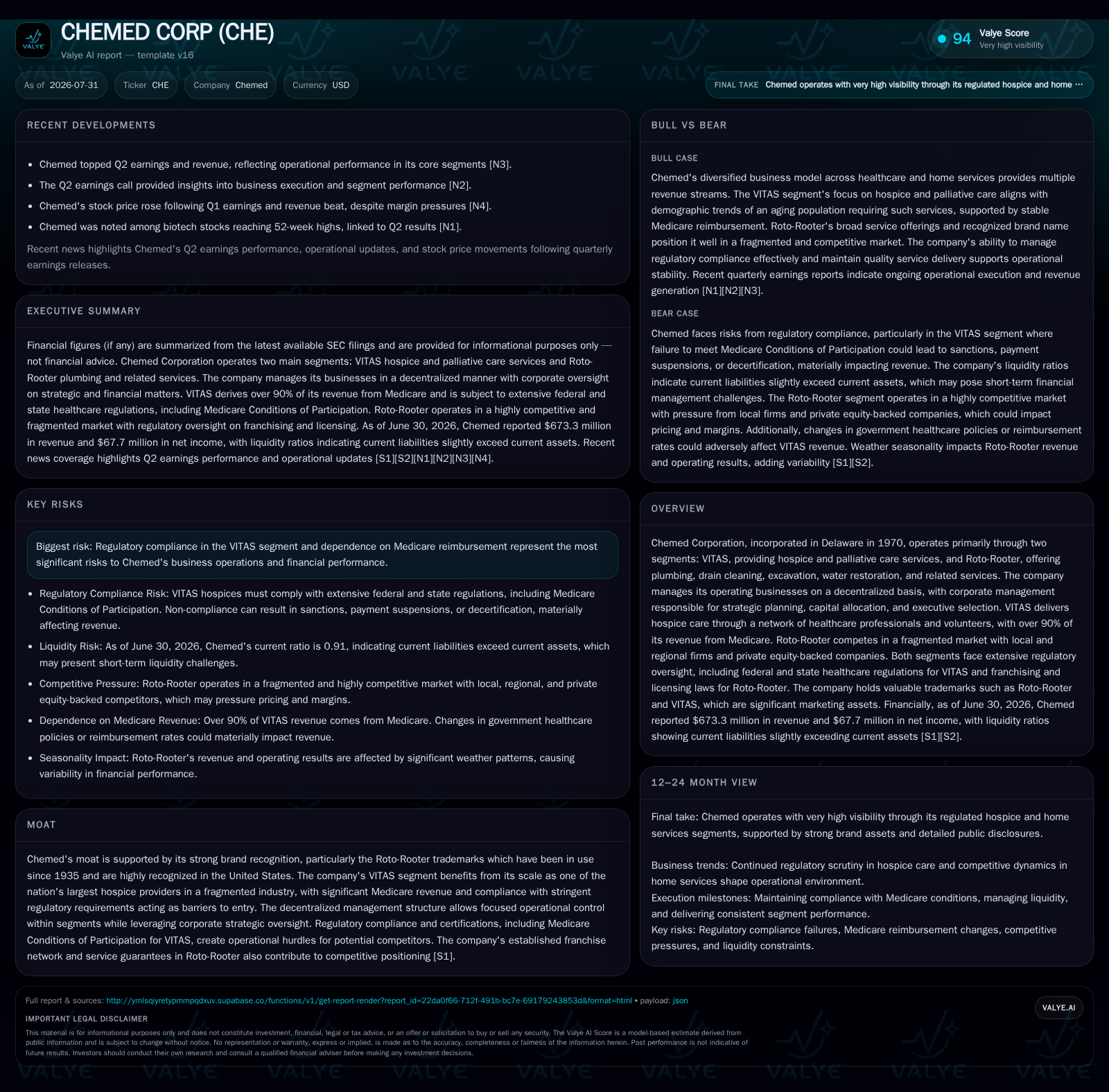
Chemed Corporation reported solid financial results for Q2 2026, driven by growth in both its VITAS hospice care segment and its Roto-Rooter home services segment. The company continues to navigate regulatory complexities, notably Medicare reimbursement dependency and franchising regulations, while maintaining strong brand moats and decentralized operational control. Labor market pressures and competition remain notable risks, particularly in the fragmented home services space. Chemed’s ability to balance capital allocation between its healthcare and home repair businesses, alongside managing workforce training and safety programs, will be key to sustaining its growth trajectory.
Recent Operating Update
Chemed Corporation’s Q2 2026 performance reinforced its dual-segment business model strength. On July 28, 2026, the company announced second-quarter earnings that topped analyst estimates on both revenue and net income [S3][N3]. The results reflect positive contributions from both its VITAS hospice care operations—where over 90% of revenue stems from Medicare reimbursements—and the Roto-Rooter home services segment, which contends with a fragmented competitive landscape but benefits from brand recognition dating back to 1935 [S2][S1][F1]. This latest quarterly disclosure provides a timely window into ongoing operational execution during external headwinds.
Business Model Overview
Chemed operates primarily through two independent segments: VITAS (hospice and palliative care) and Roto-Rooter (plumbing, drain cleaning, excavation, water restoration). These segments are managed on a decentralized basis where individual operational units focus on service delivery nuances appropriate to healthcare or home services verticals. Corporate headquarters exercises strategic oversight including capital allocation decisions, compliance governance, executive selection, and long-term planning [S1].
VITAS generates revenue almost entirely via fee-for-service Medicare reimbursement programs administered under federal guidelines. This model necessitates meeting strict clinical standards involving an interdisciplinary team of licensed healthcare professionals—physicians, nurses, social workers—and volunteers offering end-of-life care [S1]. Patient census growth directly influences top-line trends while reimbursement rates set by government agencies heavily condition profitability.
The Roto-Rooter business functions as a service operator combined with a significant franchise network presence. It sells plumbing-related emergency repairs and planned maintenance services primarily to residential customers but also serves commercial clients. Competitive differentiation comes from maintaining a storied brand recognized nationwide alongside guaranteed emergency availability which supports premium pricing compared to local operators lacking scale or reputation [S1]. Revenue drivers include volume measured via customer call counts and job completions. Franchisee recruitment and retention underpin expansion strategies.
Both segments confront intricate regulatory environments: VITAS complies with healthcare certifications like Medicare Conditions of Participation; Roto-Rooter navigates federal/state franchising statutes plus state licensing laws governing plumbing operations. Compliance costs impose an ongoing fixed burden that scales slower than revenue but could spike unexpectedly per legal developments or enforcement actions [S1]
Industry Structure & Competitive Position
Hospice care nationally is fragmented yet concentrated among a few large providers such as Amedisys and LHC Group who similarly rely predominantly on Medicare payments. Chemed’s moat derives from the scale of VITAS as one of the largest hospices nationally coupled with acquired certifications creating regulatory barriers for new entrants. However, the sector faces persistent risk due to potential regulatory tightening or payment rate reductions impacting margin sustainability [S1]
Roto-Rooter's competitive environment illustrates classic fragmentation common to home repair markets; competition ranges from small local businesses to regional players sometimes backed by private equity capital seeking consolidation. Advertising efficacy has grown more challenging as AI platforms alter customer search behaviors requiring adaptation in marketing spend optimization. Unlike healthcare payors, Roto-Rooter depends heavily on direct consumer payments where discretionary spending cycles can affect demand [S1]. The value of the Roto-Rooter brand mitigates some price sensitivity by enabling premium pricing through trust signals embedded in longstanding trademarks.
Growth Drivers
For VITAS, demographic tailwinds linked to an aging U.S. population structurally expand hospice demand over time. Policy factors such as gradual Medicare fee schedule adjustments similarly influence intermediate growth potential rather than abrupt volume shocks [S1]. Incremental patient admission increases alongside mild census growth support top-line gains. Operational enhancements through staff training programs also aim to elevate patient outcomes driving referral pathways within the continuum of care
Roto-Rooter growth hinges on geographic penetration via adding franchises coupled with bolstering same-store sales through service quality improvements and enhanced emergency responsiveness. Technology investments that streamline scheduling bolster customer experience which can lead to higher job retention rates—a critical metric amid tough labor markets where skilled plumbers are scarce [S1]. Expansion into complementary water restoration services creates cross-sell opportunities.
Cross-segment synergies occasionally emerge in shared best practices around employee retention policies or safety protocols though direct operational overlap is minimal given distinct customer bases.
Risks & Watchpoints
The most salient risks revolve around regulatory uncertainty tied primarily to the Medicare reimbursement formula affecting VITAS’s revenues. Any adverse revision could compress operating margins materially given the fixed-cost nature of clinical staffing obligations [S29]. Further risk arises from state-level restrictions limiting for-profit ownership or acquisitions within hospice markets (e.g., New York’s prohibitions). Restrictions cap growth options or force complex structural compliance mechanisms.
In Roto-Rooter’s domain, intensifying competition driven by localized players armed with aggressive digital marketing approaches elevates customer acquisition costs while prospects for gaining meaningful pricing leverage narrow without superior service differentiation [S1]. Additionally, evolving franchising legislation may increase compliance burdens or franchisee disputes.
Labor supply challenges are pervasive across both segments; recruiting licensed nurses for hospice care or skilled technicians for plumbing directly impacts capacity utilization rates affecting revenue growth ceilings [S1]. Chemed’s investment in comprehensive employee training—covering safety protocols, human resources issues like harassment prevention, workplace violence mitigation—is thus critical for reducing turnover
Economic downturns pose discretionary demand risks more acutely on Roto-Rooter’s residential customer base compared to relatively recession-insulated hospice services.
What to Watch Next
Upcoming milestones include monitoring quarterly updates on patient census trends at VITAS that disclose response sensitivity to Medicare policy changes or demographic shifts. For Roto-Rooter, tracking franchisee count changes alongside reportable same-store sales metrics will illuminate effectiveness of expansion efforts amid competitive intensity.
Execution-wise, progress measured through sustained low employee attrition rates post-training campaigns would validate human capital strategies mitigating labor constraints.
Regulatory developments warrant close attention: any modifications announced by CMS regarding hospice payment reforms or FTC activity concerning franchising regulations could shape operational outlook dramatically.
Financial guidance releases—if provided—should clarify management’s expectations around capital spending plans balancing investments into healthcare infrastructure versus home service fleet upgrades.
Financial Profile Discussion
As of June 30, 2026, Chemed held approximately $40 million in cash equivalents against current liabilities exceeding $319 million resulting in a current ratio of about 0.91—slightly below the typical threshold implying cautious liquidity management amidst working capital needs [F1][S2]. The company’s most recent available data indicates total debt figures are dated and thus current leverage levels cannot be precisely confirmed [F1]. Operating income reached $338 million on nearly $2.53 billion in calendar year revenues ending December 31, 2025 reflecting healthy profitability supported by scale efficiencies in both segments [F1]. Capital expenditures historically remain modest relative to operating cash flows reflecting asset-light nature except for service vehicles and clinical support equipment; this disciplined capex approach maintains financial flexibility.
This analysis synthesizes publicly available information as of July 31, 2026 without providing investment advice or forecasting future market performance. It emphasizes factual interpretation grounded in recent SEC filings combined with sector expertise on healthcare services paired with home repair markets.
Disclaimer: This is research-only, informational analysis and not investment advice. It may include AI-generated interpretation and general industry context. Always verify important details using primary sources.

Comments