
LyondellBasell’s Portfolio and Global Reach Drive Recovery Amid Chemical Industry Cyclicality
Q2 2026 results show margin improvement led by market recovery, supported by integrated operations and technology licensing.
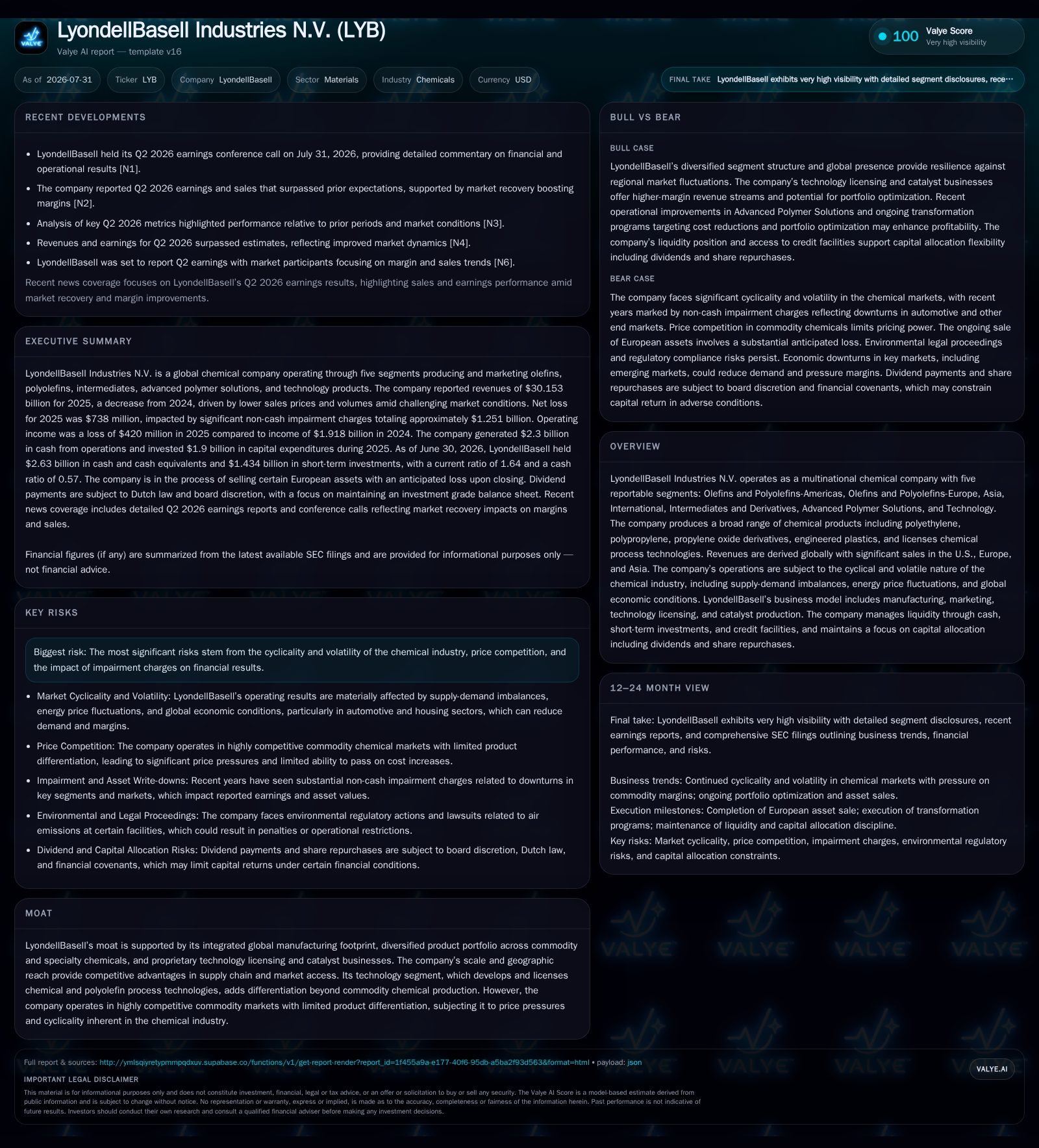
LyondellBasell Industries N.V. reported a strong Q2 2026 performance with improved margins driven by recovering polyolefin markets and disciplined cost management. The company’s diverse global footprint across commodity chemicals, specialty polymers, and technology licensing segments mitigated cyclical headwinds. However, cyclicality in feedstock costs and competitive price pressures remain key risks. Going forward, capacity utilization trends, licensing milestones, and sustainability investments will be critical growth drivers amid capital-intensive industry dynamics.
Recent Operating Performance Highlights
LyondellBasell delivered a Q2 2026 operating update reflecting a meaningful rebound in profitability driven by improving market conditions for its olefins and polyolefins products. The firm highlighted that tighter supply-demand balances in these commodities lifted average selling prices while plant operating rates rose across several regions sustaining higher capacity utilization [S2][N2]. This recovery helped partially offset the previous quarters' challenges related to oversupply and softened demand particularly in Asia. The company also benefitted from disciplined cost management initiatives advanced through its cash improvement plan which targets over $1.3 billion in cumulative savings by end-2026 relative to 2024 levels [S7][S12].
Additionally, LyondellBasell finalized the sale of select European olefin and polyolefin assets to AEQUITA during Q1 2026 aligning its production footprint toward markets with more favorable long-term dynamics and regulatory environments [S19]. This divestiture reflects an ongoing portfolio optimization effort designed to enhance overall asset returns and concentrate investment on core production pillars.
Business Model: Integrated Global Chemicals with Technology Leverage
LyondellBasell operates an integrated petrochemical business spanning five reportable segments: Olefins & Polyolefins-Americas, Olefins & Polyolefins-Europe/Asia/International (EAI), Intermediates & Derivatives (I&D), Advanced Polymer Solutions (specialty polymers), and Technology. The core manufacturing assets produce basic commodity chemicals such as polyethylene (PE), polypropylene (PP), propylene oxide derivatives, along with chemical intermediates used extensively by downstream manufacturers in packaging, automotive components, construction materials, and consumer goods sectors [S1]
Revenue streams are diversified beyond pure commodity sales via technology licensing agreements where LyondellBasell licenses proprietary process technologies (notably polypropylene production processes) to third-party producers globally. This segment offers higher margin potential although subject to milestone-based revenue timing variability tied to license implementations or expansions. The company also produces catalysts integral to polyolefin production which establish additional product differentiation in an otherwise price-competitive landscape.
The firm’s monetization is primarily transaction-based on volume shipped at market-index linked prices for commodities where contract durations tend to be short-term or spot linked [S26][S9]. Thus revenue volatility is influenced heavily by production volumes (capacity utilization) and prevailing global feedstock costs such as naphtha or ethane prices which fluctuate with energy markets. Margins compress when feedstock costs rise substantially without corresponding selling price increments due to competitive pressures
Industry Structure and Competitive Position
The chemical sector for olefins and polyolefins is highly capital intensive with large-scale integrated production facilities needed to maintain cost competitiveness [S1][S26]. LyondellBasell is among the world’s largest producers with significant scale advantages allowing access to multiple geographic markets — the U.S., Europe, Asia — buttressed by a diversified product mix including both commodity grades and engineered plastics targeting more specialized applications
Peers include integrated majors such as Dow Inc., SABIC, INEOS, ExxonMobil Chemical, BASF (noted for specialty chemicals innovation), and Chevron Phillips Chemical. Compared to peers like Dow or SABIC which may have broader specialty chemical portfolios or upstream integration into fossil fuels, LyondellBasell's differentiation lies partly in its technology licensing business which supplements cyclically linked commodity revenue flows with recurring income streams derived from intellectual property.
The industry faces persistent cyclicality largely driven by macroeconomic factors impacting industrial output globally—recessions reduce polymer demand notably in automotive/construction sectors while expansions increase it. Supply-demand imbalances arise due to capacity additions lagging demand growth or unexpected shutdowns creating tightness. This volatility affects average selling prices per ton sold as well as capacity utilization rates which drive financial performance for all players consistently.
Growth Drivers
Several structural factors underpin LyondellBasell's growth prospects:
- Global Economic Expansion: Growth in emerging economies stimulates demand for plastics primarily used in packaging innovations, automotive parts lightweighting for fuel efficiency mandates, and infrastructure development requiring construction materials.
- Circularity Initiatives: The company's updated sustainability goals target producing/marketing 800k metric tons of recycled or renewable-based polymers annually by 2030 featuring investments like the MoReTec-1 chemical recycling plant under construction in Germany enabling closed-loop recycling capabilities using proprietary technologies [S1].
- Technology Licensing: Continued innovation fuels license contracts providing stepwise revenue from new license launches or expanded capacity for existing licensees.
- Operational Efficiency: Improved plant operating rates coupled with cost reduction programs bolster competitiveness amid pricing pressures.
- Product Innovation: Development of specialty polymers contributes incremental margin improvement versus commoditized grades aligning with customer preferences for enhanced product attributes.
Risks / Watchpoints / Growth Constraints
The firm's operating model is inherently exposed to:
- Cyclicality & Volatility: Demand swings tightly follow industrial cycles; volatile feedstock raw material costs impose margin squeeze when price pass-through lags.
- Competitive Pricing Pressure: As commoditized products dominate revenues (~majority of sold volume), limited product differentiation constrains pricing power leading to potential erosion during excess capacity periods.
- Regulatory & Environmental Compliance Costs: Stringent emissions regulations necessitate ongoing capital expenditures; emerging climate legislation may increase compliance costs putting pressure on operational margins [S9][S16].
- Asset Impairments: Divestitures or market contractions could require write-downs impacting financial results adversely as noted with recent European asset sales generating potential impairment risks if market valuations shift unexpectedly [S21].
- Geopolitical & Currency Risks: Operations span multiple jurisdictions exposing the company to foreign exchange fluctuations impacting translation of international earnings plus possible trade policy impacts on supply chains.
- Intellectual Property Litigation: Reliance on patent protections underpins technology licensing income; failure to defend IP rights could diminish this important differentiator [S9].
What to Watch Next
Key indicators signaling operational trajectory include:
- Capacity Utilization Rates: Monitoring increases especially in Olefins & Polyolefins segments gives forward insight into volume-driven revenue changes.
- Technology Licensing Revenue Trajectory: Milestone achievements tied to new licenses or expansions provide early signals of incremental high-margin income streams.
- Feedstock Cost Trends vs Selling Prices: Tracking spreads informs margin cycle position relevant for near-term profitability.
- Chemical Recycling Ramp-Up Progress: Success scaling MoReTec plant operations reflects commitment toward circular economy adaptations impacting longer-term competitiveness.
- Capital Expenditure Deployment: Adherence to planned strategic investments while optimizing maintenance capex is essential given capital intensity of petrochemicals manufacturing.
- Dividend Policy Adjustments & Share Repurchases: Changes here suggest management confidence/caution amid fluctuating cash flow profiles influenced by cyclical earnings variations.
Financial Profile Discussion
As of Q2 2026 close, LyondellBasell reported $2.63 billion in cash and equivalents against $11.22 billion in total debt resulting in a net debt position of roughly $8.58 billion while maintaining a current ratio of approximately 1.64 indicating adequate short-term liquidity to meet obligations without distress [F1]. The company amended credit facilities increasing maximum leverage ratio covenants temporarily allowing greater financial flexibility through mid-2027 but imposes restrictions on dividend hikes or share repurchases if leverage exceeds certain thresholds underpinning its capital allocation discipline [S6][S7].
Overall, the firm sustains an investment-grade profile supported by stable cash flows from diversified product lines combined with relatively robust liquidity despite industry cyclical dynamics. Effective working capital management contributing significantly to cash flow generation remains a focal point executing the company’s broader financial strategy.
This analysis synthesizes LyondellBasell's recent filings supplemented by industry context without offering investment advice but aims to clarify operating realities shaping performance amid chemically cyclical marketplace challenges.
Disclaimer: This is research-only, informational analysis and not investment advice. It may include AI-generated interpretation and general industry context. Always verify important details using primary sources.

Comments