
Verizon’s Q2 2026 Update Anchors Growth on Fiber Expansion and 5G Leadership Amid Capital Intensity
Verizon strengthened its network leadership with strategic acquisitions and ongoing investments, balancing subscriber gains against high capital outlays.
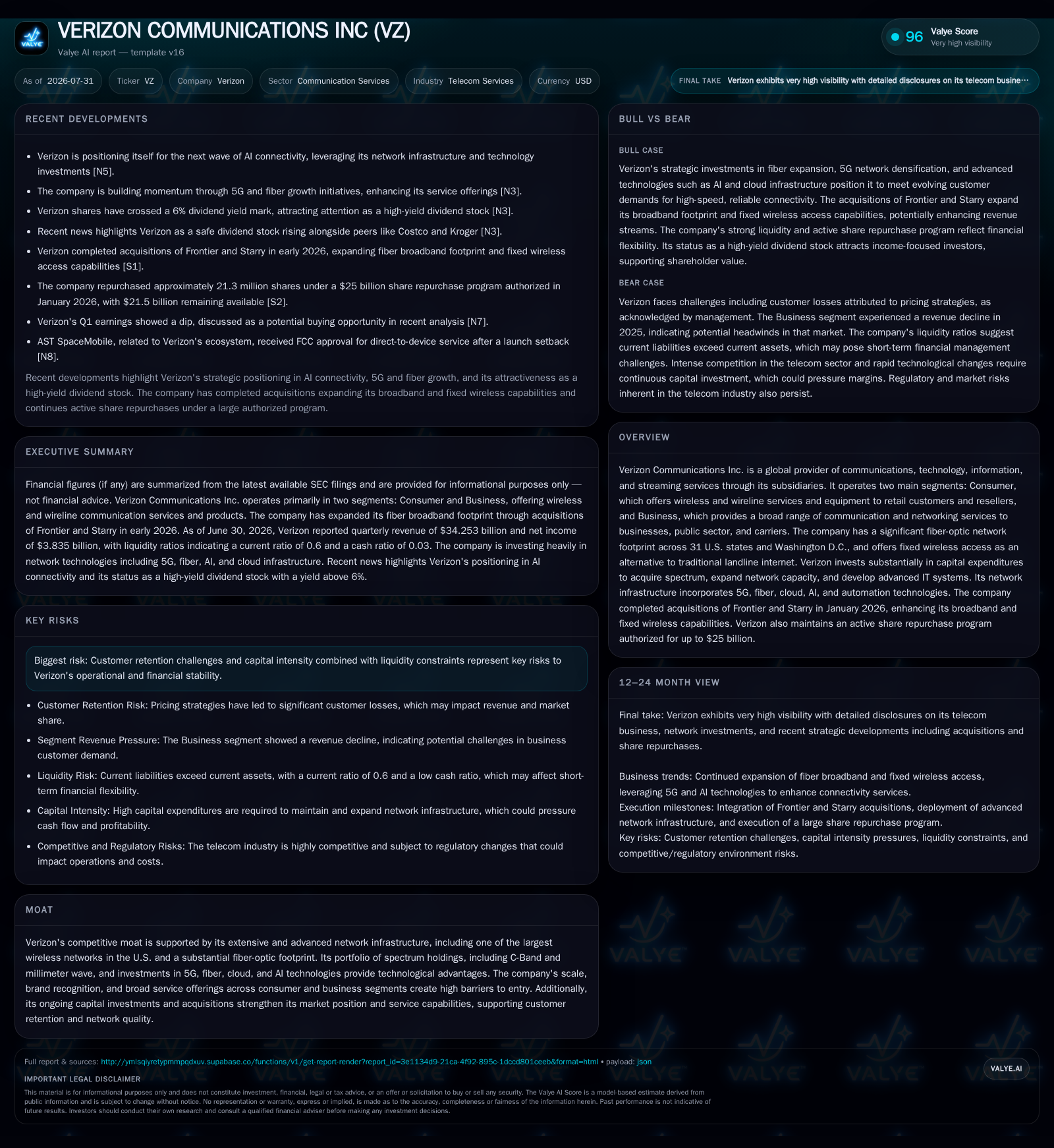
In Q2 2026, Verizon Communications continued leveraging its extensive fiber and 5G infrastructure to support revenue resilience and subscriber growth across consumer and business segments. The company remains focused on fixed wireless access expansion as an alternative broadband option while progressing integration of the Frontier acquisition. Despite intensifying capital expenditure requirements, Verizon initiated a $25 billion share repurchase program signaling confidence in cash flow generation. Key risks remain with customer retention pressures and managing leverage in this highly capital-intensive industry.
Recent Operating Update: Sustaining Network Investment during Subscriber Momentum
Verizon's latest quarterly filing for Q2 ended June 30, 2026 provides the freshest lens on the company's operational trajectory. The company disclosed ongoing capital-intensive commitments toward expanding its wireless and wireline networks alongside maintaining robust subscriber engagement. Notably, Verizon deployed an aggressive share repurchase initiative authorized at $25 billion commencing January 2026—with roughly 21.3 million shares repurchased via an Accelerated Share Repurchase (ASR) by end of June at an average price near $47 per share [S2]. This move reflects management's confidence in sustained free cash flow despite heavy capex demands.
Subscriber metrics continue underpinning the business model’s core health; wireless retail postpaid accounts remain a vital KPI reflecting user base quality. Verizon combines its traditional cellular services with fixed wireless access (FWA)—leveraging its advanced 5G network as a substitute for legacy landline broadband especially in underserved areas served by its expanding fiber footprint across 31 states plus D.C. The fiber-optic network enables competitive high-speed broadband offering critical for value creation in both consumer and enterprise segments [S1][S23].
The acquisition of Frontier Communications finalized in January 2026 materially increased fiber network depth especially in key residential markets [S1]. Alongside the Starry acquisition closing the same month, these moves strengthen Verizon's market positioning for delivering scalable broadband bundles blending wired fiber with FWA solutions—a strategic play during intense competition from cable operators like Comcast and Charter who dominate wireline broadband space
Business Model: Integrated Wireless-Wireline Subscription Base With Equipment & Wholesale Revenue
Verizon operates through two main reportable segments—Consumer and Business—each contributing distinct revenue streams tied closely to subscription models. The Consumer segment markets wireless voice/data plans alongside wireline internet primarily over the company’s own fiber infrastructure or via FWA over 5G/4G LTE networks. Equipment sales (smartphones, routers) supplement service revenues but face margin pressure due to promotional amortization effects discussed in filings.
The Business segment extends network connectivity into enterprise-grade services targeting businesses, public sector entities, carriers, featuring managed networking solutions that incorporate Verizon’s cloud, AI capabilities, and expansive spectrum holdings [S1][S23]. Revenue mechanics depend heavily on multi-year contracts aided by service-level agreements (SLAs), providing some stability amid cyclical demand shifts.
Wholesale arrangements further diversify revenues by allowing MVNOs or smaller providers access to Verizon's backbone under negotiated terms—which helps optimize asset utilization though often at thinner margins than direct retail channels.
Industry Structure and Competitive Position: Scale-Driven Moat Supported by Fiber & Spectrum Assets
Telecommunications is a capital-intensive duopoly/trio-driven U.S. industry where major national wireless carriers—AT&T, Verizon, T-Mobile—vie primarily on breadth and quality of licensed spectrum assets plus network densification including millimeter wave bands critical for full-fledged 5G deployment. Peer wireline competition includes large cable companies like Comcast offering broadband plus voice bundles.
Verizon’s moat stems from its one of the largest U.S. wireless networks combined with a growing fiber-optic network that penetrates millions of households directly or supports fixed wireless alternatives. Its portfolio now includes substantial C-Band holdings critical for mid-band 5G coverage plus millimeter wave for ultra-high throughput in dense urban areas.
This integrated infrastructure positions Verizon advantageously against competitors more reliant solely on wireless or wireline exclusivity. Furthermore, brand recognition combined with diversified product lines spanning consumer retail to public sector enterprise clients buttresses customer stickiness despite overall market saturation.
Growth Drivers: Leveraging Technological Advances & Fiber Expansion Amid Increasing Consumption Patterns
Key demand drivers include steadily growing consumption of mobile data fueled by streaming video proliferation and connected device adoption (smartphones, tablets, wearables). Enterprise digital transformation encourages migration towards cloud-enabled networking solutions supported by Verizon’s investments in AI automation that improve operational efficiencies while enabling differentiated service offerings [N2][N3].
Fiber footprint expansions via Frontier acquisition materially increase addressable market for broadband subscribers fed through both direct wired connections and FWA overlays—a crucial strategy amidst tightening regulatory mandates promoting broadband accessibility.
Additionally, next-gen use cases for low-latency connectivity such as augmented reality (AR), industrial IoT applications offer incremental upside if Verizon can capitalize on its advanced network architecture avoiding commoditization risks inherent to mere bandwidth sales.
Risks / Watchpoints: High Capital Needs Coupled With Churn Pressure And Leverage Constraints
Despite clear technological competence and scale advantages, Verizon faces persistent risks typical for telecom services firms. Customer retention challenges are amplified by smartphone market saturation limiting new account growth; thus subscriber churn rates become a critical metric to track given their direct impact on revenue stability.
Capital intensity remains a stubborn constraint—the firm expects $16–16.5 billion annual capex focusing on spectrum deployment (e.g., completing C-Band rollout), fiber expansion, and updating IT systems supporting product innovation [S10][S12][S16]. This level of investment pressures free cash flow despite solid EBITDA margins.
Leverage presents another watchpoint: As of June 30, 2026 net debt stood near $141.7 billion (total debt $143.4B minus ~$1.75B cash) while current liabilities exceeded current assets yielding a current ratio around 0.6 indicating tight liquidity buffers typical in this industry but warranting careful monitoring vis-à-vis interest coverage ratios intertwined with credit ratings implications [F1][S3]
Regulatory shifts affecting spectrum licensing or wholesale access terms could also impact future cost structures or market access dynamics.
What to Watch Next: Integration Milestones And Execution On Capex Efficiency Will Be Crucial
Investors should monitor subscriber net additions post-Frontier integration as the combined entity attempts cross-selling to bundled wireless-wireline services enhancing ARPU metrics.
Execution on cost rationalization programs mentioned in filings aimed at lowering unit capex without sacrificing network quality will inform long-term margin sustainability.
Spectrum auction outcomes or reallocations could alter the competitive landscape favorability around mid-band capacity vital for maintaining leadership atop AT&T’s aggressive fleet buildout.
Watch also any changes to dividend policy or acceleration/pauses in share buybacks which reflect management confidence amid evolving macroeconomic conditions.
Financial Profile Discussion
Liquidity wise, cash & equivalents contracted from year-end to about $1.75 billion by mid-2026 although supplemented partially by unutilized credit facilities totaling nearly $24 billion as noted at December-end 2025 illustrating availability of committed financing sources if needed [F1][S4]
Debt maturity schedule reflects sizable near-term obligations (~$17 billion due within next twelve months) necessitating disciplined refinancing strategies amid stable but elevated interest rate environment impacting weighted average cost of capital hovering near historical averages just above 5% [F1][S16]
Capital expenditures guidance hovers around $16 billion annually indicating sustained reinvestment required for technology leadership—a necessity shared broadly across peers but intensified by recent acquisitions requiring integration funding plus technology refresh cycles driven by accelerated innovation curves especially around AI-powered networks.
Free cash flow remains under watch given the balance between robust operating cash generation offset by elevated capex; management’s willingness to deploy significant capital simultaneously into buyback programs points toward prudent optimism but also signals necessity to closely manage leverage ratios going forward [S3][S21]
This analysis is based solely on publicly available filings from Verizon Communications Inc., augmented with standard telecommunications industry context provided by generally accepted knowledge frameworks applicable to North American telecom services providers. It does not constitute investment advice or research views regarding participation in securities or other financial instruments related to the issuer.
Disclaimer: This is research-only, informational analysis and not investment advice. It may include AI-generated interpretation and general industry context. Always verify important details using primary sources.

Comments