
Schneider National Advances Fleet Technology with AI and Regulatory Adaptation
Q2 2026 results highlight Schneider National's efforts to manage regulatory costs and leverage AI for operational efficiency amid evolving transportation industry dynamics.
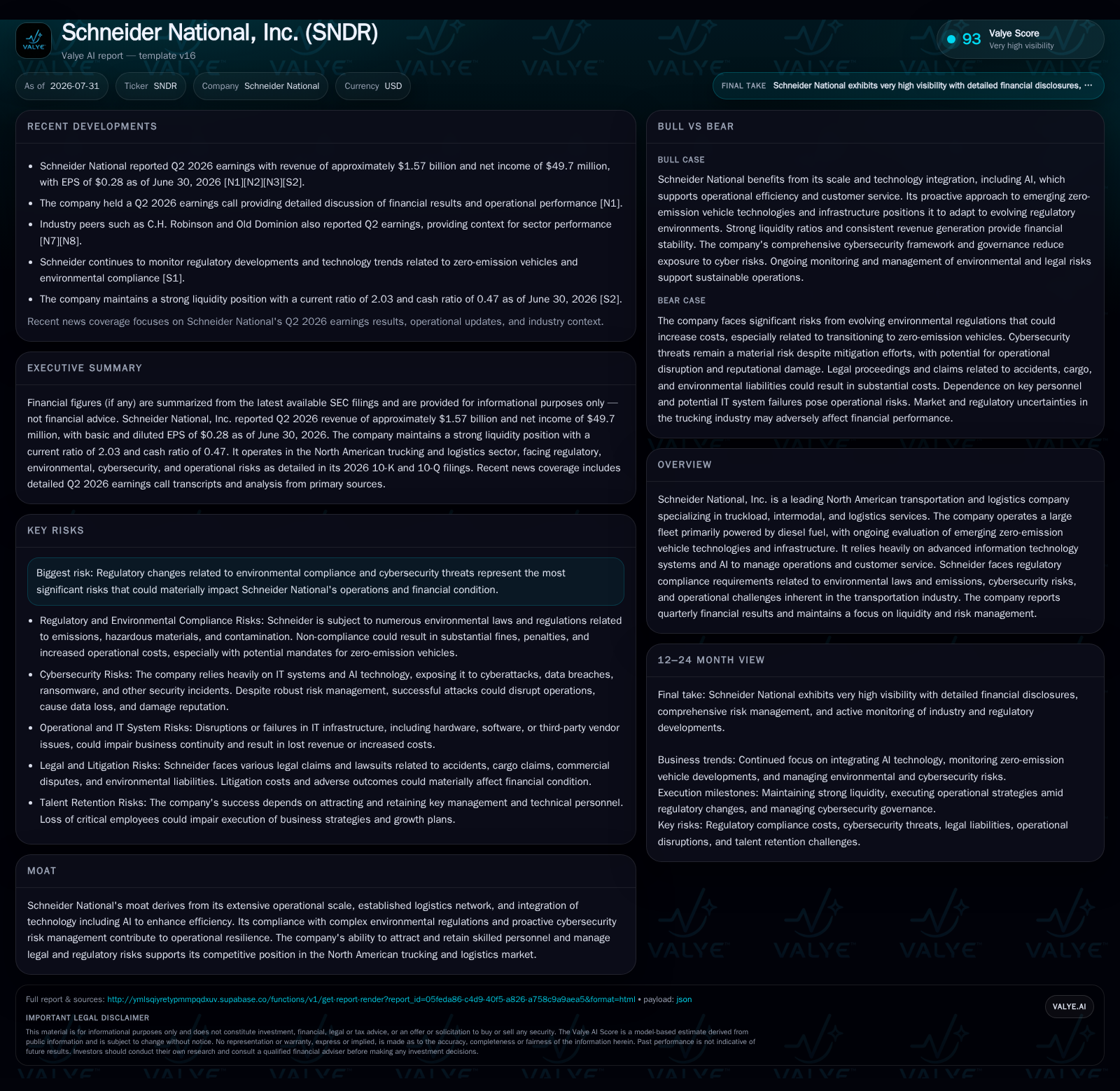
In Q2 2026, Schneider National demonstrated resilience in a regulatory environment tightening around fleet emissions, reflected in operating margin pressures partly offset by AI-driven efficiency gains. The company's revenue generation hinges on asset-based truckload, intermodal, and logistics services powered primarily by diesel fleets, with emerging zero-emission vehicle adoption constrained by technology and infrastructure challenges. Its competitive moat is reinforced through integrated logistics offerings and fleet scale, navigating cost inflation and labor market pressures typical in North American trucking. Ongoing monitoring of environmental regulations enforcement, haul rate trends, and AI adoption milestones will shape near-term operational outlooks.
Q2 2026 Operational Update Highlights Regulatory Pressure and Efficiency Gains
Schneider National's Q2 2026 filing reveals a nuanced operational landscape where regulatory compliance costs are increasingly influencing profitability metrics. The reported operating ratio reflected compression driven primarily by higher environmental compliance-related expenses alongside increased costs in purchased transportation from third-party carriers subject to similar mandates [S2]. Despite these headwinds, management commentary highlighted improvements in capacity utilization and haul rate stabilization that partially mitigated margin erosion [S3]. This interplay suggests that while Schneider navigates an intensified cost structure influenced by tightening emissions regulations, its ability to sustain revenue-per-mile growth through effective load factor management retains strategic importance. An improving operating ratio would be an early sign of successful cost pass-through or efficiency gains.
Fleet Management Evolution Under Environmental Regulatory Constraints
Schneider National operates predominantly diesel-powered Class 8 tractor fleets for long-haul truckload operations across North America [S1]. The company acknowledges material risks from emerging greenhouse gas emissions regulations imposed at federal, state, and local levels. However, the commercially scaled adoption of zero-emission vehicles (ZEVs) remains stymied by technical limitations — including challenges in powertrain performance requirements such as torque and range — as well as inadequate nationwide charging/fueling infrastructure [S1]. Schneider's disclosures note uncertainty over enforcement consistency of state-level mandates following California Air Resources Board’s (CARB) policy shifts [S1]. This regulatory ambiguity complicates capital planning related to fleet upgrades or leasing decisions.
Cost pressures also emerge indirectly through increased purchased transportation expenses since brokered carriers must comply with such rules or pass costs higher [S1]. These factors suggest that near-term fleet composition changes will be gradual. The durability of Schneider’s diesel-focused asset base underpins its core service reliability while it vigilantly monitors legislative developments influencing long-term capital expenditure commitments.
Leveraging AI and Digital Technologies as Operational Differentiators
A key element strengthening Schneider’s moat is the strategic deployment of AI-powered systems within its operational framework [S1]. The company leverages advanced information technology solutions to optimize route planning, fleet utilization rates, load matching, and real-time supply chain visibility. For instance, AI-enabled analytics reduce deadhead miles — unproductive travel without freight — thereby enhancing capacity utilization metrics that directly impact revenue efficiency per mile.
Beyond operational optimization, AI supports cybersecurity postures vital to safeguarding digitized logistics operations against emerging threats [S1]. This layered technology integration not only improves cost structures but enhances customer service reliability—a competitive edge against less tech-integrated peers. Continuously improving metrics like load factor improvements or reductions in average deadhead percentage would substantiate the efficacy of these digital investments.
Competitive Landscape: Asset-Based Truckload vs. Third-Party Logistics Dynamics
Within the North American transportation sector context, Schneider occupies a position as an asset-intensive carrier offering truckload, intermodal, and logistics services combined with freight brokerage elements. Its main peer cohort includes asset-heavy competitors like J.B. Hunt Transport Services and Knight-Swift Transportation, firms similarly managing large fleets under stringent regulatory scrutiny. Conversely, third-party logistics (3PL) providers such as C.H. Robinson operate asset-light models focusing on brokerage and supply chain solutions without significant capital tied up in trucks.
Schneider's integration of physical freight movement with logistics execution creates switching costs for customers preferring consolidated service providers. This multi-modal capability—spanning owned trucks to intermodal rail integrations—differentiates it within fragmented logistics networks. Customer decisions often weigh the trade-off between integrated offerings' complexity versus brokerage flexibility.
Emerging Growth Channels Through Intermodal and Logistics Solutions Integration
The company continues expanding its intermodal freight services, leveraging rail-truck combinations that enhance fuel efficiency and network reach [S1]. Growing manufacturing output and e-commerce distribution demands drive this modal shift owing to intermodal's potential for lower emissions per ton-mile hauled. Integration into logistics service contracts complements this expansion by increasing Schneider's share of supply chain value-added activities.
This strategy supports improved revenue per mile by capturing higher-yield specialized freight segments while stabilizing capacity utilization rates amid broader market cyclicality. Expansion into these adjacent channels aligns with infrastructure shifts favoring rail investments and addresses customer desires for more sustainable shipping options within existing cost frameworks.
Headwinds from Market Capacity, Driver Retention, and Cost Inflation Risks
Despite strategic positioning, Schneider faces pronounced labor market constraints typical for trucking carriers—chiefly driver shortage-induced turnover [S1]. High turnover rates amplify recruitment and training expenses while affecting service continuity metrics essential for customer retention.
Fuel price volatility remains an acute risk given diesel's predominant role in its fleet energy mix [S1]. Operating income sensitivity to fuel expenditures introduces earnings variability absent comprehensive fuel surcharges or price pass-through mechanisms.
Regulatory uncertainty further complicates operating cost forecasting as new environmental mandates could elevate capital intensity or necessitate purchased transportation adjustments before routes or pricing fully adapt. These pressures collectively temper near-term margin expansion prospects despite underlying demand resilience.
'What to Watch': Regulatory Developments, Rate Trends, and Technology Adoption Milestones
Key forward-looking indicators include the clarity and enforcement rigor of zero-emission vehicle legislation at state and federal levels; any acceleration here would materially affect Schneider’s fleet investment timetable [S1][S2]. Freight market haul rates relative to fuel inflation will reveal the sustainability of current operating ratios under rising input prices [S2][N3].
Technological investment progress—measured through fleet utilization KPIs linked to AI systems—will also provide insights into margin resiliency potential amid a challenging macro backdrop. Monitoring these factors quarterly will help assess whether Schneider can maintain its competitive efficiency edge while managing regulatory-driven cost inflation.
Financial Profile Discussion: Liquidity, Leverage, and Capital Allocation Priorities
As of June 30, 2026, Schneider maintained a robust liquidity position evidenced by $293 million in cash equivalents against total current liabilities totaling approximately $697 million—a current ratio of about 2.03 indicating sound short-term financial flexibility [F1]. Total debt stood near $386 million with net debt (debt minus cash) around $93 million at quarter-end [F1], reflecting conservative leverage relative to asset scale.
This balance sheet strength enables continued capital deployment toward fleet modernization initiatives required both for regulatory adaptation (e.g., fuel-efficient or compliant trucks) and digital technology investments supporting operational efficiencies highlighted earlier. Capital expenditures linked to emerging ZEV transition technologies may accelerate depending on regulatory signals but currently coexist with traditional diesel truck maintenance needs.
Maintaining this financial discipline while investing selectively preserves Schneider’s ability to respond dynamically across the evolving transportation landscape without compromising credit quality or liquidity buffers.
Schneider National stands at a strategic inflection point common among large North American asset-based carriers confronting heightened environmental regulation alongside transformational digital opportunities. Their Q2 2026 performance encapsulates this dual challenge: navigating immediate cost pressures from compliance while securing longer-term competitiveness through AI-enhanced fleet management and broadening logistics integrations. Close monitoring of regulatory clarity regarding ZEV mandates combined with tangible improvements in operational KPIs linked to technology adoption will be determinative signals shaping their evolving business model trajectory.
Disclaimer: This is research-only, informational analysis and not investment advice. It may include AI-generated interpretation and general industry context. Always verify important details using primary sources.

Comments