
Rocky Mountains Group’s Struggle to Scale Independent Financial Literacy Seminars Amid Concentration and Cost Challenges
Early-stage New Zealand-based Rocky Mountains Group delivers product-agnostic financial literacy services but faces customer concentration and profitability hurdles.
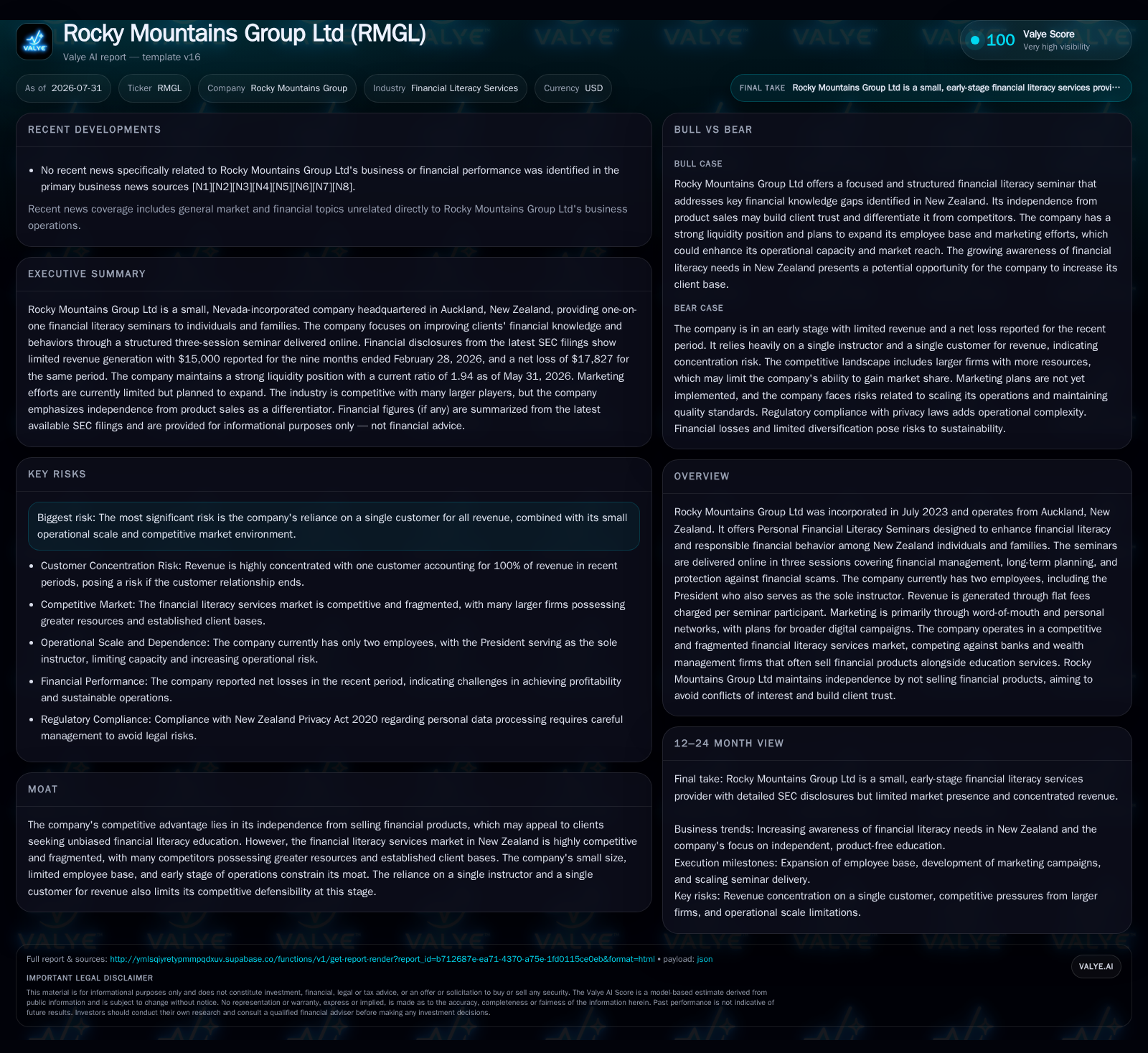
Rocky Mountains Group Ltd operates in the fragmented New Zealand financial literacy education market, focusing on fee-based personal seminars aimed at improving long-term financial behavior. The company’s independence from product sales offers a niche competitive angle but is offset by its reliance on a single instructor, a small employee base, and total dependence on one client for revenue. Recent quarterly results show declining revenues and widening losses reflecting operational scale limits and ongoing high administrative expenses. Growth depends critically on expanding the participant base, diversifying customers, hiring additional instructors, and scaling marketing efforts beyond word-of-mouth.
Recent Operating Update
Rocky Mountains Group Ltd's latest quarterly filing ending February 28, 2026 reported revenue of just $15,000 for the nine-month period—down significantly from $25,105 a year earlier—generated from providing one personal financial literacy seminar participant [S9]. This sharp drop highlights critical scaling issues as the company currently relies almost entirely on delivering highly personalized seminars taught exclusively by the President/CEO. General and administrative expenses surged to $31,437 in the same period as legal, audit and banking costs remain largely fixed despite minimal sales volume [S9]. The resulting net loss expanded sharply to $17,827 from a prior net income of $3,686 [S9].
Cash and cash equivalents were reported at $15,131 as of May 31, 2026 with current assets of $16,526 against current liabilities of $8,500 yielding a current ratio of 1.94 [F1]. Despite this liquidity cushion, the company carries an accumulated deficit of $45,395 and has negative cash flow from operations ($23,665) raising substantial doubt about its ability to continue as a going concern absent improved revenue generation or additional financing support [S16].
The filing also disclosed material weaknesses in internal controls primarily due to governance structure limitations including absence of an effective audit committee and inadequate segregation of duties reflecting early-stage operational risks [S6], [S18].
Business Model Analysis
Rocky Mountains Group operates in the niche segment of personal financial literacy education targeting individuals and families in New Zealand through online seminars that cover fundamental topics such as financial management techniques, long-term planning strategies, and protection against financial scams [S1]. Revenue originates solely from flat fees charged per participant attending these seminars. Unlike many competitors linked to product-selling banks or insurers that combine education with sales incentives potentially compromising client trust considerations, Rocky Mountains emphasizes independence from product sales aiming to establish credibility as unbiased educators [S1].
Currently the company employs only two people: the President delivers all seminars while also handling executive functions. This creates a severe bottleneck limiting instructor utilization rates—the ratio of instructional hours delivered to total available teaching capacity—and constrains seminar throughput.
Marketing efforts thus far rely heavily on word-of-mouth referrals and personal networks with plans mentioned for future digital campaigns lacking explicit timelines or resource commitments [S1]. This strategy limits reach given the strong competition from larger financial institutions that use cross-selling channels embedded within their broader client base.
Customer concentration risk is acute; all recent revenues have been derived from one client participant per reporting period [S3], signaling vulnerability if that relationship dissolves. Revenue growth mechanics hinge primarily on growing participant count per seminar and securing multiple paying clients rather than raising per-participant fees given price sensitivity inherent in educational services.
Cost structure analysis shows general administrative expenses absorb a large portion of revenue at this scale given fixed legal/audit fees not directly tied to seminar delivery volume. Operating margins remain negative due to underutilized capacity and high overhead relative to revenues achieved.
Industry Structure and Competitive Position
The financial literacy services industry in New Zealand resembles global markets with significant fragmentation combining independent educators like Rocky Mountains alongside bank-affiliated programs (e.g., JPMorgan Chase's education arms), wealth management firms embedding client engagement curricula (e.g., Merrill Lynch), insurance brokers adding literacy touchpoints, online platforms (Coursera/Khan Academy), non-profits offering free alternatives (National Endowment for Financial Education), and corporate wellness providers.
Unlike integrated firms bundling product sales with advisory services which can leverage existing client bases for scalable seminar distribution—often subsidizing education as an engagement tool—Rocky Mountains faces resource constraints impeding rapid geographic or demographic expansion.
Its independence is a double-edged sword: while appealing for reducing potential conflicts of interest enhancing trust—as indicated in their filings—it has yet to overcome barriers related to instructor bandwidth limits compounded by nascent brand recognition beyond local networks.
Financially robust peers tend to exhibit diversified customer portfolios reducing concentration risks; higher instructor headcount enabling group or cohort-based delivery models improving utilization metrics; established digital marketing funnels lowering customer acquisition costs; and demonstrated operating leverage driving improving margins with scale.
Growth Drivers
Several sector tailwinds bode well for companies delivering impartial financial literacy:
- Regulatory focus intensifies globally encouraging improved consumer education particularly given complexity increases in financial products requiring broader public awareness.
- Consumer demand grows for unbiased advice free from sales influence stimulating opportunities for independent educators.
- Digital delivery mechanisms expand feasible reach beyond local geographies enabling cost-effective scaling if deployed rigorously.
- Corporate adoption of employee-centered wellness including financial literacy programs presents partnership opportunities.
- Demographics such as younger generations exhibiting stronger appetite for proactive money management knowledge represent expanding target audiences.
Rocky Mountains acknowledges these drivers but remains early-stage; planned broader digital campaigns intend to tap into these trends though tangible execution timing is unspecified [S1]. Hiring additional instructors adhering to standardized protocols could unlock new capacity essential for delivering multiple concurrent seminars thus elevating participant counts per period potentially improving operating margins through better fixed-cost absorption.
Risks and Watchpoints
The dominant strategic risk is high customer concentration: dependence on a single paying attendee per period exposes volatility stemming from client churn or inability to secure new engagements [S3]
Operational scalability hurdles are pronounced due to reliance on one instructor-President limiting total deliverable seminar hours constraining revenue growth potential absent recruitment [S1]
Competitive pressures intensify with market incumbents leveraging product tie-ins reducing direct price competition barriers that an independent provider like Rocky Mountains faces alone.
Fixed administrative costs coupled with control weaknesses flagged during audits elevate risk related to governance shortcomings which could impair investor confidence or regulatory standing if unaddressed [S6], [S18].
Effectiveness measurement challenges inherent in quantifying educational impact raise uncertainty around repeat client retention rates—a key KPI for sustainable revenues—given no defined feedback metrics disclosed currently.
Finally economic cycles impacting discretionary spend on education create exposure; subdued consumer spending would exacerbate difficulty in attracting participants given marginal willingness-to-pay thresholds typical in this sector.
What To Watch Next
Important near-term milestones should include:
- Progress securing multi-client contracts increasing number of paid seminar participants driving top-line growth metrics reported in subsequent quarters.
- Execution effectiveness of planned digital marketing campaigns measurable via reach/conversion KPIs lowering customer acquisition expense relative to historical word-of-mouth dependency.
- Initiation of hiring additional instructors operating under Company SOPs enhancing instructional capacity enabling simultaneous deliveries lifting utilization ratios vital for margin improvement.
- Internal control remediation addressing identified material weaknesses potentially unlocking better governance transparency attractive to future investors or partners.
- Cash flow stabilization evidenced by narrowing operating losses or transition towards positive EBITDA status confirming improving business sustainability amid current going concern uncertainties.
Financial Profile Discussion
The latest available balance sheet as of May 31, 2026 reflects cash & equivalents totaling $15.1K against current liabilities approximating $8.5K yielding a modest current ratio near 1.94 signaling short-term liquidity adequacy though working capital remains constrained given accumulated deficit now at roughly $45K due to persistent operational losses since inception [F1], [S16].
Operating income stands negative at -$23.6K aligned with net losses corroborating ongoing burn from low revenue volumes paired with fixed overhead burdens characteristic of small service providers embarking on commercial scaling phases [F1]
Cash flows show sustained negative operating activity mainly driven by underutilized resources exacerbated by prepayments suggesting elevated upfront costs not yet balanced by proportional income inflows [S9], [S16].
No material debt or off-balance sheet arrangements were disclosed simplifying capital structure but underscoring reliance on shareholder financing or external funding support going forward as management explicitly notes continuation hinges upon future funding availability or improved profitability milestones being met promptly [S16]
In summary Rocky Mountains Group faces classic early-stage growth liabilities combining operational scale limits amid concentrated clientele counterweighted by sector tailwinds favoring independent unbiased educators amid rising regulatory emphasis on broad financial literacy impact.
Disclaimer: This is research-only, informational analysis and not investment advice. It may include AI-generated interpretation and general industry context. Always verify important details using primary sources.

Comments