
Vynleads Shifts to Subscription SaaS with AI-Driven Metabolic Wellness Platform
Latest quarterly results reveal operational strides and persistent challenges as Vynleads refocuses on recurring subscription revenue and AI-powered personalization.
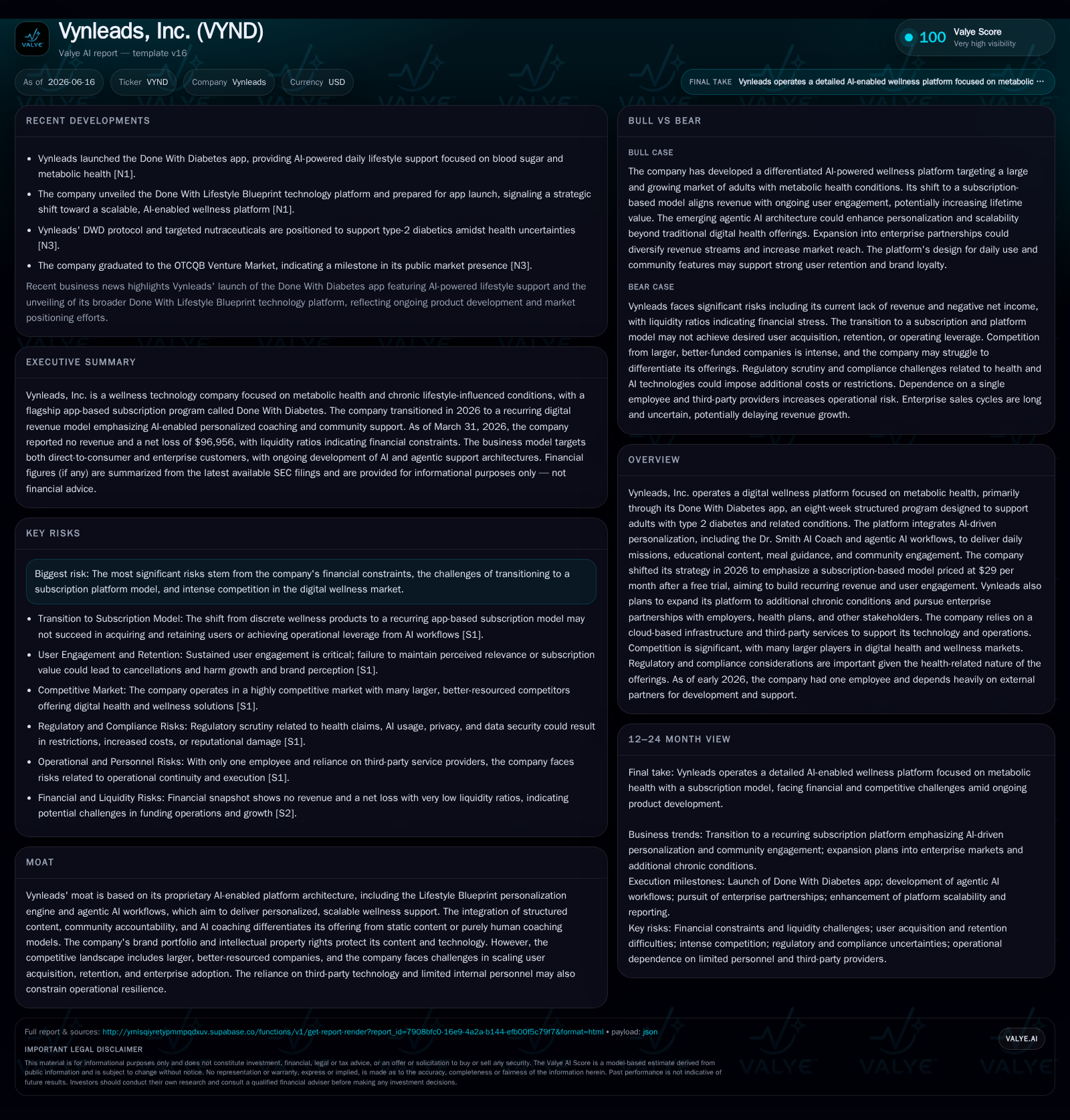
Vynleads' June 2026 10-Q highlights progress in transitioning its Done With Diabetes app into a subscription-based SaaS model, emphasizing AI-enabled coaching and engagement-driven retention. The company aims to leverage its proprietary agentic AI workflows and community accountability features to differentiate in the competitive digital wellness market. However, persistent financial constraints, high customer acquisition costs, and a lengthy enterprise sales cycle temper near-term growth prospects. Expansion beyond metabolic health into additional chronic conditions represents a strategic opportunity but remains contingent on resource availability.
Q2 Update: Subscription Transition Gains Traction but Challenges Persist
Vynleads’ latest quarterly filing dated June 16, 2026 [S2], presents an operating snapshot grounded in its strategic pivot toward a subscription-based platform anchored by the Done With Diabetes app. This transition marks a material change from prior discrete wellness product sales toward sustaining recurring revenues built on monthly engagement. Management emphasized efforts to convert users from a seven-day free trial into paying subscribers at $29 per month, seeking to enhance lifetime value (LTV) while managing customer acquisition costs (CAC).
However, despite initial traction, the quarterly disclosure signals ongoing challenges in scaling user engagement metrics reliably enough to reduce churn and increase paid subscriber counts. The company’s operational scale remains constrained by limited internal resources and intense competition within the digital wellness software sector [S1]. This quarter thus illustrates a critical near-term inflection where execution effectiveness around user activation and retention will determine if the subscription model can support sustainable economics.
Subscription SaaS Business Model Drives Recurring Revenue Focus
At its core, Vynleads monetizes through subscriptions for its flagship Done With Diabetes program—an app-based digital wellness solution structured as an eight-week lifestyle intervention focused on metabolic health [S1][S4]. The $29/month pricing after a one-week free trial seeks to balance accessibility with achieving positive unit economics tied closely to retention rates. Because revenue depends heavily on users maintaining active subscriptions beyond the initial program phase into Lifetime Wellness Mode, continuous user engagement is paramount.
This business model contrasts with prior one-time product sales by creating an ongoing relationship where daily missions, meal guidance, AI coaching prompts, community features, and gamified elements aim to encourage habitual use [S21]. Supporting this effort is an integrated onboarding process capturing lifestyle data that feeds personalized Success Blueprints leveraging proprietary AI capabilities. Additionally, the company pursues enterprise distribution channels targeting employers and health plans, which potentially offer steadier revenues but involve longer evaluation cycles and contractual complexities [S5]. Enterprise buyers demand compliance assurances, scalable reporting workflows, clinical alignment, and information security features beyond consumer app functionality.
AI-Enabled Personalization as Core Differentiator in Digital Wellness
Vynleads’ key technical advantage lies in its advanced personalization framework powered by agentic AI workflows—a system wherein specialized AI agents interact both with users via the Dr. Smith AI Coach and internally coordinate content delivery based on individual program progress [S1][S6][S21]. These capabilities aim to deliver highly tailored guidance without linearly increasing human support costs. The platform can dynamically generate relevant educational content, behavioral prompts, meal research views, and motivational messaging tailored by a user's profile and activity signals.
The architecture’s sophistication theoretically offers scalability advantages over traditional human coach-led models or static content apps. However, it also carries inherent risks related to AI output accuracy, potential biases, or inappropriate guidance that could undermine trust or prompt regulatory scrutiny [S16][S19]. Given the nascent maturity of agentic AI in healthcare-adjacent contexts, maintaining control over model behavior and ensuring safety through layered monitoring is crucial. Furthermore, these technologies underpin proprietary intellectual property including trademarks like Lifestyle Blueprint and Dr. Smith AI Coach that bolster barriers against competitor imitation [S6].
Competitive Landscape: Mid-Tier Player Among Well-Funded Wellness Tech Giants
Within the broader digital health space focused on lifestyle management and chronic condition support, Vynleads positions itself modestly amidst better-capitalized incumbents such as Noom—known for behavioral retention techniques—and enterprise-centric platforms like Omada Health or Livongo. These peers benefit from expansive marketing budgets, established brand trust, diverse product portfolios covering multiple chronic conditions, smoother enterprise integration paths, and refined sales cycles.
Vynleads’ relative constraints in financial resources combined with a lean internal headcount necessitate heavy reliance on third-party technology providers for cloud hosting and AI infrastructure [S17][S18]. This dependency both limits operational resilience and adds vulnerability should vendor disruptions occur. While the company’s ‘lifestyle-first’ approach focusing initially on metabolic health may differentiate through niche content quality and community engagement structures, scaling user acquisition cost-effectively remains an obstacle given competition offering lower pricing or bundled health services.
Growth Drivers: Expanding Use Cases and Enterprise Partnerships Key to Scale
Fundamental demand tailwinds underpinning Vynleads' market opportunity include rising prevalence of type 2 diabetes and related metabolic disorders globally coupled with growing consumer interest in digital wellness interventions accessible outside clinical environments [S4][S5]. Advances in smartphone penetration facilitate broad distribution of app-based solutions integrating educational content with coaching support.
Alongside direct-to-consumer growth potential reliant on effective marketing mix optimization, enterprise adoption through employers and payers represents a critical long-term channel [S5]. Such relationships could provide volume stability once established but require investments in administrative tooling for compliance reporting and security certifications. Additionally, Vynleads envisions expanding its DWX platform’s applicability beyond diabetes into other chronic conditions such as heart disease or depression—though timing remains speculative given development needs and regulatory considerations [S1][S4]. Extensibility offers opportunities for revenue diversification if successfully executed without diluting focus.
Risks & Watchpoints: Engagement, Retention, Capital Constraints, and Regulation
Vynleads faces significant execution risks tied directly to its subscription economy model. Its ability to convert free trials into long-term paying subscribers hinges on delivering compelling daily missions and value perceived as worth $29 monthly—a nontrivial hurdle amid abundant alternative wellness offerings [S1][S18]. Weak retention would disproportionately damage revenue predictability due to churn amplifying marketing spend inefficiencies (high CAC).
Moreover, regulatory uncertainties surround digital wellness products bordering clinical domains including scrutiny of health claims validity and evolving laws governing AI-assisted research views [S9][S16][S19]. Noncompliance or adverse legal events could impair reputation or necessitate costly adaptations. Dependence on third-party cloud services further exposes operational continuity risks.
What to Watch Next: User Metrics, Enterprise Wins, Platform Enhancements Ahead
Near-term milestones for observers include improvements in key KPIs shaping sustainable recurring revenue: subscriber conversion rate from trial phase; churn reduction during the Lifetime Wellness Mode; monthly active user counts reflecting ongoing engagement; plus qualitative feedback like net promoter scores reflecting user satisfaction [S2][S4]. Progress securing enterprise customers undergoing prolonged evaluation processes will signal market validation of platform robustness.
On product evolution fronts, incremental rollouts enhancing agentic AI orchestration layers—improving contextual responsiveness—and expansions of programming addressing wider chronic condition subsets will be pivotal execution markers aligning with Vynleads’ broader DWX platform vision.
DISCLAIMER: This analysis reflects data disclosed by Vynleads in their SEC filings as of June 16, 2026. It does not constitute investment advice or research views. All forward-looking statements are subject to inherent risks detailed within company documents.
Disclaimer: This is research-only, informational analysis and not investment advice. It may include AI-generated interpretation and general industry context. Always verify important details using primary sources.

Comments