
LAMY’s Strategic Shift: From Edutainment Startup to Biotechnology Innovator
LAMY’s latest quarterly filing reveals mounting liquidity challenges as it pivots from educational gaming toward clinical-stage biotechnology following its acquisition of Exousia AI.
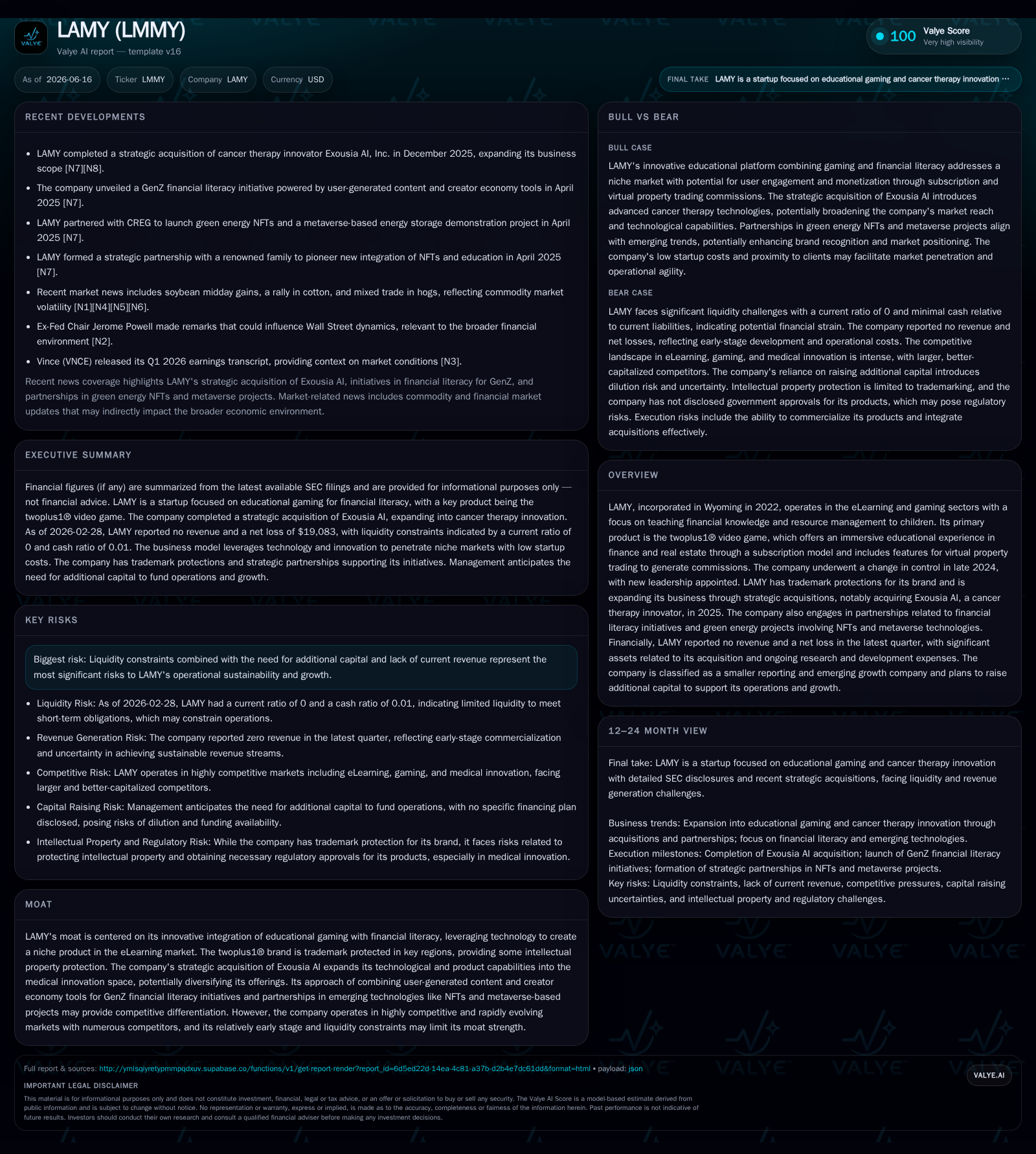
LAMY reported zero revenue and increasing net losses in its most recent quarter ended February 28, 2026, highlighting severe liquidity constraints including default on a $250,000 convertible note. The company has pivoted significantly from its original educational gaming business centered on the twoplus1® financial literacy video game to focus primarily on biotechnology innovation via its acquisition of Exousia AI, a clinical-stage oncology-focused firm. This strategic shift introduces new operational complexities and funding demands as LAMY attempts to balance early-stage biotech R&D expenses against its nascent subscription gaming model. The continuation of operations depends critically on successful capital raises in an uncertain financing environment.
The company reported a net loss of approximately $19,000 for the quarter and an accumulated deficit approaching $289,000 [S2]. A $250,000 convertible promissory note issued in January 2026 matured on March 26, 2026 and remains unpaid; default terms allow conversion at steep discounts potentially diluting shareholders heavily [S2]. These facts underscore the severity of near-term funding pressures.
The company anticipates that its working capital needs will increase materially as it builds out the Exousia AI business plan involving research-and-development expenditures, professional fees, regulatory compliance costs, and payroll additions [S2][S24]. Without access to traditional lines of credit or bank financing, LAMY continues to depend on private placement issuances and advances from related parties for funding [S2]. Management’s disclosure cautions that capital availability on acceptable terms is uncertain, heightening execution risk.
Business Model Evolution: Subscription Gaming Meets Clinical-Stage Biotechnology
Originally conceived as an eLearning startup focused on children's financial literacy through gamification, LAMY developed the twoplus1® video game to deliver immersive education in finance and real estate concepts via a competitive subscription model [S1]. The platform integrates monetization mechanisms such as commissions from virtual property trading within the game environment—embedding virtual goods trading dynamics akin to those seen in broader creator economies. This approach situates twoplus1® in the intersecting space between educational content delivery and interactive learning games leveraging gamification [S1]. Intellectual property protections cover the twoplus1® brand in key markets including the UK [S1], offering some differentiation.
However, since inception LAMY has struggled to generate tangible revenue from these activities. Reported revenues were zero for both the three months ended February 28, 2025 and February 28, 2026 [S2], indicating challenges in scaling subscribers or converting engagement into paying users. Against this backdrop of limited commercial traction in EdTech gaming, the company executed a pivotal strategic acquisition of Exousia AI in late 2025 [S20].
Exousia AI is a clinical-stage biotechnology company developing novel therapies exploiting exosomes with initial focus on oncology indications [S12][S20]. Its business model is fundamentally distinct from LAMY’s original subscription-based gamified education platform: biotech commercialization hinges on successful clinical trials, regulatory approvals, and market launches with inherently long timelines and high R&D intensity. Since acquiring Exousia AI through issuance of over 62 million shares as consideration [S20], LAMY rebranded itself as Exousia Bio effective January 2026 while retaining its original ticker [S20].
This dual-track operation combines an early-stage consumer-oriented educational gaming line with an emerging biotech pipeline reliant on capital-intensive research activities—a complex portfolio far removed from LAMY’s initial EdTech startup profile.
Competitive Positioning within Educational Gaming and Emerging Biotech Fields
In educational technology circles, key peers like Duolingo and Kahoot! provide benchmarks for gamified learning subscription models emphasizing user engagement growth and retention. Roblox's user-generated content ecosystem offers an example of harnessing a virtual economy with transactional monetization reminiscent of LAMY's virtual property trading model. However, unlike these established platforms with scalable MAU and proven monetization paths through freemium conversion or ARPU optimization, LAMY remains nascent with no reported revenue scale.
LAMY holds trademark protection for twoplus1®, which could afford some IP moat within niche financial literacy education for children—a narrowly targeted segment that combines edutainment with practical money management learning. Yet this moat is modest considering numerous competitors agilely innovating with low barriers to entry due to digital distribution channels.
On the biotechnology front, Exousia AI represents a complete departure from existing competitive sets. Clinical-stage biotech companies operate under rigorous regulatory scrutiny requiring substantial ongoing R&D spend before eventual product commercialization. While Exousia’s focus on exosome therapies may offer differentiated science-driven pipelines potentially addressing underserved oncological niches [S12], LAMY's integration into this field confronts inherent scientific development cycles alongside demanding capital needs. This diversification introduces operational risks uncommon to EdTech entities.
Growth Opportunities Anchored on Gamification, Virtual Economy, and Tech Integration
Despite early stage commercial performance setbacks, LAMY's foundational twoplus1® platform aligns with growing global demand for remote learning tools combining gamification with practical skills training such as financial literacy—an area gaining parental priority amid an increasingly complex economic environment for younger generations. The subscription model design supports scalability via recurring revenue potential contingent upon benefits realized through improved user engagement metrics such as subscriber growth rate and churn reduction.
Moreover, inclusion of virtual property trading embedded within the game opens monetization avenues tied to commission-based income linked directly to virtual transaction volume—similar mechanics employed by platforms blending educational content with microtransactions or NFT-enabled assets within metaverse ecosystems [S1]. Partnerships exploring NFT integration and metaverse functionalities aim to capitalize on emerging digital economies targeting GenZ consumers with creator economy dynamics underpinning user-generated content expansion.
Additionally, leveraging technology innovations can reduce operational overhead relative to traditional education methods by automating content delivery via learning management systems (LMS) integrated within engaging game environments. However, these opportunities depend fundamentally on overcoming initial barriers around customer acquisition cost (CAC) efficiency and transitioning free users into paying subscribers at sustainable conversion rates.
Risks: Capital Constraints, Market Adoption Hurdles, and Sectoral Complexity
LAMY faces pronounced risks stemming chiefly from inadequate liquidity—with no lines of credit available—and reliance on uncertain equity or convertible debt financings which threaten dilution risk especially given outstanding defaulted convertible instruments bearing punitive conversion discounts [S2][S24]. Failure to refinance or repay obligations could materially impact shareholder value.
Market adoption challenges also persist: user retention difficulties inherent in educational gaming are compounded by competition from seasoned peers offering broad content libraries supported by established brand recognition. Conversion hurdles from free-to-paid usage reflect common industry monetization risks especially for startups lacking scale economies.
The pivot into clinical-stage biotechnology compounds execution complexity as success now depends heavily on regulatory milestones unattainable without sustained R&D investment. This sector involves longer timelines before tangible returns emerge compared to digital subscription products—further exacerbating near-term cash burn concerns.
Moreover, transitional integration risks arise attempting to operate simultaneously within highly divergent sectors (EdTech gaming versus biotech therapeutics), each governed by distinct competitive forces, regulatory environments (notably children's online data privacy laws vs FDA drug approval processes), and stakeholder expectations.
Looking Ahead: Capital Raising Milestones, Product Commercialization Timelines, and User Engagement Signals
Over the next twelve months management must address critical financing gaps—including restructuring or repaying maturing convertible notes—to sustain operations while scaling Exousia AI’s R&D initiatives alongside nurturing progress with its twoplus1® platform subscription growth strategy [S2][S24]. Monitoring will focus keenly on capital raise success indicative by any announced equity or debt issuances.
Measurement of subscriber growth rate alongside churn will serve as leading user engagement indicators for the educational game’s commercial viability; progress toward establishing recurring revenue streams is essential given current lack thereof. Concurrently, milestones related to clinical trial advancements or intellectual property licensing arrangements emerging from Exousia Bio’s pipeline may materially influence investor sentiment.
Operational execution includes managing monthly service fees stipulated under technical support agreements (e.g., ProgeniX service agreement) while containing administrative overhead amid expanding regulatory compliance burdens related to both segments [S24]. Transparency around timelines for product commercialization remains limited but will be decisive going forward.
This analysis uses exclusively verified information drawn directly from LAMY's latest SEC disclosures without speculation beyond evidenced claims. It highlights a startup grappling simultaneously with pioneering educational technology ambitions while navigating entry into biotechnological drug development—a duality creating both opportunities for innovation-led differentiation and substantial execution risks amid tight liquidity.
Disclaimer: This is research-only, informational analysis and not investment advice. It may include AI-generated interpretation and general industry context. Always verify important details using primary sources.

Comments