
Vistagen Therapeutics Advances Clinical Pipeline Amid Positive Phase 3 Progress
The company's latest quarterly filing highlights clinical trial advancements and strategic licensing developments pivotal for its intranasal pherine drug platform.
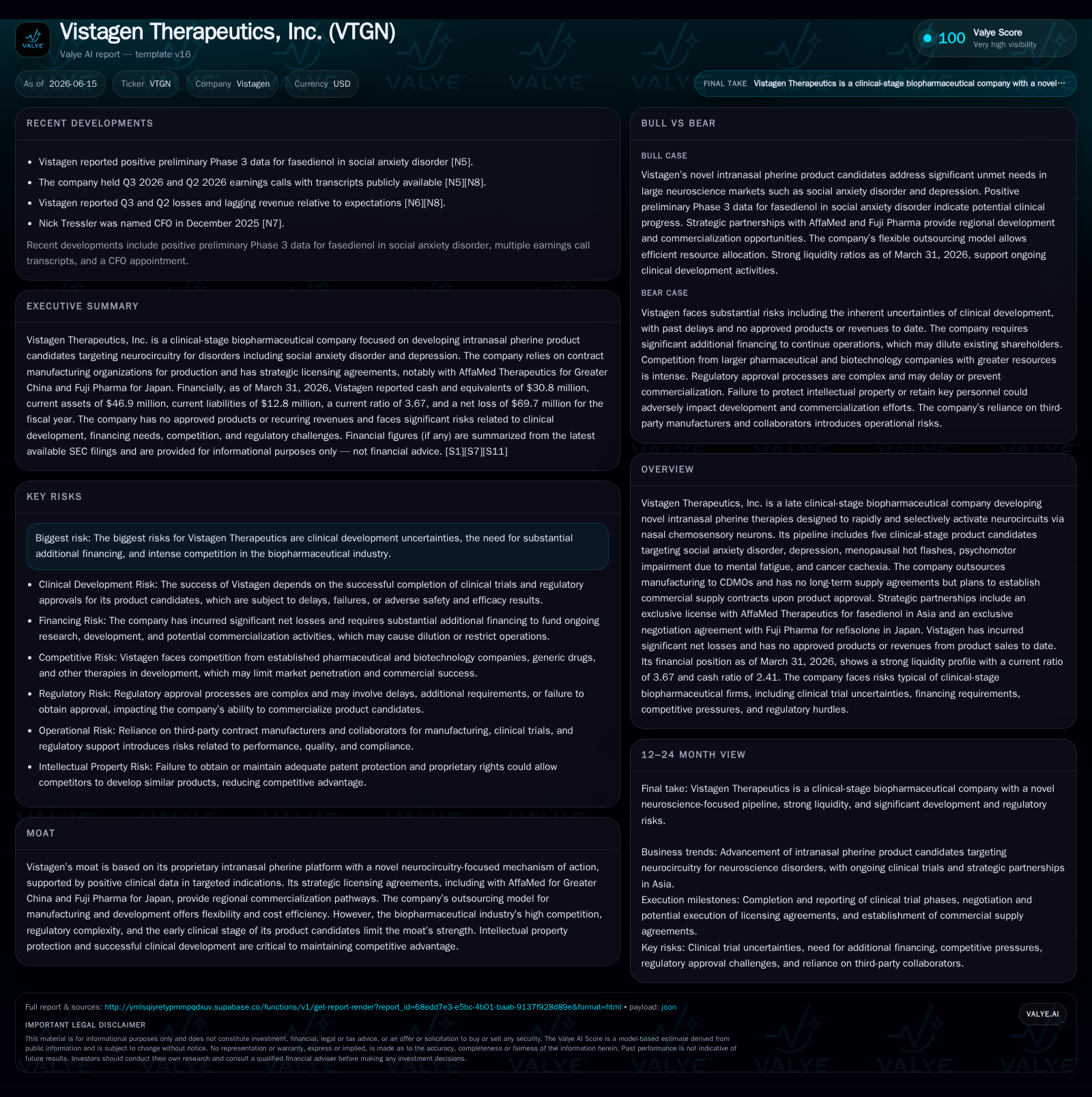
Vistagen Therapeutics reported encouraging preliminary Phase 3 data for its lead candidate, fasedienol, in social anxiety disorder, marking a significant clinical milestone. The company's distinct intranasal pherine platform leverages neurocircuitry activation with ongoing trials across multiple CNS and related indications. Strategic licensing agreements with AffaMed Therapeutics for Asia and Fuji Pharma for Japan position Vistagen for regional commercialization while manufacturing remains outsourced to CDMOs. Despite substantial net losses and ongoing financing needs, the latest filings signal progress towards regulatory submissions and potential market entry.
Latest Quarterly Operating Highlights and Clinical Milestones
In its February 2026 10-Q filing [S2], Vistagen Therapeutics disclosed critical progress in its clinical development activities, particularly reporting encouraging preliminary Phase 3 results for its lead candidate fasedienol aimed at treating social anxiety disorder (SAD). This positive readout signals a pivotal moment as it underpins expectations of regulatory submission steps later in the year. Complementing this, a May 2026 press release confirmed the completion of patient visits in the PALISADE-3 Phase 3 study [S14] along with positive interim efficacy signals announced shortly thereafter [N5]. These developments indicate a robust clinical trial enrollment pace and reinforce confidence in meeting specified endpoint criteria—a vital KPI for late-stage biopharmaceutical companies targeting CNS indications.
Vistagen’s Business Model: Intranasal Pherines and Licensing Strategy
Vistagen’s business model centers on proprietary intranasal pherine drug candidates engineered to activate brain neurocircuits rapidly via nasal chemosensory neurons without systemic circulation involvement [S1]. This innovative mechanism of action differentiates it from traditional small molecules or biologics that rely on systemic distribution or blood-brain barrier penetration. The company currently advances five clinical-stage product candidates covering several high unmet medical need areas including social anxiety disorder, depression, menopausal vasomotor symptoms (hot flashes), mental fatigue-induced psychomotor impairment, and cancer cachexia [S1].
Revenue generation anticipates milestone payments and royalties mostly derived from regional licensing agreements rather than direct product sales at this stage. Notably, the exclusive license deal with AffaMed Therapeutics grants rights for fasedienol development and commercialization across Greater China and Southeast Asia regions [S6]. This arrangement includes upfront payments received by Vistagen ($5 million) plus further regulatory, developmental, and sales milestones aligned with product advancement. Separately, Vistagen is engaged in an exclusive negotiation period with Fuji Pharma to develop refisolone for menopausal hot flashes in Japan—with a non-refundable payment of $1.5 million acting as consideration during these discussions [S26].
Manufacturing responsibility lies entirely with external contract development and manufacturing organizations (CDMOs), chosen for cost efficiency and flexibility. While no long-term commercial supply contracts exist as yet, operational plans dictate entering such agreements post-approval to scale product output [S22]. This outsourcing model avoids substantial fixed overhead while enabling scalability aligned with market launch.
Industry Context: Biotech Competition and Regulatory Considerations
Operating within the biotechnology sector's late-clinical stage therapeutic segment focused on central nervous system (CNS) disorders places Vistagen among firms striving against significant clinical and regulatory barriers. The company's intranasal mechanism represents a technological niche relative to peers working on novel CNS agents requiring systemic exposure or complex biologic modalities. Regulatory scrutiny by agencies like the FDA is stringent given the novelty of intranasal neurocircuitry activation approaches; successful navigation depends heavily on clean safety profiles alongside demonstrable efficacy endpoints reflecting meaningful patient benefit.
CNS drug development pipelines generally face high attrition rates stemming from difficulties in demonstrating durable clinical effectiveness amid placebo effects common in psychiatric trials. Additionally, patent life preservation via term extensions post-FDA approval will be critical to defend commercial positioning once on market [S1]
Growth Prospects: Pipeline Development and Partner Expansion
Vistagen’s growth trajectory hinges upon advancing multiple pipeline candidates through pivotal trials toward FDA submissions. Besides fasedienol’s ongoing Phase 3 progression with upcoming full data readouts anticipated soon [S14][N5], early-stage programs like refisolone are poised to enter or have initiated late-stage clinical evaluations bolstered by recent FDA "Study May Proceed" letters [S18].
Licensing partnerships offer strategic leverage—AffaMed assumes development costs within their territory while Vistagen retains rights elsewhere, allowing capital-efficient global reach without overextension of internal resources [S6]. Further commercialization collaborations could materialize from exclusive negotiations underway in Japan via Fuji Pharma or other geographic expansions consistent with industry norms.
Increased R&D expenditures reported reflect deliberate investment into pipeline diversification likely targeting faster-to-market or complementary indications underpinning sustainable revenue streams post-approval [S2]. The adoption of intranasal delivery platforms meets growing demand among clinicians seeking rapid-onset symptom control treatments—especially relevant in psychiatric afflictions exhibiting episodic exacerbations.
Key Risks: Clinical Uncertainties and Financing Needs
The risk environment retains typical biotechnology dynamics characterized by substantial clinical trial failure probabilities despite positive interim findings [S2][S16]. Regulatory approvals remain uncertain particularly due to the novel mechanism where limited precedent exists—requiring extensive safety evaluations alongside efficacy demonstrations.
Competitive pressures across targeted indications add complexity; many large pharmas pursue CNS disorders aggressively employing varied platforms which could limit market penetration if Vistagen’s products do not demonstrate superior risk-benefit profiles or differentiated patient outcomes.
What to Watch: Upcoming Data Releases and Regulatory Filings
Key near-term catalysts include completion and full disclosure of PALISADE-3 Phase 3 data for fasedienol as well as initiation/advancement markers associated with refisolone pending FDA submissions following positive study signals [S2][N5][S26]. Milestone achievements under licensing deals remain watchpoints potentially unlocking non-dilutive funding streams.
Monitoring updates from ongoing exclusive negotiations with Fuji Pharma will illuminate strategic choices regarding Japanese market entry timing [S26]. Additionally, announcements concerning new partnerships or commercial supply agreements post-clinical validation would be material indicators of readiness toward commercialization.
Financial Overview: Cash Position and Funding Outlook
As per the most recent financials dated March 31, 2026 [F1], Vistagen held $30.8 million in cash and equivalents alongside total debt approximating $15.9 million resulting in net cash positioning supportive of near-term operations absent unforeseen developments.
Operating losses remain substantial at nearly $72 million annually driven by continued research & development investments vital for progression across the pipeline [F1]. Absent product revenue streams presently, funding strategies must focus on capital markets or licensing-derived income to sustain forward momentum through costly pivotal phases. The company’s outsourcing strategy mitigates fixed cost expansion but eventual requirements to secure commercial manufacturing agreements post-approval will contribute significantly to future capital needs.
This analysis draws solely on reported SEC filings and public disclosures to encapsulate Vistagen Therapeutics' current operational status within the evolving biotechnology landscape specializing in CNS-targeted intranasal therapies. Such companies embody inherently high-risk/high-reward profiles shaped by binary clinical outcomes coupled with strategic partner validations yet reliant on successful execution amid competitive innovation environments.
All assessments avoid speculative commentary beyond established facts presented here to provide an informed industry perspective aligned with best practices in biotech company evaluation.
Disclaimer: This is research-only, informational analysis and not investment advice. It may include AI-generated interpretation and general industry context. Always verify important details using primary sources.

Comments