
Leonardo DRS Strengthens Backlog and Technology Footprint Amid Defense Spending Cycles
Latest quarterly results reflect backlog growth and strategic acquisitions reinforcing Leonardo DRS’s position in advanced defense technologies amid U.S. defense budget dynamics.
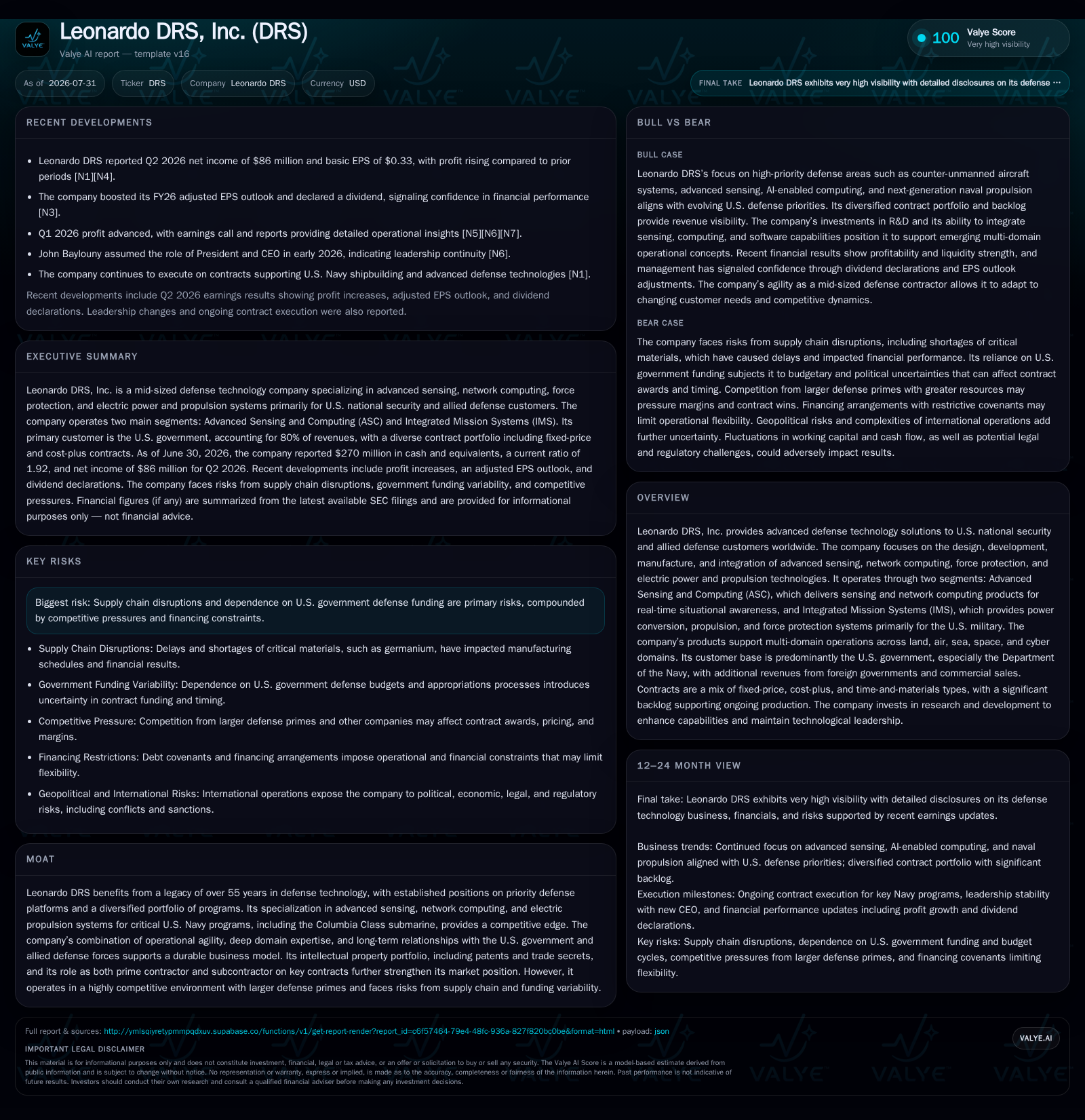
Leonardo DRS reported a meaningful increase in its funded contract backlog as of June 30, 2026, underscoring stronger near-term revenue visibility despite ongoing challenges in government appropriations timing. The company’s two distinct segments—Advanced Sensing and Computing (ASC) and Integrated Mission Systems (IMS)—continue to deliver solutions aligned with Department of the Navy priorities, especially in naval propulsion and AI-enabled sensing. Against a backdrop of intense competition involving larger defense primes, Leonardo DRS leverages its mid-tier agility and diversified portfolio to capture growth in multi-domain operational technologies. Key risks revolve around supply chain constraints and government funding variability. Financially, Leonardo DRS maintains solid liquidity and a conservative net debt profile that supports operational flexibility.
Quarterly Backlog Trends Provide Clear Forward Revenue Signal
Leonardo DRS reported an increase in its funded contract backlog to approximately $4.64 billion as of June 30, 2026, up from $4.18 billion at the end of 2025 [S2][S1]. This expansion signals improved revenue visibility over the near term despite persistent challenges related to U.S. government appropriations timing inherent in defense procurement cycles. Notably, funded backlog reflects orders for which the government has appropriated or authorized funds less amounts already recognized as revenue, offering a concrete measure of contractually supported future revenues. The growth trend aligns with higher order intake levels driven by sustained demand for advanced sensing and naval propulsion technologies that are central to U.S. Department of the Navy priorities. However, unfunded backlog—orders contracted but not yet appropriated—remains a contingent revenue source sensitive to budget volatility. This distinction underscores the ongoing risk that delays or cancellations in funding could affect revenue realization timing.
Two-Segment Business Model Anchored in Advanced Sensing and Naval Propulsion
Leonardo DRS monetizes its long-term government contracts through two principal technology-driven segments: Advanced Sensing and Computing (ASC) and Integrated Mission Systems (IMS) [S1]. ASC delivers electro-optical sensors, network computing systems, and AI-enabled situational awareness solutions that support decision-making across contested environments including land, sea, air, space, and cyber domains. IMS concentrates on electric power conversion, propulsion systems for next-generation naval vessels such as the Columbia Class submarine program, and force protection technologies enhancing survivability.
The product portfolios reflect complementary market niches responding to evolving DoD warfare priorities emphasizing multi-domain operations integration. Within these segments, contract types vary between fixed-price agreements exposing margins to cost risks during inflationary pressures and cost-plus contracts offering more stable margin profiles subject to contract execution efficiency. Margins tend to be tighter on fixed-price projects requiring precise program management but provide upside when execution exceeds plan. The diversity across contract types affords Leonardo DRS balanced exposure while leveraging its engineering capabilities.
Competitive Positioning amid Larger Defense Primes and Procurement Cyclicality
As a mid-tier defense technology integrator, Leonardo DRS differentiates itself through a combination of specialized domain expertise—particularly in naval propulsion and advanced sensing—and operational agility compared with larger defense primes such as Lockheed Martin or Northrop Grumman [S1][N1]. While larger primes command scale advantages and broader customer portfolios, Leonardo DRS leverages focused intellectual property holdings including electro-optical sensor technologies and proprietary power systems to maintain competitive relevance.
However, the company faces headwinds from the dominance of established primes that often control broad platform contracts along with elevated supply chain complexity amplified by geopolitical issues affecting component availability. Government contracting dynamics exert additional cyclicality due to annual appropriations processes tied to the federal fiscal year ending September 30. Timing mismatches between contract awards, funding certifications, and delivery schedules contribute to variability in current quarter revenues that require careful management.
Growth Drivers Centered on Multi-Domain Operational Capabilities
The strategic growth trajectory for Leonardo DRS is anchored in secular demand trends including increased U.S. defense budgets focused on modernization initiatives spanning C-UAS (Counter-Unmanned Aircraft Systems), layered air and missile defense architectures, electronic warfare enhancements, and next-generation naval shipbuilding aligned with national security imperatives [S1][N1]. The company’s investments into AI-enabled sensing solutions within the ASC segment target expanding requirements for autonomous threat detection capabilities in increasingly contested environments.
Additionally, reiterative procurement by allied foreign governments offers potential upside from international sales albeit constituting a smaller portion (~8%-13%) of total revenues historically [S1]. Complementing organic technology advancements are strategic acquisitions such as the July 2026 announced definitive agreement to acquire Raft LLC which augments Leonardo DRS’s propulsion technology base supporting its integrated mission systems roadmap [S16]. This acquisition exemplifies proactive portfolio recalibration consistent with evolving defense needs.
Risks Focused on Contract Execution, Supply Chain, and Funding Volatility
Leonardo DRS acknowledges several material operating risks including exposure inherent in fixed-price contract arrangements that increase vulnerability to cost overruns especially amid inflationary pressures impacting raw materials like germanium semiconductors used in sensors [S7][S1]. Supply shortages can delay manufacturing throughput thereby disrupting delivery milestones critical for revenue recognition timelines.
Moreover, dependency on timely government funding raises uncertainty around order inflows; any protracted delays or reductions due to legislative gridlock or shifting DoD priorities may adversely impact financial performance. Regulatory compliance also remains complex given extensive requirements covering facility security clearances necessary for classified contract work under the National Industrial Security Program Operating Manual—failure here could curtail project eligibility.
Competition further intensifies pressure especially from well-resourced primes capable of leveraging scale economies across diversified program portfolios affecting pricing power.
Upcoming Milestones: Contract Awards, Funding Decisions, Program Deliveries
Key upcoming operational touchpoints include monitoring contract award rounds scheduled toward end-of-federal-fiscal-year periods when customers seek to obligate expiring budgets [S2][N1]. These windows influence order intake rates directly impacting funded backlog replenishment critical for sustaining revenue momentum.
Program delivery milestones tied to major naval propulsion initiatives alongside sensing system integrations will serve as tangible execution markers validating backlog conversion into revenue streams. Strategic assessments will focus on on-time delivery rates and successful passage through rigorous customer acceptance processes which underpin margin realization.
Brief Financial Profile Discussion: Liquidity Strength Supports Operating Stability
As of June 30, 2026, Leonardo DRS maintained a strong liquidity position characterized by approximately $270 million in cash & equivalents against total debt of roughly $139 million resulting in an approximate net cash position (negative net debt) of $131 million [F1]. The current ratio stood at about 1.92 reflecting healthy working capital adequacy suitable for navigating near-term funding cyclicality inherent in defense contracting [F1][S2].
This conservative leverage profile reduces refinancing risk amid volatile credit markets while supporting discretionary investment capacity in R&D—which accelerated notably with independent research expenses rising alongside customer-funded development costs—and targeted acquisitions such as Raft LLC enhancing technology depth [S1][S16]. Maintaining access to capital markets via existing credit agreements subject to typical covenants further underpins operational flexibility vital within this capital-intensive sector.
This analysis synthesizes information from Leonardo DRS's latest filings combined with industry context relevant to mid-tier defense technology suppliers navigating multi-domain operations amid federal budget cycles. It does not constitute investment advice or research views.
Disclaimer: This is research-only, informational analysis and not investment advice. It may include AI-generated interpretation and general industry context. Always verify important details using primary sources.

Comments