
AGNC Investment's Leverage and Hedging Strategy Shift in Q2 2026
AGNC’s latest quarterly filing reveals strategic leverage adjustments and refined hedging calibrations to sustain dividends amid evolving interest rate dynamics.
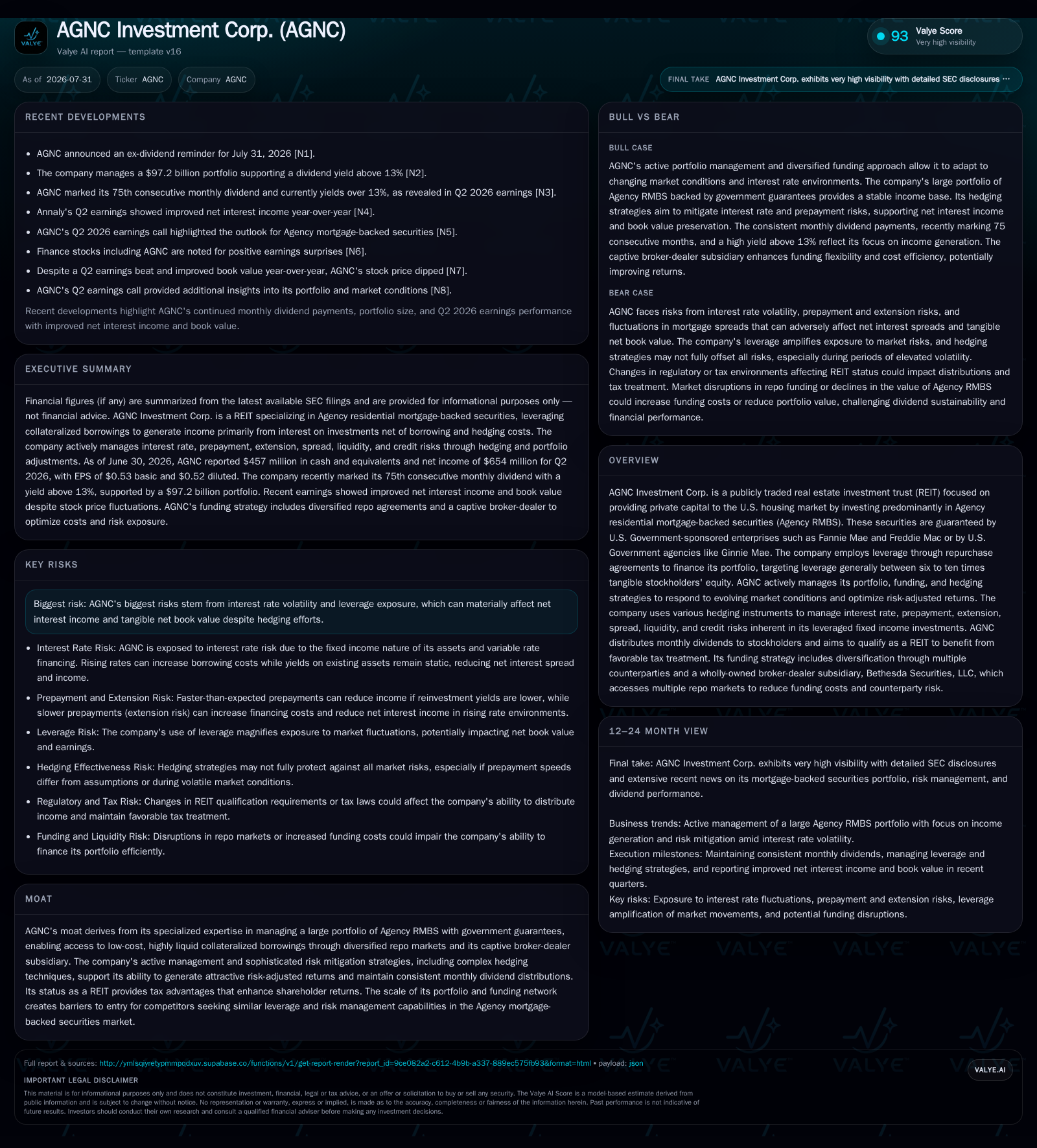
In its July 31, 2026, 10-Q filing, AGNC Investment Corp. reported tactical shifts in portfolio leverage and hedging in response to rising interest rate volatility. The mortgage REIT’s core model of borrowing short term to invest in longer-duration Agency RMBS remains intact, with active management of net interest spread and duration gap crucial to preserving dividend distributions. Compared to peers like Annaly Capital and Two Harbors, AGNC continues leveraging its broker-dealer subsidiary for funding advantages while navigating prepayment and extension risks. Key risks persist around interest rate fluctuations and leverage sensitivity, with investor focus on upcoming dividend declarations and hedge effectiveness.
Q2 2026 Operating Metrics Highlight Strategic Leverage Rebalancing
AGNC Investment Corp.’s latest quarterly filing dated July 31, 2026, signaled a deliberate rebalancing of its leverage strategy amid heightened interest rate uncertainty [S2]. The company reported a tangible net book value "at risk" leverage ratio modestly below historical peaks, reflecting management’s response to mitigate downside risks associated with rising short-term borrowing costs. Net interest income (NII) showed improvement over previous quarters despite the constrained margin environment driven by the Fed's tightening cycle [S2]. This suggests that AGNC’s dynamic portfolio adjustments and calibrated hedging efforts are producing effective offsetting gains against increased financing expenses.
Moreover, commentary around the quarter emphasized enhancements in hedge calibration targeting duration gap management and prepayment risk mitigation [S3]. These shifts align closely with market rate volatility patterns observed during mid-2026 that adversely affect mortgage REITs’ asset-liability sensitivity. The firm’s ongoing recalibration aims to stabilize earnings streams critical for sustaining monthly dividend distributions [N1]. This near-term operational update underscores an active risk management posture rather than a broad strategic shift.
How AGNC’s Business Model Extracts Income from Agency RMBS Amid Rate Volatility
As detailed in AGNC’s annual report earlier this year [S1], the company operates predominantly within the Agency residential mortgage-backed securities (Agency RMBS) space. These securities carry explicit guarantees from U.S. Government-sponsored enterprises such as Fannie Mae and Freddie Mac or government agencies like Ginnie Mae. This government backing provides a cornerstone credit enhancement that limits default risk for AGNC’s portfolio.
AGNC employs collateralized repurchase agreements (repo) extensively to finance its asset base—borrowing short term at variable rates while investing primarily in longer-duration fixed-rate Agency RMBS. The company's profitability hinges on capturing a positive net interest spread between yields on its mortgage assets and the cost of these borrowings. However, given the fixed nature of asset coupons versus floating borrowing costs, rising interest rates typically compress net spreads absent active mitigation.
Key operating levers include meticulous management of duration gaps — the differential sensitivity of asset values versus liabilities to interest rate changes — alongside convexity considerations that arise due to mortgage prepayment behaviors. AGNC deploys sophisticated hedging instruments such as interest rate swaps, swaptions, U.S. Treasury futures contracts, and collateralized mortgage obligations (CMOs) structured for risk reduction [S1]. These tools allow it to temper exposure to unfavorable changes in prepayment speeds or extension risks that can rapidly alter the effective duration of liabilities or assets.
Industry Position: Peer Comparison of Leverage and Hedging Sophistication in Mortgage REITs
Within the mortgage REIT industry cohort—including peers like Annaly Capital Management and Two Harbors Investment Corp.—AGNC stands out for its integrated approach combining active portfolio management with a captive broker-dealer subsidiary [N2]. This subsidiary facilitates access to diverse repo funding sources at competitive costs, granting AGNC an edge in liquidity depth relative to some peers who rely predominantly on external counterparties.
AGNC generally maintains leverage ratios within a target range that balances return amplification against regulatory restrictions and NAV volatility. Compared to Annaly’s typically more aggressive leverage postures or Two Harbors’ distinct agency-focused strategies, AGNC’s cautious trimming post-Q2 signifies prudent capital stewardship amid rising rate headwinds.
Additionally, peer analyses highlight that AGNC has delivered relatively consistent monthly dividends—now surpassing a remarkable 75 consecutive months [N1]—underscoring effective hedging discipline relative to industry benchmarks where sustained dividend payments remain a key investor criterion. The nuanced calibration of hedge portfolios aimed at neutralizing duration mismatches places AGNC among top-tier operators skilled at mitigating volatile NAV swings common across mortgage REITs.
Key Growth Catalysts: Agency Market Expansion and Refinancing Activity Underwatch
Growth prospects for AGNC fundamentally tie back to the underlying health and size of the U.S. residential mortgage market. Expansion in Agency RMBS issuance bolsters available investment inventory—a direct input into AGNC’s portfolio construction options [S1]. Moreover, monetary policies influencing prevailing mortgage rates shape refinancing activity levels; elevated refinancing triggers increased prepayment speeds that affect yield realization but also free capital for reinvestment.
Housing affordability metrics further influence demand dynamics for new mortgages underpinning Agency RMBS supply. While rising mortgage rates can dampen homebuyer activity long term, transient surges or policy adjustments can introduce episodic volume growth favoring institutions like AGNC.
The company’s ability to access diversified repo financing channels via its dedicated broker-dealer arm enhances agility in scaling positions when market conditions warrant it [S1]. These structural enablers fortify AGNC’s capacity to capitalize on favorable windows within an otherwise macro-driven sector characterized by cyclical refinancing waves.
Risk Factors: Interest Rate Fluctuations, Prepayment Dynamics, and Leverage Sensitivities
AGNC explicitly acknowledges several material risks inherent to its operating model. Foremost is sensitivity to interest rate volatility which can erode net interest spreads swiftly since liabilities reset faster than asset yields; this dynamic is exacerbated by negative convexity effects where price declines accelerate beyond linear duration estimates [S1]
Leverage amplifies these movements as borrowing magnifies exposure—heightened losses on asset values or compressed spreads directly impact tangible net book value per share. Additionally, mortgage prepayment variability poses challenges: faster-than-forecasted prepayments reduce expected income duration while slower prepayments extend portfolio lives unexpectedly [S1]. Both scenarios can impair hedging effectiveness since assumptions built into swaps or futures may become misaligned with actual cash flows.
Liquidity constraints within repo markets also pose risk during stress periods when funding costs spike or availability wanes, possibly forcing deleveraging at unfavorable prices [S2]. Attention should be paid to any managerial commentary around acceptable leverage ranges following current conservative posture changes identified in Q2 filings
Further updates on adjustments made within the hedge portfolio—particularly how rapidly evolving swaption volatilities or Treasury curve shifts are incorporated—will be key measures of ongoing risk mitigation efficacy [S3]. Investors will benefit from monitoring tangible net book value fluctuations reported each quarter as proxies for embedded risk outcomes post-hedge recalibrations.
Finally, external macro factors such as Federal Reserve policy signals shaping short-term rates will invariably impact borrowing costs feeding into net spread calculations; how adeptly AGNC navigates these through capital structure decisions will materially influence shareholder returns going forward.
Financial Profile Discussion: Liquidity Status and Earnings Support Dividend Sustainability
At June 30, 2026, AGNC reported $457 million of cash and cash equivalents providing a solid liquidity buffer supporting operational flexibility under current financial conditions [F1]. The firm generated net income of $1.67 billion during fiscal year 2025 demonstrating strong income generation capability amidst fluctuating rates [F1]. Expense ratios remain tightly controlled relative to assets under management supporting margin stabilization necessary for dividend commitments.
While precise quarter-end debt levels were not explicitly disclosed outside leveraged ratio contexts in filings examined here [S2], it is evident from trailing data that management pursues active deleveraging as warranted by market signals without compromising return targets. This balanced approach reflects an awareness of regulatory requirements tied to REIT qualification alongside investor appetite for high-yield equity instruments.
This analysis focuses strictly on publicly disclosed information from SEC filings dated through July 31, 2026; no forward-looking guidance or speculation has been included beyond observed trends or confirmed corporate disclosures. Readers should consider market developments subsequent to these dates separately when forming their own assessments.
Disclaimer: This is research-only, informational analysis and not investment advice. It may include AI-generated interpretation and general industry context. Always verify important details using primary sources.

Comments