
SouthState Bank Expands Through Acquisition and Capital Optimization in Q2 2026
Recent quarterly results reveal SouthState's acquisition-driven growth and capital management amid evolving interest rate dynamics.
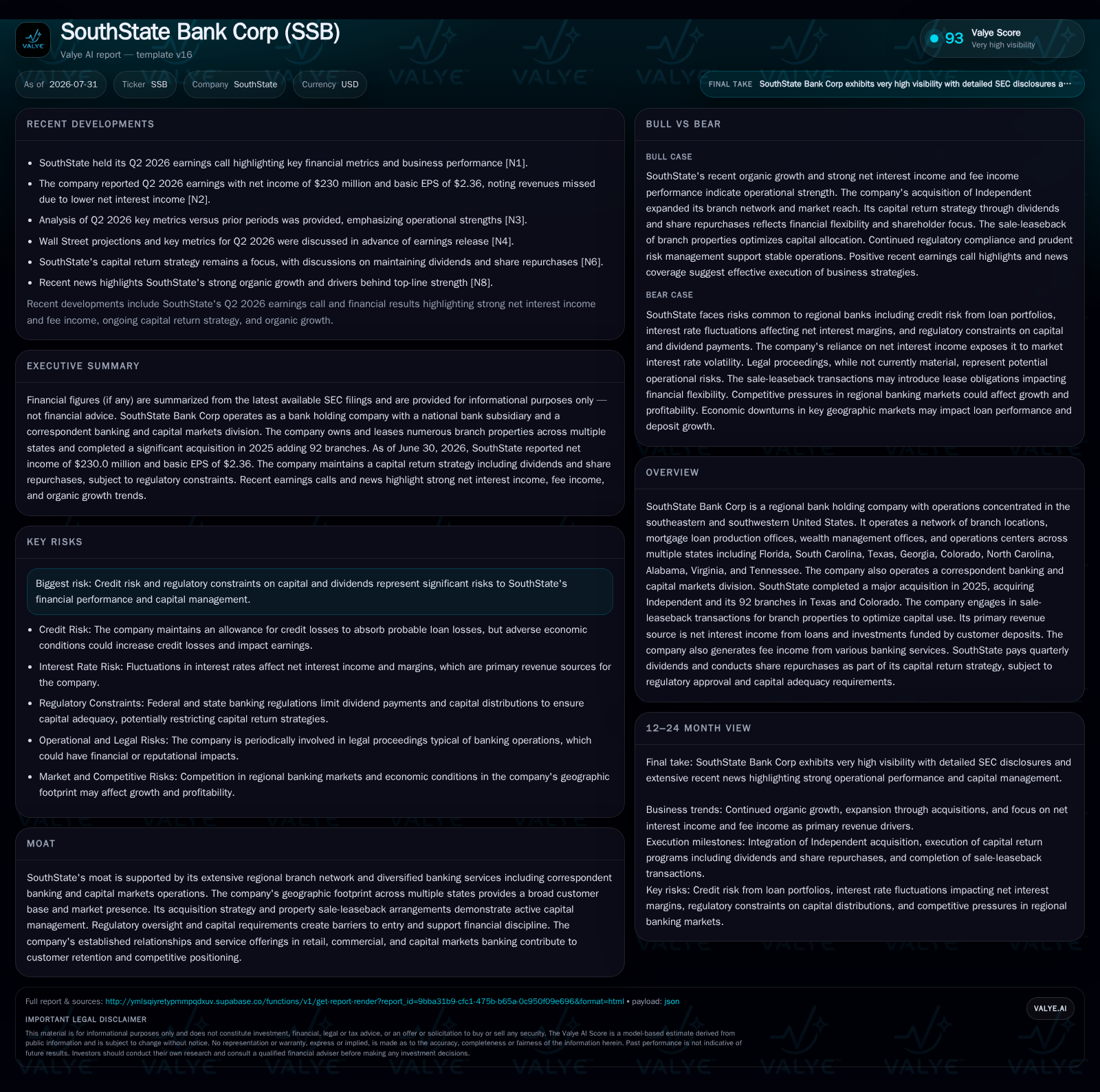
SouthState Bank Corp’s latest quarterly update highlights the ongoing integration benefits of its 2025 acquisition of Independent, which expanded its branch network across Texas and Colorado. The company continues to leverage sale-leaseback transactions to optimize capital deployment, while balancing net interest income pressures from a shifting rate environment. Its diversified service lines in correspondent banking and capital markets support fee income streams, contributing to overall earnings resilience. Regulatory capital adequacy remains sound, enabling a dividend increase announced in July 2026.
Recent Operating Update
SouthState Bank Corp’s second quarter 2026 filing confirms a strategic continuation of its growth and capital efficiency initiatives anchored by the January 2025 acquisition of Independent. This acquisition added 92 branches across Texas and Colorado, notably expanding SouthState’s southwestern presence beyond its traditional southeastern base [S1]. The integration of these branches is central to loan portfolio expansion strategies and wider customer reach in dynamic regional markets.
In parallel, SouthState effectuated a significant sale-leaseback transaction involving branch properties in multiple southeastern states including Florida, South Carolina, Georgia, North Carolina, Alabama, and Virginia. Closing on February 28, 2025, this move transferred ownership of select real estate assets to Blue Owl Real Estate Capital while SouthState entered triple-net leases to continue branch operations uninterrupted [S1]. This capital-light approach frees up balance sheet capacity for lending or other purposes while maintaining operational footprint.
The latest 10-Q for Q2 2026 highlights mixed financial trends typical of the current rate environment. Despite net interest income (NII) pressures stemming from interest rate fluctuations impacting loan yields versus deposit costs [N2],[S2], the bank’s diversified fee income streams — including correspondent banking commissions, wealth management fees, and capital markets activities — provided offsetting revenue support [S1]. The board approved a dividend increase from $0.60 to $0.66 per share effective August 14, 2026 [S3], signaling maintained confidence in earnings stability and strong regulatory capital ratios.
Business Model Overview
As a regional bank holding company operating predominantly in the southeastern and southwestern United States, SouthState generates primary revenue through net interest income. This is realized by deploying customer deposits into retail and commercial loans—spanning mortgage loans produced via specialized offices—and investing excess funds prudently within securities portfolios. The acquired Independent branches contribute directly to expanding the loan book and deposit base within Texas and Colorado markets.
Complementing this core lending activity is a growing focus on non-interest income derived from fee-generating businesses [S1]. Wealth management offices across multiple states provide advisory services commanding advisory fees; mortgage production offices bolster origination volumes generating loan-related fees; meanwhile, correspondent banking operations facilitate liquidity management solutions for smaller banks generating fee spreads; lastly, the capital markets division engages in bond sales and trading activities primarily out of Georgia, Alabama, Tennessee, and California locations
Operationally, SouthState maintains over 400 physical locations combining owned (108) and leased (299) properties used as branches or operational centers [S1]. The utilization of sale-leaseback transactions embodies a strategic effort to convert real estate assets into liquid capital while preserving customer-facing presence. These leasing arrangements with Blue Owl Real Estate enable predictability of occupancy costs under triple-net leases.
Revenue mechanics hinge on volume growth through increased loans offset by deposit costs sensitivity amid fluctuating interest rates. Fee income acts as a stabilizing complement particularly when NII margins compress. Loan-to-deposit ratio monitoring ensures liquidity balance while asset quality metrics guide credit risk provisioning policies.
Industry Structure and Competitive Position
SouthState occupies a distinctive niche among regional bank holding companies serving multi-state geographic footprints but concentrating on sub-national markets where relationship banking provides competitive advantage. Its peers such as Regions Financial Corporation or Trustmark Corporation similarly blend comprehensive retail/commercial banking with ancillary wealth management and capital markets platforms.
Regional banks rely heavily on branch networks as critical distribution channels influencing customer acquisition, retention, deposits gathering, and cross-selling opportunities essential for diversified revenue generation. SouthState’s acquisition-driven expansion strategy parallels Independent Bank Group’s model where scale gains in key states broaden market penetration while leveraging existing operational infrastructure.
Sale-leaseback transactions are increasingly common among mid-sized regional banks seeking optimized balance sheets without sacrificing branch footprint—a tactic also utilized by entities partnering with firms like Blue Owl Real Estate Capital. Regulation imposing minimum tier one capital ratios (e.g., CET1 ratio) enforces discipline in lending growth versus capital accumulation constraining overly aggressive expansion but protecting solvency.
Growth Drivers
A primary engine of growth is the sequential expansion of branch networks through acquisitions such as the Independent deal finalized early 2025 [S1]. This enhances geographic diversification reducing concentration risks related to local economic cycles while broadening customer bases for deposits and lending products.
Loan portfolio growth follows this expanded footprint particularly within commercial real estate, small business lending, consumer mortgages originated through dedicated offices, potentially increasing net interest income contingent on favorable rate spreads. Deposit base growth driven by branch presence supports these lending efforts maintaining healthy loan-to-deposit ratios crucial for liquidity stability.
In parallel, increasing penetration into wealth management services fosters fee income diversification vital during periods of NII margin compression from fluctuating rate environments [N2]. Correspondent banking operations provide additional revenue variability tied to interbank transaction flows while capital markets activities capitalize on bond issuance demand among institutional clients.
Risks and Watchpoints
Key risks remain rooted primarily in credit exposure inherent to retail and commercial loan portfolios—adverse economic shifts could elevate non-performing loans impacting provision charges adversely affecting net income [S1]. Persistent regulatory constraints regarding minimum regulatory capital levels limit flexibility in dividend policy or aggressive organic growth endeavors.
Interest rate volatility poses ongoing margin pressure risks; should rising deposit costs outpace asset yield growth it can compress net interest margins materially despite fee income offsets observed so far. Additionally, integration challenges exist when assimilating acquired branches including systems consolidation or cultural alignment which could temporarily depress operating efficiency ratios.
Competitive pressures also mount from larger national banks extending regional reach alongside fintech players innovating customer interface or product delivery potentially eroding client wallet share over time.
What to Watch Next
Subsequent quarters will shed light on how well SouthState manages sustained net interest margin pressures amid prevailing interest rate dynamics—metrics such as loan growth rates versus deposit expansion adjusted for mix changes will be pivotal indicators.[S2],[N3]
Monitoring credit quality trends via non-performing loans ratio changes can indicate emerging asset risks requiring cautious provisioning amidst macroeconomic uncertainties.[S1]
Capital adequacy reports post-integration will clarify regulatory buffer status influencing potential dividend sustainability or share repurchases following the recent payout raise announcement [S3].
Further acquisition activity or additional sale-leaseback arrangements would signal continued commitment to geographic diversification coupled with balance sheet optimization strategies enhancing long-term earnings power.
Financial Profile Discussion
Dividend increases corroborate adequate retained earnings availability after meeting regulatory capital standards fostering shareholder value return policies that align with long-term growth aspirations [S3].
Efficiency ratios reflective of operating cost versus revenue generation merit close watching post-acquisition since any rises could undermine margin accretion anticipated from scale economies demonstrated by peers like City Holding Company or Regions Financial Corporation.
Maintaining CET1 ratios above mandated thresholds remains imperative ensuring continued operational flexibility particularly given cyclical sensitivities involved in mortgage origination cycles or commercial loan performance.
Disclaimer: This analysis is based solely on publicly available SEC filings dated through July 31, 2026, company disclosures including recent earnings releases as cited, industry knowledge frameworks for regional banking sectors, and third-party news sources referenced. It does not constitute investment advice or research views regarding securities of SouthState Bank Corp or any related instruments.
Disclaimer: This is research-only, informational analysis and not investment advice. It may include AI-generated interpretation and general industry context. Always verify important details using primary sources.

Comments