
Roma Green Finance Expands ESG Advisory with Strategic AI/HPC Infrastructure Investments
Mid-2026 filings highlight Roma Green Finance's transition from traditional ESG consulting to direct investments in sustainable AI and high-performance computing infrastructure.
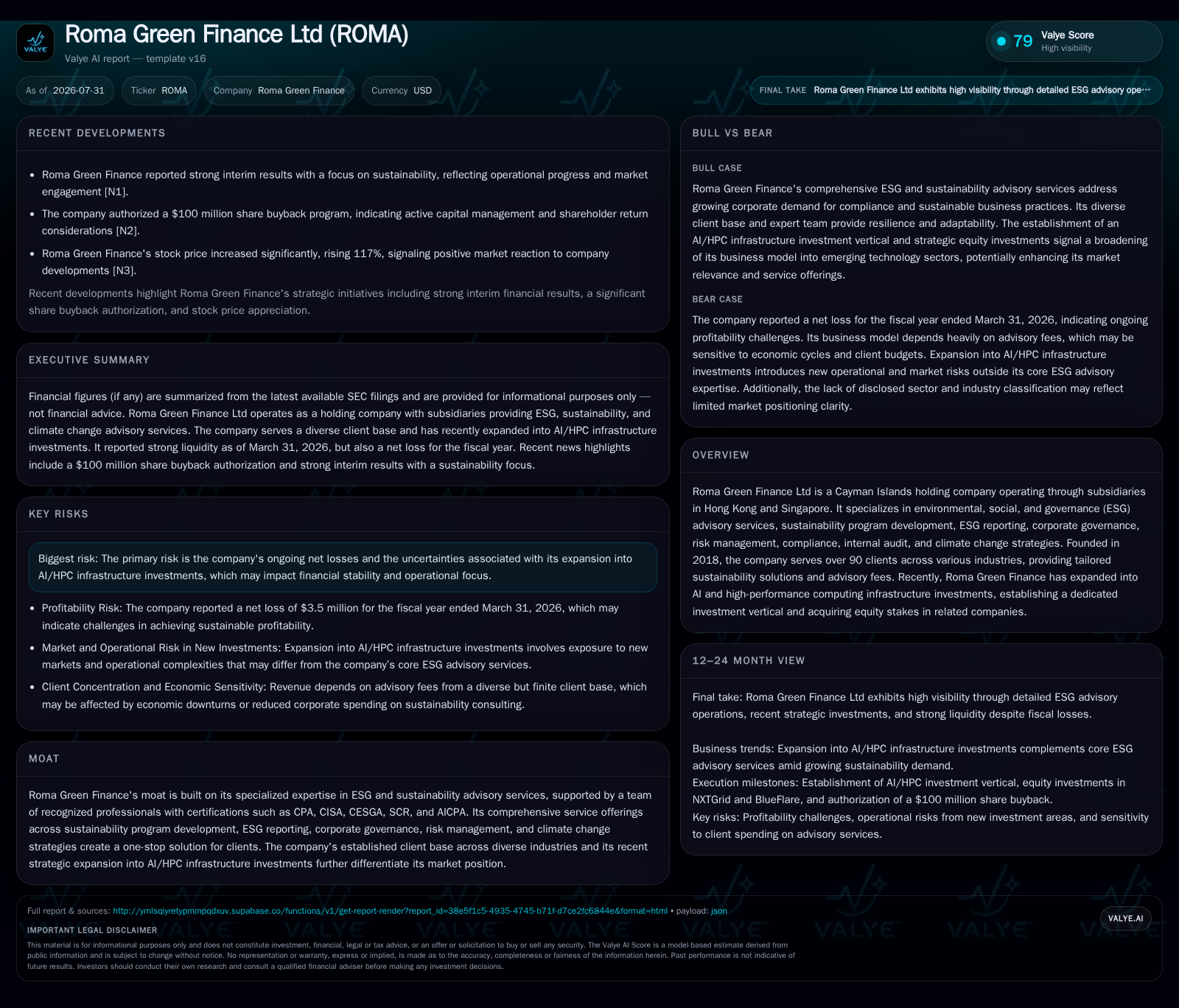
Roma Green Finance faces revenue pressures in its core ESG advisory business due to evolving client demand favoring standardized reporting over bespoke consulting. In June 2026, the company launched a new investment vertical targeting low-carbon AI and HPC digital infrastructure, securing $30 million in cornerstone equity positions across two specialized firms. This strategic pivot diversifies revenue streams but introduces significant capital deployment and execution risks. The company reported operating losses of approximately $3.5 million for fiscal 2026, reflecting growth investments and advisory fee softness. Material internal control weaknesses were disclosed, underscoring governance challenges amid rapid expansion. Despite these headwinds, Roma holds strong liquidity with a current ratio above 22x as of March 2026, supporting near-term operational resilience and investment activity.
Strategic Shift: Roma Green Finance Ventures into AI/HPC Infrastructure Investments
In its latest quarterly filing dated June 23, 2026, Roma Green Finance announced a significant strategic expansion beyond its core ESG advisory business by establishing a dedicated investment vertical focused on Artificial Intelligence (AI) and High-Performance Computing (HPC) infrastructure [S2]. The company signed non-binding letters of intent to acquire 5% equity stakes for $15 million each in both NXTGrid Compute Power Inc. and BlueFlare Group Holdings Inc., signaling a move into direct ownership of sustainable digital infrastructure assets.
NXTGrid specializes in developing powered land sites for AI and HPC workloads with plans to energize approximately 65 MW of capacity across three Alberta locations by the end of 2026 [S2]. BlueFlare operates behind-the-meter (BTM) data center platforms that integrate on-site renewable power generation to reduce carbon footprints [S2]. Roma’s focus on distributed sub-50 MW compute assets paired with BTM power solutions positions it within an emerging niche at the intersection of sustainability finance and digital infrastructure.
This pivot reflects a broader industry trend where sustainability-focused firms seek recurring cash flows and asset appreciation through direct investments rather than relying solely on advisory fees. However, it also introduces new operational complexities including capital allocation discipline, project execution risk, regulatory compliance for infrastructure developments, and integration challenges between consultancy expertise and asset management.
Core ESG Advisory Business: Client Dynamics Amid Evolving Regulatory Landscape
Roma Green Finance was founded in 2018 as a specialist firm delivering comprehensive ESG advisory services primarily through subsidiaries based in Hong Kong and Singapore [S1]. Its service suite includes sustainability program development, ESG reporting compliance, corporate governance frameworks, climate change strategy consulting, risk management, and environmental audits [S1]. The company serves more than 90 clients spanning diverse industries, generating revenue predominantly from advisory fees tied to customized engagements.
Recent annual disclosures reveal that regional regulatory maturity is shifting client demand away from multi-stage strategic consulting towards streamlined annual ESG reporting requirements [S1]. This has resulted in decreased average revenue per client despite a stable or growing client base. For fiscal year ended March 31, 2026, revenues declined to approximately $1.2 million (HK$9.5 million), down about 20% year-over-year [S1]. This trend mirrors broader sector-wide pressures as ESG disclosures become standardized commodities rather than bespoke services.
Maintaining strong client retention rates and expanding service diversification—potentially leveraging synergies with new investment activities—are critical levers to counter revenue compression going forward.
Competitive Positioning: Boutique Specialization Versus Scale Players
Within the competitive landscape of ESG advisory services, Roma Green Finance occupies a boutique niche characterized by specialized certifications (e.g., CPA, CESGA) and tailored client solutions rather than scale-driven standardization [S1]. This contrasts with larger professional services firms such as KPMG or ERM that deploy extensive global networks to offer broad-based compliance frameworks often supported by technology platforms.
While this specialization fosters deep client trust particularly among mid-market corporations seeking customized sustainability programs, it also exposes Roma to competitive pressures as industry consolidation accelerates and commoditization intensifies. The firm's recent expansion into AI/HPC infrastructure investments may provide differentiation by integrating advisory insights with ownership stakes in low-carbon technology assets.
Alignment with Sustainability Objectives: Low-Carbon Digital Infrastructure Focus
Roma’s AI/HPC investment vertical targets distributed compute sites under 50 MW coupled with behind-the-meter renewable power generation—a model designed to minimize carbon emissions while managing energy costs effectively [S2]. These investments align tightly with corporate net-zero commitments prevalent among technology operators increasingly scrutinized for their environmental impact.
Behind-the-meter power typically involves onsite renewable sources such as solar or wind paired with energy storage systems that reduce grid reliance and enhance energy efficiency. By investing in companies like BlueFlare and NXTGrid operating in cost-advantaged regions such as Alberta (Canada), Roma positions itself at the forefront of decarbonizing computational infrastructure—a market expected to grow rapidly given surging AI workloads globally.
This integrated approach combining sustainability consulting expertise with direct asset ownership could yield operational synergies enhancing both financial returns and client value propositions.
Risk Factors: Financial Performance Pressures and Governance Challenges
Moreover, the company disclosed material weaknesses in internal control over financial reporting during the same period [S1], indicating challenges scaling governance frameworks amidst rapid organizational change compounded by a dual-class share structure concentrating voting power among select stakeholders [S1]. These weaknesses pose risks related to timely accurate financial disclosures and potential misstatements absent successful remediation efforts.
Execution risks inherent to early-stage investments include technology adoption uncertainties, regulatory shifts affecting project feasibility or economics, counterparty credit exposure within project financing arrangements, valuation volatility due to limited market comparables for equity stakes held at fair value levels [F1][S1].
Near-Term Catalysts: Project Financing Rights, Deployment Milestones & Capital Raising Flexibility
Looking ahead through mid-2026 and beyond, critical indicators will gauge Roma’s ability to translate strategy into sustainable financial performance. Notably, Roma holds a non-exclusive right of first offer for project-level financing at BlueFlare’s distributed Alberta data center sites targeting up to 500 MW aggregate capacity over multiple years [S2]. Success in securing debt or equity funding for these developments alongside meeting deployment timelines will be key performance metrics.
Additionally, monitoring client retention trends amid evolving ESG disclosure regulations will shed light on the resilience of Roma’s advisory business segment [S3]
Financial flexibility is enhanced by an At-The-Market (ATM) offering agreement established June 15, 2026 allowing up to $200 million aggregate share sales through H.C. Wainwright & Co., providing opportunistic capital access during this transformative phase [S3]. The pace of ATM utilization relative to cash burn will be an important liquidity signal.
Financial Profile Discussion
The dual-class share structure implemented in late 2025 concentrates voting rights among certain shareholders which may influence governance dynamics during this complex growth phase [S1]. Addressing internal control deficiencies remains critical not only for regulatory compliance but also for sustaining investor confidence as the company navigates this strategic transition.
This analysis synthesizes information from filings up to July 2026 to provide an informed perspective on Roma Green Finance Ltd’s evolving business model amid market maturation pressures and strategic expansion into AI-driven low-carbon infrastructure investments without offering investment advice.
Disclaimer: This is research-only, informational analysis and not investment advice. It may include AI-generated interpretation and general industry context. Always verify important details using primary sources.

Comments