
BrightSpring Health Services Advances Integrated Home Care Model Amid Strategic Portfolio Streamlining
BrightSpring leverages its nationwide pharmacy and provider services platform focused on complex seniors and specialty patients, while managing operational and regulatory complexities.
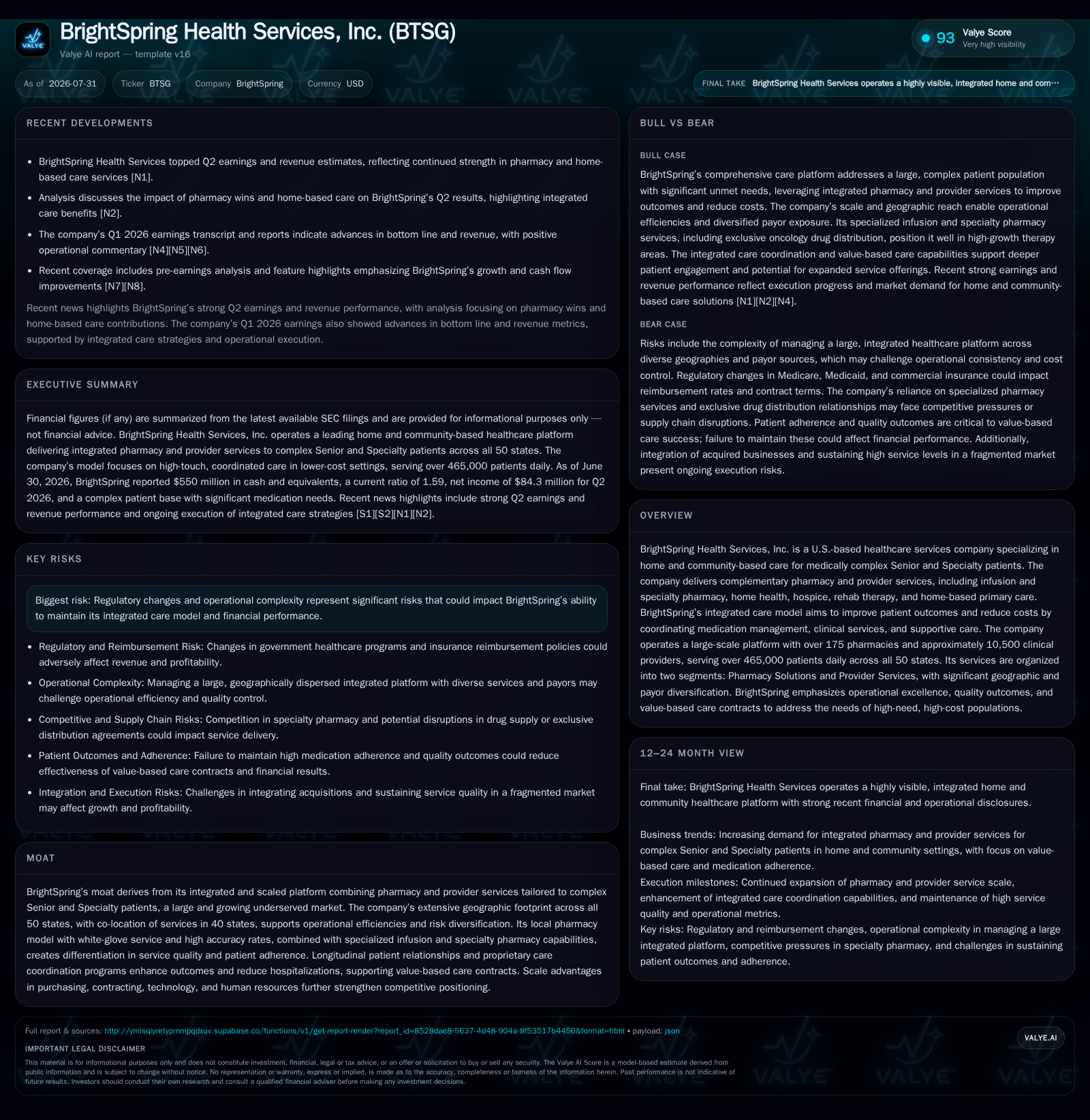
BrightSpring Health Services reported solid second-quarter 2026 results, supported by growth in integrated pharmacy and home-based provider offerings focused on medically complex Senior and Specialty patients. The company’s recent divestiture of its Community Living segment sharpens strategic focus on scalable, reimbursable home health, rehabilitation, hospice, and specialty pharmacy services across all 50 states. BrightSpring’s large provider and pharmacy network enables coordinated care delivery, improving outcomes and supporting value-based contracts. However, regulatory risks and operational complexity remain key factors to watch as the company navigates reimbursement dynamics and integration challenges.
Recent Operating Update: Q2 2026 Highlights and Strategic Focus
BrightSpring Health Services topped earnings and revenue expectations for the quarter ended June 30, 2026 [N1][S2]. The company attributes this performance chiefly to expanding volumes in its Pharmacy Solutions segment—including infusion therapy and specialty pharmacy—and Provider Services such as home health, hospice care, rehabilitation, and home-based primary care. The company's patient census remains robust at serving over 465,000 patients daily through roughly 10,500 clinical providers and pharmacists distributed across a broad geographic footprint covering all U.S. states [S1].
A pivotal strategic event completed earlier this year was the divestiture of its Community Living business segment—covering home- and community-based waiver programs focused on intellectual/developmental disability services—which closed in the first quarter of fiscal 2026 for approximately $835 million [S1][S25]. This divestiture represents a major reshaping aimed at concentrating BrightSpring's resources on higher-growth target markets such as home health, rehab therapy, hospice, primary care, and specialty pharmacy that align better with the company’s goal of operational efficiency and clinical integration.
Management has articulated that narrowing the portfolio sharpens their payor mix towards more commercially attractive Medicaid/Medicare segments while enhancing synergy across segments within Provider Services. Operational excellence efforts post-divestiture are expected to augment revenue growth rates along with Adjusted EBITDA expansion [S1]
Business Model: Integrated Pharmacy and Provider Platform
BrightSpring operates a dual-segment platform: Pharmacy Solutions provides comprehensive medication therapy management including dispensing through over 175 retail pharmacies nationally as well as specialized infusion therapies delivered in-home or clinic settings. Provider Services deliver direct clinical care through licensed nurses, therapists, social workers and associated supportive caregivers addressing activities of daily living for seniors with chronic conditions or neurobehavioral specialties.
The company's monetization relies heavily on fee-for-service billing under Medicare Parts A/B/D for clinical visits (home health episodes typically reimbursed per case), infused medications dispensed via specialty pharmacies (including oncology), hospice services billed via per diem rates tied to patient certification periods, rehabilitation therapy under defined CPT codes per session or episode length; plus growing involvement in value-based contracts where shared savings reward efficiency gains through reduced hospitalizations and enhanced outcomes [S1].
Key operational drivers affecting revenue include patient census growth across both segments; adherence to prescribed medication regimens which impacts refill rates; payer mix given Medicare/Medicaid reimbursement variability by state programs; geographic coverage enabling patient access; clinician/provider recruitment influencing capacity utilization; as well as regulatory impacts on billing codes or payment policy changes [S1]
Margins in this sector are sensitive to labor costs from clinical staff turnover risks and pharmaceutical costs managed via scale purchasing power. BrightSpring emphasizes cross-functional coordination between pharmacy services dispensing critical medications at the right time combined with synchronized clinical visits that improves patient adherence while reducing redundant or avoidable hospital stays hence supporting profitability.
Industry Structure and Competitive Positioning
The home and community-based healthcare services industry is characterized by a fragmented landscape of providers often focusing either on clinical care or pharmacy specialties but rarely integrating both at scale. BrightSpring’s moat arises from its breadth—large-scale physical presence spans all states—and vertically integrated service model combining high-touch local pharmacies plus robust provider networks who jointly manage medically complex seniors requiring multi-modal interventions including behavioral health support.
This scale facilitates bargaining leverage with pharmaceutical suppliers helping to contain medication costs relative to smaller competitors. Furthermore, consolidated data systems aid proprietary care coordination programs focusing on medication therapy management that drive higher patient adherence metrics—a crucial KPI linked directly to better outcomes in chronic disease management.
Peers such as LHC Group concentrate mostly on home health/hospice while Option Care Health specializes only in infusion therapies; BrightSpring’s dual-segment approach offers a compelling bundled solution poised for growth especially under evolving payer-driven mandates favoring outcome alignment through value-based contracts.
Regulatory complexity is a pervasive feature of this industry due to evolving CMS policies on Medicare/Medicaid reimbursements plus state licensing regulations affecting scope-of-practice rules or facility approvals. BrightSpring confronts these challenges with compliance infrastructures including rigorous audit responses but remains exposed should payment models tighten or anti-kickback/Fraud & Abuse enforcement intensify [S4][S5][S6][S7].
Growth Drivers
Primary growth is anchored by demographic tailwinds—expanding elderly populations with multiple chronic conditions needing complex coordinated support outside institutional settings. This population consumes disproportionately large healthcare dollars (~41% of US healthcare spending attributed to patients with multiple chronic illnesses), creating scalable addressable market expansion opportunities for providers like BrightSpring serving such segments [S1].
Further momentum stems from systemic shifts encouraging transitions from inpatient hospitals/nearly all institutional post-acute settings toward more cost-effective home- or community-based models emphasizing quality outcomes alongside affordability. Legislative supports continue favoring these trends including expanded CMS waivers for home infusion reimbursements or bundled payments incentivizing reduced avoidable rehospitalizations.
Innovations enabling telehealth integration complement medication adherence programs allowing remote monitoring combined with periodic pharmacist or nurse interactions enabling timely intervention before adverse events escalate.
Moreover, increasing demand for specialty pharmacy services linked especially to oncology or rare diseases boosts volume trends in infusion therapies managed within patients' homes—a segment recognized for higher reimbursement premiums relative to standard retail drugs. Value-based care contract participation accelerates as payors increasingly shift risk-sharing responsibility onto providers demonstrating measurable quality improvements allied with cost containment—directly benefiting integrated service providers like BrightSpring who can influence both medication usage patterns and clinical care trajectories simultaneously.
Risks / Growth Constraints
Foremost among risks is regulatory uncertainty affecting reimbursement dynamics from Medicare/Medicaid reforms which could compress rates or impose stricter audit criteria exposing the company to financial clawbacks. Anti-Kickback Statute enforcement combined with Stark Law amendments create legal compliance burdens that require continuous oversight potentially inflating SG&A costs.[S4][S5][S6]
Operationally sustaining coordinated service execution at scale remains challenging amid ongoing workforce shortages impacting nurses, pharmacists, therapists—a widespread industry issue threatening capacity constraints elevating wage inflation pressures.
Complexity also arises from managing geographically dispersed operations requiring consistent quality control standards across states where licensing licenses differ materially.
Competition risks exist not only from specialized standalone entities but also vertically integrated health systems increasingly moving downstream into home care markets leveraging broader regional referral networks.
Shifts in payer policies or changes in government healthcare funding driven by budgetary shortfalls could reduce available reimbursements negatively impacting revenue streams [S9][S29]
Lastly technological integration gaps could hinder leveraging data analytics platforms critical for effective care coordination thereby limiting ability to maximize outcome improvements necessary for sustaining value-based contracts.
What To Watch Next
Investors should monitor quarterly patient census trends specifically within Medicare Advantage-enrolled populations since these groups often participate in value arrangements paying premium fees tied to outcome benchmarks. Monitoring enrollment growth into proprietary coordinated care programs evidences traction enhancing stickiness among referral sources like hospitals/case managers. Early-stage impact of the portfolio streamlining post-community living divestiture indicated by segment revenue/EBITDA margin progression will be telling regarding realization of synergies promised by management. Regulatory updates especially CMS rule finalizations affecting infusion therapy reimbursements or new state licensure laws must be tracked closely given their material impact potential. Observation of medication adherence rate improvements reflecting efficacy of synchronized pharmacy-provider model provides leading indicator of downstream hospitalization rate reduction crucial for success under risk-sharing models. Management commentary around workforce acquisition/retention efforts will signal capacity sustainability amid tight labor markets within nursing/pharmacy disciplines.
Financial Profile Discussion
As of June 30, 2026, BrightSpring held $550 million in cash and equivalents against total debt near $2.25 billion resulting in net debt approximating $1.7 billion [F1]. Its current ratio stands at a healthy 1.59 reflecting sufficient liquidity to cover current liabilities comfortably [F1]. This liquidity profile supports ongoing working capital needs intrinsic to high-volume reimbursable service operations reliant on timely collection cycles from mixed Medicare/Medicaid/commercial payors.
Operating income last reported stood at approximately $295 million by end of calendar year 2025 with net income around $191 million indicating positive profitability trends at scale though ongoing investments into operational improvements may temper margin expansion near-term [F1]. Maintaining adjusted EBITDA margins amid labor cost pressures will be critical going forward given the capital intensity involved in maintaining physical infrastructure such as pharmacies alongside provider staff deployments.
Debt levels remain elevated reflecting both ongoing strategic acquisitions embedded legacy liabilities plus funding prior portfolio refinements but appear manageable given sustained free cash flow generation capability inherent in recurring reimbursable healthcare service revenues provided collection efficiency is maintained.[F1] Overall financial condition aligns with typical mid-cap home health/pharmacy model peers where leverage often reflects balance between growth funding needs versus steady underlying cash flow maturity stages.
This analysis is based solely on publicly available information including SEC filings through July 31, 2026 (), company disclosures (), latest financial snapshot data ([F1]), supplemented by standard industry context relevant to the integrated home- and community-based healthcare services sector. No investment advice is offered.
Disclaimer: This is research-only, informational analysis and not investment advice. It may include AI-generated interpretation and general industry context. Always verify important details using primary sources.

Comments