
Garden Stage Ltd’s Capital Compliance and Revenue Growth Contrast with Rising Net Losses
Latest filings reveal revenue expansion driven by diversified financial services alongside escalating net losses and nascent robotics segment.
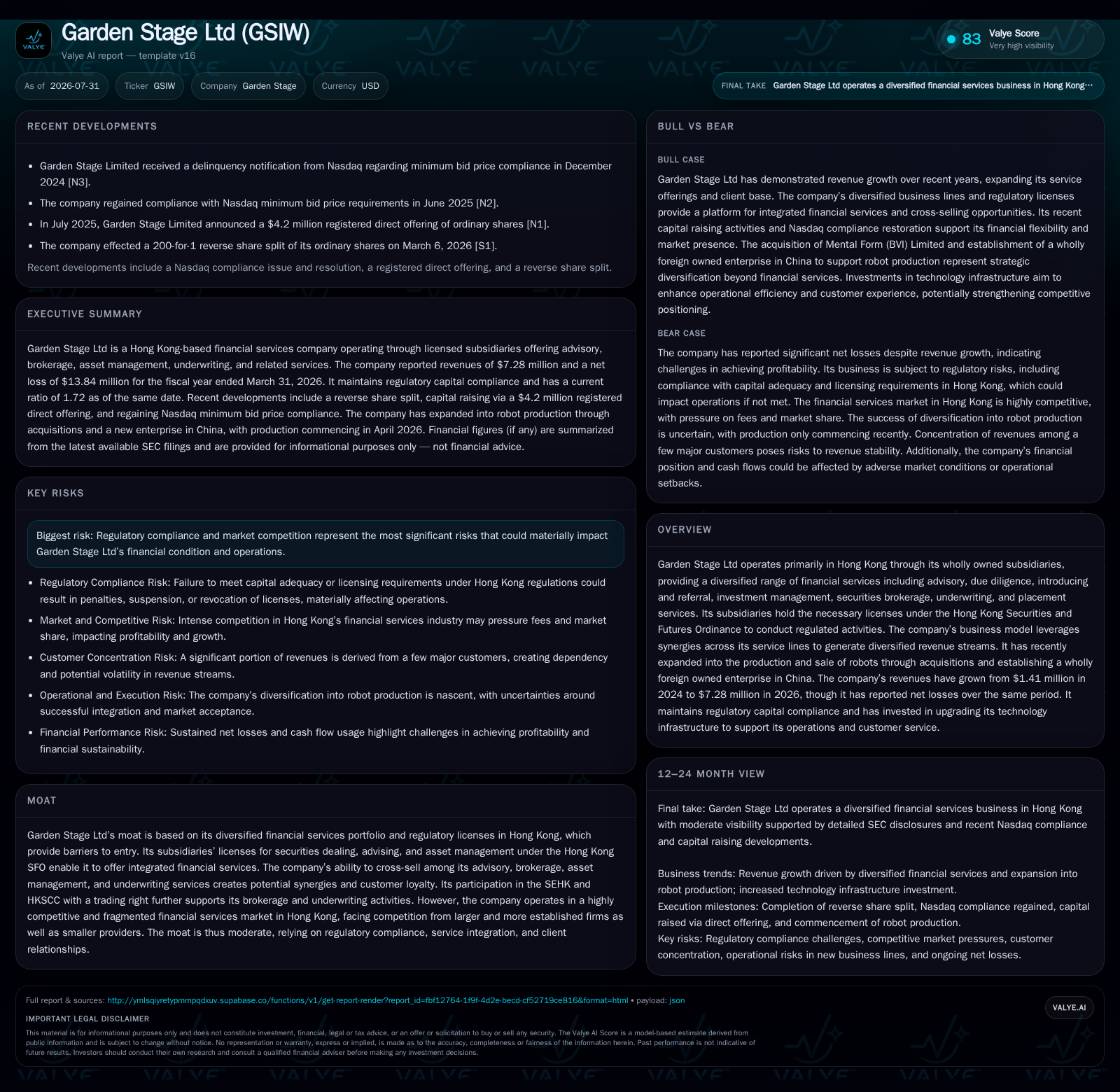
Garden Stage Ltd, a Hong Kong-based diversified financial services provider, posted revenues rising from $1.4 million in 2024 to over $7.2 million in 2026 while concurrently deepening net losses to nearly $14 million in fiscal 2026 [F1][S1]. Its licensed subsidiaries deliver integrated services spanning securities brokerage, asset management, advisory, underwriting, and placement under Hong Kong’s SFO regulatory framework [S1]. The company also initiated robotics production through recent acquisitions and a wholly foreign-owned enterprise in China, representing a strategic diversification with limited current contribution [S1][S16]. Despite strong regulatory capital adequacy and improved liquidity metrics, Garden Stage faces challenges balancing growth investments against sustained operating deficits amid competitive pressures and market-dependent revenue streams [S10][F1].
Latest Operating Update
Business Model Overview
Garden Stage operates principally through Hong Kong-regulated subsidiaries encompassing I Win Securities Limited (Type 1 dealer), I Win Asset Management Limited (Types 4 & 9 advising and asset management), along with consultancy arms requiring no specific license ([S1]). The firm generates revenues via multiple synergistic streams: advisory fees for investment consulting; brokerage commissions tied chiefly to customer trading volume; underwriting and placement fees reflecting deal mandates won on a project basis; due diligence; introducing; referral services; plus investment management fees related to assets under management (AUM). These integrated financial service lines enable cross-selling capabilities that broaden client engagements across the capital markets value chain.
Crucially, revenue drivers such as trading volume are sensitive to macroeconomic factors—investor confidence shifts stemming from political events or market upheaval directly affect brokerage commissions while underwriting mandates fluctuate per deal flow availability. The firm’s participation as a recognized trading right holder on the SEHK exchange adds operational breadth allowing direct securities transactions execution ([S1]).
In parallel with its core businesses centered on regulated financial activities under Securities and Futures Ordinance oversight—which embeds strict capital requirements—the company has embarked on diversifying into robotics manufacturing via acquisition and establishing operations in mainland China ([S16],[S17]). While potentially expanding its long-term growth runway off the volatile financial services platform, this robotic line is currently unprofitable given early-stage production startup costs coupled with sizeable intangible asset amortization ($11M expected over next decade) relating to intellectual property acquired ([S17],[S25]). This diversification adds complexity without immediate synergy realization.
Industry Positioning and Competition
Garden Stage’s presence within Hong Kong’s fragmented but tightly regulated diversified financial services sector positions it among full-service brokers with asset management capabilities typical for companies licensed under HKSFC regimes (). Its regulatory licenses across securities dealing (Type 1), investment advisory (Type 4), and asset management (Type 9) create barriers against non-licensed entrants but do not shield it fully from well-capitalized incumbents like CLSA or Haitong Securities dominating institutional client segments.
Competitive pressures stem largely from scale disadvantages relative to larger entities offering similar integrated service suites combined with stronger distribution networks. However, Garden Stage leverages moderate synergies from cross-selling between advisory mandates, brokerage operations supported by SEHK trading rights participation, underwriting project wins negotiated on customer relationships basis—with revenues fluctuating accordingly—and increasing penetration of margin financing that could further grow fee income streams if scaled successfully.
Expansion into robotic product sales reveals strategic intent to hedge cyclical risks inherent in capital markets-linked revenues but introduces industry-domain unfamiliarities requiring operational capability build-up outside its core competence.
Growth Drivers
Key growth catalysts include:
- Increasing investor participation in Hong Kong's vibrant equity markets boosting brokerage trading volumes—a direct lever for commission revenue growth.
- Scaling asset management mandates leveraging licensed Type 9 subsidiary aiming to accumulate AUM which provide stable recurring fee income less volatile than transaction-driven brokerage fees.
- Underwriting activity expansion tied to periodic securities issuance demand creates episodic high-margin income potential when mandates are secured.
- Cross-selling opportunities where clients engaged on advisory or introduction/referral services receive bundled offerings across securities dealing and asset management enhancements.
- Regulatory environment permitting non-traditional service entries opens avenues for innovation including margin financing balance scaling if compliance hurdles remain manageable.
- The recently initiated robotics business segment may develop into an alternate revenue pillar if commercialization succeeds post-April 2026 commencement.
Risks and Watchpoints
Principal risks encompass:
- Regulatory compliance volatility: Sudden changes or stricter enforcement of local capital adequacy rules under HKSFC could constrain operational flexibility or impose incremental capital burdens adversely impacting profitability ([S10],[S18]).
- Market dependence: Trading volume fluctuations driven by geopolitical tensions or investor sentiment shifts can materially swing brokerage commission levels causing earnings lumpiness ([S1]).
- Client retention uncertainty: Maintaining customer relationships across diverse service lines is critical; loss of key underwriting clients or fragmentation in advisory mandates would reduce revenue reliability.
- Integration hazards: Robotics division remains unproven operationally; high intangible amortization costs along with product launch risks could further pressure margins ([S17],[S25]).
- Competition intensity from larger full-service brokers diminishes pricing power potential especially for smaller scale players lacking established brand recognition or deep institutional client bases.
- Operational risks including technology platform adequacy for complex multi-license activity compliance plus cybersecurity concerns relevant across financial segments.
- Foreign exchange exposure although mitigated somewhat given HKD peg to USD still requires monitoring since operations span multiple currencies including Japanese Yen deposits ([S20]).
Key watchpoints will involve observing quarterly revenue segmentation shifts—particularly brokerage commissions versus asset management uptakes—underwriting deal counts secured each quarter as well as progression on robotics-related revenue contributions post first quarter production activation.
What To Watch Next
Focus upcoming quarters will be on:
- Quarterly updates on brokerage trading volumes as primary driver underpinning commission revenues amidst varying market conditions.
- Asset management client count growth reflecting efficacy of launch efforts by licensed Type 9 subsidiary aiming at stabilizing fee income base.
- Number and size of underwriting/placement transactions secured showcasing success penetrating this episodic yet lucrative business segment.
- Scalability milestones achieved within margin financing services potentially increasing interest income streams.
- Early commercial traction at Shenyang Mental Aether Technology — monitoring initial robotics sales contributions relative to associated amortization expense run-rate informs viability of diversification strategy ([S16],[S17]).
- Management commentary addressing regulatory capital adequacy evolution amid business expansion plans provides signals on capital requirement headwinds or easing ([S10],[S18]).
- Cost control trend analysis regarding high fixed professional fees linked to recent acquisitions versus improvements needed to narrow losses broadly reflecting operational discipline progressiveness.
Financial Profile Discussion
Despite strong capitalization signals backing operational scale-up ambitions particularly amid volatile market backdrop where licensing constraints pose barriers for competitors lacking such buffers; profitability restoration remains elusive barring successful integration of new business lines or consistent uplift across core fee-generating segments essential for long-run sustainability.
This analysis synthesizes Garden Stage Ltd’s latest SEC disclosures emphasizing their diversified financial service platform anchored in Hong Kong’s stringent regulatory environment alongside emergent ventures into non-financial operations reflected by robot manufacturing initiation. While top-line growth shows promise especially amplified by captive client ecosystem fostering multi-line cross-selling possibilities supported by trading rights at SEHK exchange—the stark accumulation of operating losses underscores the challenges smaller diversified firms face balancing scale expansion versus cost controls amid competitive licensed peer groups. Regulatory capital strength remains a cornerstone enabling continued market participation yet vigilance is warranted regarding evolving regulations or adverse market dynamics influencing transactional flows that materially impact revenue volatility inherent in this sector.
Disclaimer: This is research-only, informational analysis and not investment advice. It may include AI-generated interpretation and general industry context. Always verify important details using primary sources.

Comments