
Arbor Realty Trust Strengthens Dual-Segment Platform with Stable Servicing and Structured Finance Income
Arbor’s latest quarter highlights its integrated agency and structured loan model amid ongoing real estate market challenges.
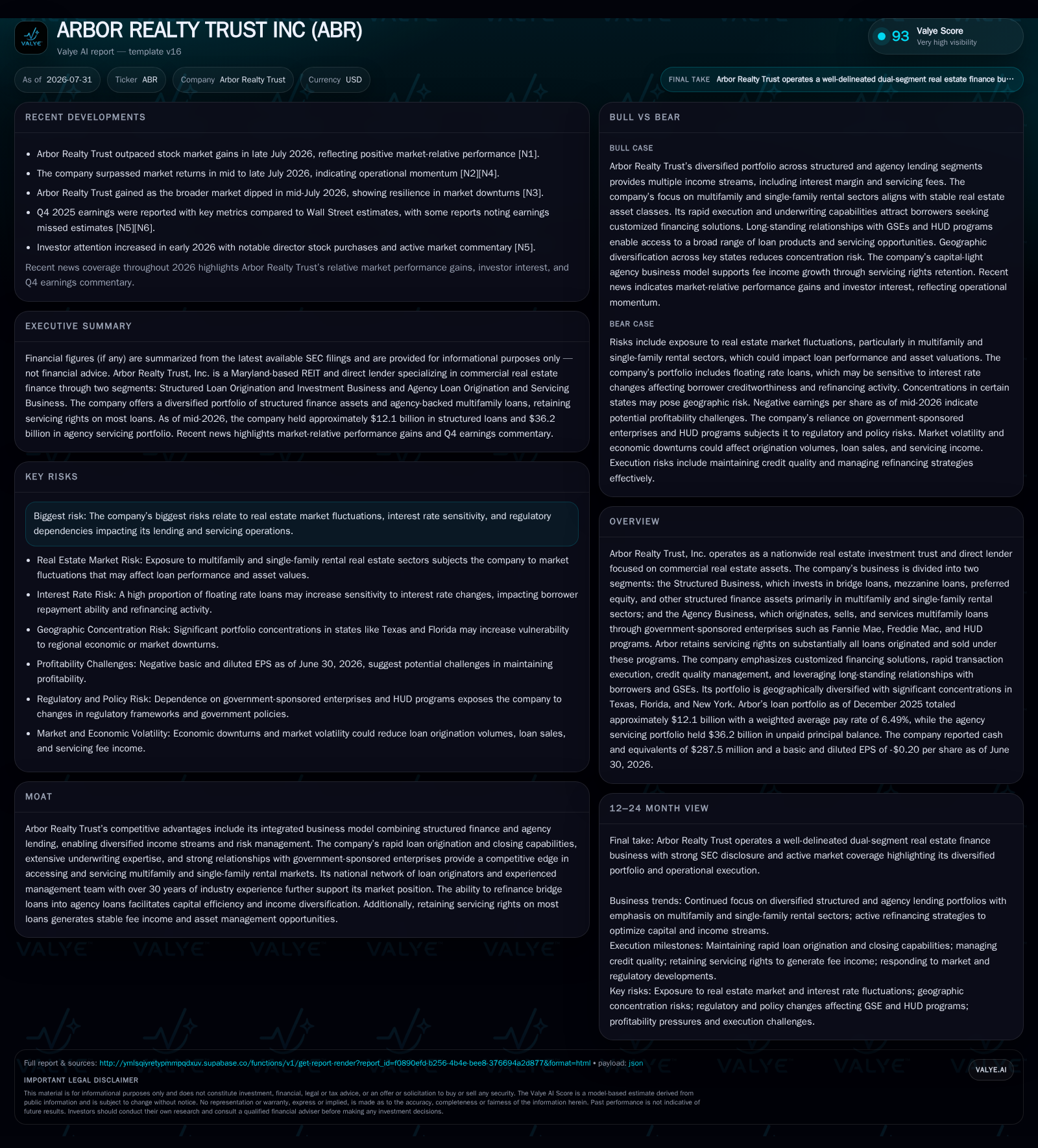
Arbor Realty Trust reported its latest quarter on July 31, 2026, emphasizing resilient performance across both its Agency and Structured lending segments despite a prolonged dislocation in commercial real estate markets. The company’s blend of bridge loans, mezzanine financing, and agency-backed multifamily loans facilitates diversified revenue streams, while its retention of loan servicing rights underpins stable fee income. Arbor’s business remains sensitive to interest rate volatility, credit risk from higher delinquencies in single-family rental and build-to-rent loans, and regulatory dependencies tied to government-sponsored enterprises (GSEs). Key growth drivers include the refinancing pipeline from bridge to agency loans and expansion of servicing portfolios. Near term, watch for credit quality trends, servicing income stability, and capital management execution.
Latest Quarterly Update Anchors Business Stability Amid Market Challenges
Arbor Realty Trust's July 31, 2026 10-Q filing underscores a continued focus on its dual-segment operating model comprising Structured Loan Origination and Investment ("Structured Business") alongside Agency Loan Origination and Servicing ("Agency Business") [S2][S1]. This bifurcated approach enables Arbor to generate diversified income across varied real estate finance channels. The quarter reflects resilience despite a prolonged dislocation marked by inflationary pressures and elevated interest rates that have extended beyond earlier forecasts. These macroeconomic factors have contributed to downward pressure on commercial property values alongside tighter credit conditions.
The Structured Business maintains an emphasis on bridge loans supplemented by mezzanine debt and preferred equity investments predominantly within multifamily and single-family rental (SFR) property sectors [S1]. Originating these shorter-duration, higher-yield assets allows Arbor to rapidly deploy capital while maintaining underwriting discipline. The Agency Business operates through established government-sponsored enterprises (GSEs), including Fannie Mae and Freddie Mac, plus HUD-related programs. Here the strategy centers on originating agency-compliant multifamily loans which are sold but accompanied by retained servicing rights — providing stable servicing fee income which cushions net interest margin volatility seen in pure lending portfolios [S1].
Business Model: Leveraging Integrated Lending and Servicing for Diversified Revenues
Central to Arbor's operating model is its capacity to originate bridge loans that can be refinanced into longer-duration agency products. This pathway not only optimizes capital deployment but balances yield profiles — bridge loans command higher rates reflecting credit complexity whereas agency loans offer lower risk-adjusted returns backed by GSE guarantees [S1]. This pipeline approach supports diversified returns across credit cycles.
Revenue mechanics differ between the segments: the Structured Business chiefly earns interest income from direct lending positions — loan volume multiplied by yield adjusted for losses — augmented by gains on sales or securitizations of certain assets [S1]. The Agency Business primarily generates fees from servicing contracts retained on sold agency loans; these fees scale with the serviced portfolio balance rather than new originations alone, supporting recurring revenue stability. Hence growth in serviced loan volumes directly lifts fee income absent proportional origination costs
Credit underwriting rigor is foundational given heightened risks arising from the company’s growing exposure to SFR development projects where cost overruns or leasing delays can increase default probabilities. Arbor employs disciplined asset management protocols to mitigate such developments though elevated provisions for credit loss reserves have been necessary reflecting macro uncertainties [S1]
Industry Structure and Competitive Positioning
Arbor occupies a hybrid role straddling commercial real estate bridge lending specialists like Blackstone Mortgage Trust and broader mortgage REIT peers such as Annaly Capital Management that concentrate heavily on agency-backed securities. Its uniquely integrated platform combining structured finance with robust GSE relationships for agency loan originations provides a strategic moat by enabling tailored financing solutions across property types with diversified counterparty risk.
Competition within Bridged-to-Agency lending demands rapid transaction execution capabilities paired with proprietary underwriting expertise; Arbor's longstanding industry relationships facilitate preferential access to both borrowers seeking interim financing as well as conduits into capital markets via securitized solutions. Its national footprint spreads geographic concentration risk relative to regional lenders though inherent market cycles still pose systemic risks common across peers.
The value chain role also includes acting as servicer on substantially all agency-originated mortgages held prior sales thus capturing ongoing asset management fees enhancing margin resiliency versus firms solely reliant on loan spread income or securitization gains [S1]
Growth Drivers Highlighted in Recent Filings
Key growth vectors reflect favorable structural trends underpinning multifamily rental housing demand alongside evolving government support programs targeting affordable housing financed through HUD or FHA schemes — segments where Arbor enjoys established approvals enabling sustained deal flow integration.[S1] Furthermore, the ability to convert higher-yield bridge positions into safer agency assets not only smooths earnings volatility but enhances capital recycling efficiency crucial during periods of market stress.
Expanding the serviced portfolio is another driver; as Arbor retains nearly all servicing rights on agency loan sales, organic portfolio growth correlates closely with fee income expansion [S2]. Given market conditions restraining origination volumes industry-wide due to capital cost inflation, servicing income offers a relatively stable revenue base insulated from immediate cyclical fluctuations.
This has led to incremental increases in nonperforming loans (NPLs), upward adjustments in loan loss reserves, heightened delinquencies requiring active workouts or restructurings as filing disclosures highlight.
Regulatory dependency remains critical given extensive reliance on access to GSE platforms which dictate underwriting parameters influence repurchase risks associated with breaches of loan representations causing potential indemnity costs. Changes in GSE regimes or funding cost structures could materially affect volume capacity or spreads realized [S1]. Additionally, concentration risks by geography or property type while mitigated by diversification still loom especially if certain real estate markets experience disproportionate downturns.
Liquidity constraints in capital markets could impair funding availability for new originations though current cash holdings above $280 million provide some buffer; leverage levels near $11 billion in total debt necessitate prudent capital management to sustain operations during refinancing needs or stress scenarios [F1][S2]
Operational risks related to loan servicing quality also merit attention since errors or disruptions therein could provoke fee income volatility or reputational damage impacting borrower retention.
What To Watch Next: Key Milestones And Performance Indicators
Going forward investors should monitor quarterly updates focusing on specific KPIs such as nonperforming loan ratios evolving across mortgage pools stratified by segment (Structured vs Agency), trends in loan modifications or workouts signaling credit stress intensifying or easing. Equally important are metrics tied to portfolio growth including gross loan origination volumes along with serviced portfolio balance changes reflecting fee income trajectory stability.
Refinancing activity converting bridge loans into agency-compliant permanent financing remains a critical barometer of operational execution effectiveness influencing both yield compression cycles and capital redeployment potential. Updates regarding regulatory developments affecting GSE underwriting guidelines or securitization frameworks also represent important information flows shaping future earnings sustainably.
Lastly, disclosure around capital structure management including maturity schedules for outstanding debt tranches alongside any share issuance or repurchase activity would provide insight into financial flexibility preservation amid rising interest rate backdrops.
Financial Profile Discussion
As of June 30, 2026, Arbor reported total debt approximating $11.1 billion against cash & equivalents near $288 million resulting in net debt around $10.8 billion indicating solid liquidity buffers in place supporting ongoing financing activities despite market stresses [F1]. The company’s substantial cash reserves relative to short-term maturities suggest prudent treasury management compatible with navigating volatile real estate credit cycles.
Capital allocation priorities appear focused on balancing new originations with opportunistic asset repositioning while preserving dividend distributions aligned with regulatory requirements governing REIT payout mandates.
In comparison with peers such as Starwood Property Trust or Blackstone Mortgage Trust that also operate multi-channel strategies encompassing structured finance coupled with agency lending exposure shows Arbor leveraging competitive advantages notably through its integrated servicing platform enhancing margin stability over time.
This analysis uses current public filings from Arbor Realty Trust including their 10-Q dated July 31, 2026, supplemented by annual disclosures and sector-relevant context without investment research views.
Disclaimer: This is research-only, informational analysis and not investment advice. It may include AI-generated interpretation and general industry context. Always verify important details using primary sources.

Comments