
AvalonBay Communities Reinforces Multifamily Leadership with Solid Q2 Results and Strategic Merger Progress
AvalonBay's Q2 2026 report highlights improved same-store NOI growth, stable occupancy, and advancing merger preparations, underscoring its competitive strength in multifamily residential REITs.
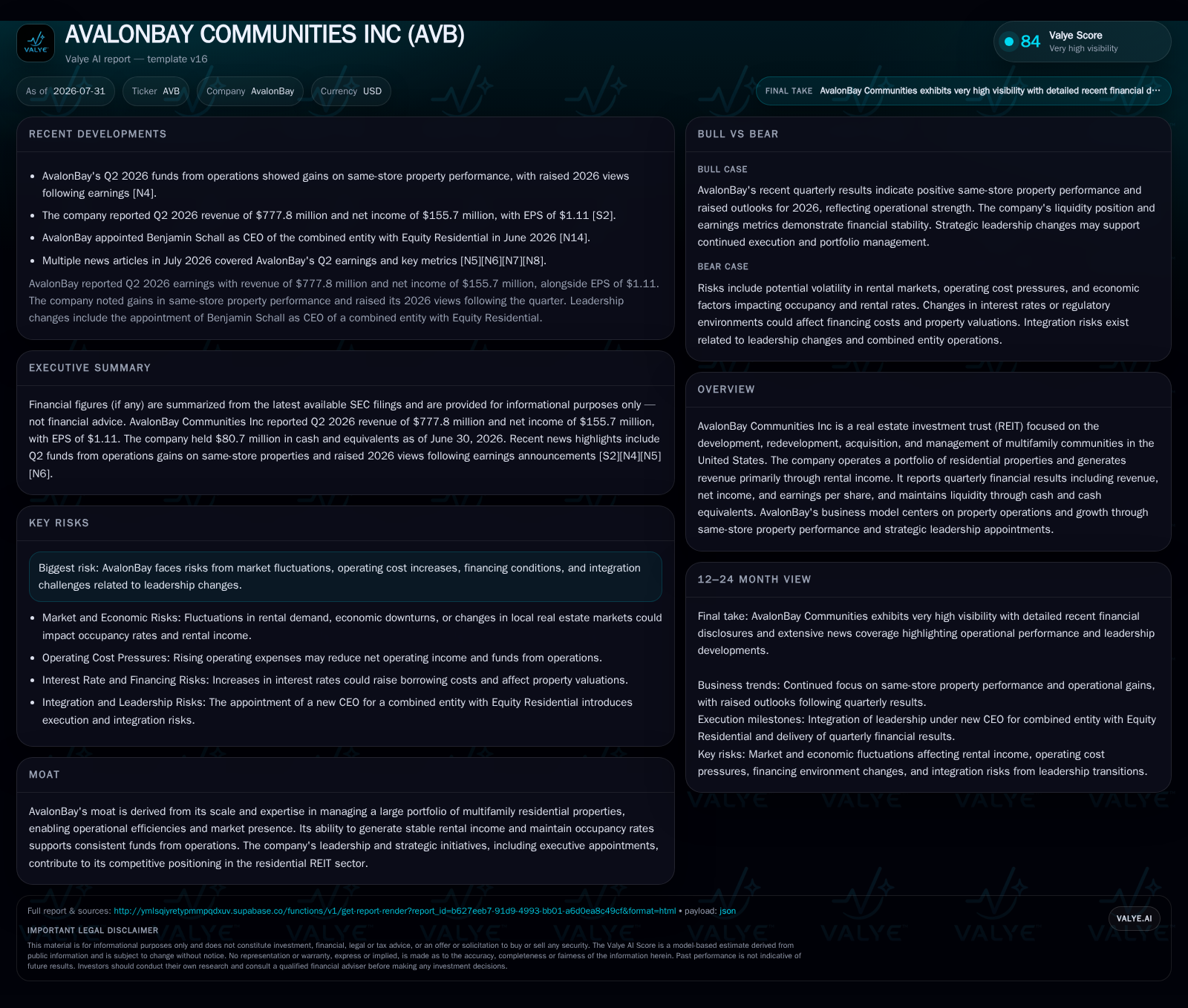
AvalonBay Communities reported robust Q2 results with accelerated same-store net operating income growth driven by strong occupancy and favorable lease renewal spreads. The company continues to leverage its scale and operational expertise as it progresses toward an all-stock merger with Equity Residential, enhancing its sector presence. Growth prospects are supported by a disciplined development pipeline and strategic acquisitions, while risks from rising interest rates and integration complexities remain key watchpoints.
Strong Second-Quarter Execution Drives Operating Momentum Ahead of Merger Close
AvalonBay Communities’ Q2 2026 filing reveals an acceleration in same-store net operating income (NOI) growth compared to previous quarters [S2]. Elevated occupancy rates have remained steady above the sector average, supporting resilient rental income streams even as macroeconomic headwinds persist. This steady operational performance signals effective asset management and tenant retention strategies that underpin funds from operations (FFO), a crucial cash flow proxy for multifamily REITs. The confirmation of executive appointments tied to the upcoming merger with Equity Residential further suggests continuity in strategic leadership during this transitional phase [S3]. Such execution consistency amid external pressures is a positive marker that operational momentum remains intact. Future confirmation will depend on sustained or accelerating same-store NOI growth.
Rental Income Dependence Anchored by Solid Occupancy Rates and Renewal Dynamics
Rental income constitutes the core revenue driver for AvalonBay, generated through leasing multifamily apartment units across its portfolio [S1]. In Q2 2026, lease renewal spreads continued their favorable trend, maintaining upward pressure on effective rental rates despite inflationary cost challenges [S2]. Coupled with occupancy rates that exceed industry norms—evidence of tenant demand resilience in AvalonBay’s key markets—this establishes a stable revenue base vital for predictable FFO generation. Tenant turnover dynamics remain critical given their impact on leasing velocity and operational expenses; however, current lease renewal rates reflect healthy tenant retention [S1]. Sustaining this dynamic is essential to insulate the revenue base from potential rent control policies or competitive pricing pressure.
Sector Standing Enhanced by Scale: Operational Efficiency Meets Strategic Integration
AvalonBay’s announced all-stock merger agreement with Equity Residential marks a significant strategic milestone that extends its leadership scale within the multifamily residential REIT sector [S14]. This merger-of-equals combination anticipates capturing cost efficiencies through shared operational infrastructure while increasing geographic diversification across premier urban and suburban multifamily markets. The recent appointment of combined company executives underscores management’s focus on seamless integration [S14]. Larger scale positions the combined entity to better navigate capital markets for financing acquisitions, developments, and refinancings—a notable advantage over peers like UDR or Mid-America Apartment Communities which operate at comparatively smaller scales. This enhanced capital access may allow more competitive bidding in property acquisitions while also potentially lowering per-unit capital expenditure intensity through economies of scale.
Growth Outlook Supported by Robust Development Pipeline and Acquisition Discipline
AvalonBay maintains an active pipeline focused on both development of new communities and redevelopment of existing assets aimed at modernizing properties to command higher rents [S1], [S2]. The balance between stretching for accretive growth opportunities versus preserving healthy operating margins is managed cautiously given rising borrowing costs in current interest rate environments. Strategic acquisitions complement organic growth by selectively expanding footprint in high-demand markets where supply constraints persist. Capital allocation demonstrates discipline prioritizing projects with clear value creation potential through rent escalation or operational efficiency improvements. As these developments transition into stabilized operations over coming quarters, they should contribute incremental rental income that supports longer-term FFO growth.
Risks Embedded in Interest Rate Volatility and Integration Complexity Post-Merger
Despite operational strengths, AvalonBay faces challenges typical for multifamily REITs amid fluctuating macro conditions. Rising interest rates increase financing costs which impact both new project economics and existing debt servicing if refinancing occurs at higher spreads [S1], [S2]. The approximately $9.08 billion total debt outstanding as of June 30, 2026 (net debt about $9 billion after cash) reflects significant leverage requiring careful liquidity management [F1]. Execution risk tied to the extensive merger integration looms large—unexpected costs or delays could dampen anticipated synergies or distract management from core operations [S14], [S1]. Additionally, regulatory uncertainties around rent control policies or zoning changes present ongoing vulnerabilities given their potential to constrain rental rate growth.
What to Watch: Upcoming Milestones in NOI Trends, Lease Metrics, and Transaction Close Timeline
Key data points that will provide forward visibility include same-store NOI performance in subsequent quarters ([S2]) which will reflect if recent momentum sustains amid macro shifts. Monitoring lease renewal spreads offers insights on pricing power retention amidst affordability concerns ([S1]). On the strategic front, shareholder approvals necessary to finalize the merger with Equity Residential are pivotal milestones ([S14]). Any incremental disclosures clarifying synergy realization timelines or capital deployment plans post-close will be important to gauge integration success levels and cash flow stability.
Financial Profile Discussion: Liquidity Position Reinforces Flexibility Amid Market Tensions
At quarter-end June 30, 2026, AvalonBay held $80.7 million in cash and cash equivalents against total debt of approximately $9.08 billion [F1]. This reflects a leveraged capital structure common in large multifamily REITs but underscores exposure to interest rate movements affecting debt servicing costs. The available liquidity offers short-term flexibility; however, upcoming debt maturities will require refinancing vigilance especially if credit market conditions tighten. Comparatively within the sector peer group including Equity Residential and UDR, AvalonBay’s leverage falls within customary industry ranges but bears close monitoring given macroeconomic uncertainties impacting real estate valuations and funding access.
Disclaimer: This analysis is based solely on information available through July 31, 2026 from SEC filings, company disclosures, and reputable news sources. It does not constitute investment advice or research views. Readers should perform independent due diligence before forming conclusions about AvalonBay Communities Inc or related securities.
Disclaimer: This is research-only, informational analysis and not investment advice. It may include AI-generated interpretation and general industry context. Always verify important details using primary sources.

Comments