
Ryan Specialty Holdings Expands E&S Market Leadership with Scale and Talent Retention
Ryan Specialty’s strong distribution network and strategic acquisitions underpin premium growth in the specialized E&S insurance market.
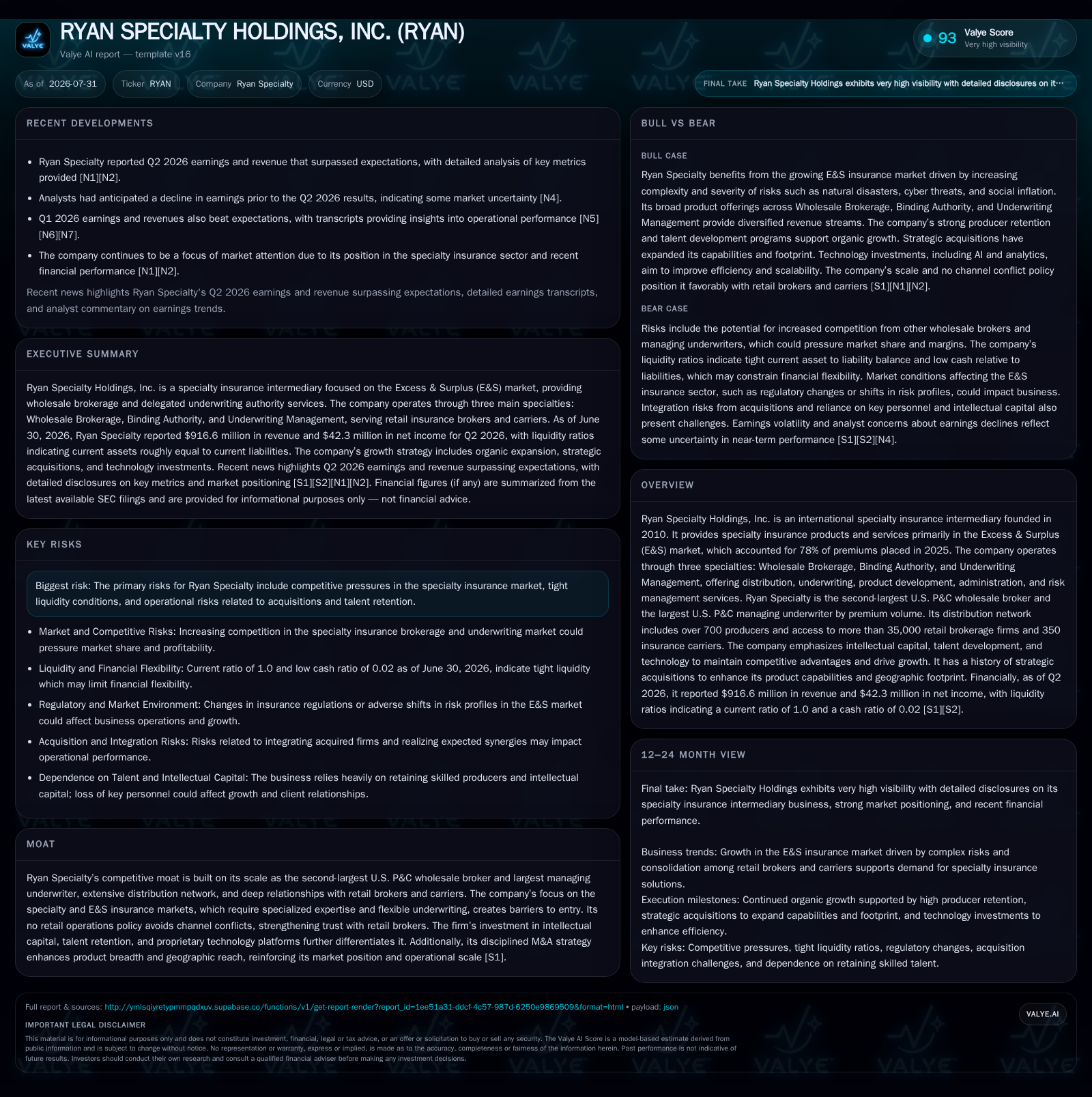
Ryan Specialty Holdings remains a dominant intermediary in the specialty insurance brokerage and managing underwriting sector, focusing primarily on the complex Excess & Surplus (E&S) market. Its latest quarterly update underscores stable risk factors, ongoing expansion through acquisitions, and robust talent retention that drive premium volume growth and service innovation. The company’s sizable network of producers and retail broker relationships supports its competitive edge against peers like Brown & Brown and AmWINS. Financially, Ryan maintains solid liquidity despite high debt levels typical in the sector, while continuing disciplined capital allocation including increased share repurchase authorization.
Recent Operating Update
Ryan Specialty Holdings’ latest quarterly filing for Q2 ended June 30, 2026, asserts operational stability with no significant changes to disclosed risk factors compared to the annual report filed February 13, 2026 [S2], [S22]. A contemporaneous event filing corroborated these results with details on earnings surpassing consensus estimates and reaffirmed dividend declarations (quarterly dividend maintained at $0.13 per share) alongside strategic capital moves including share repurchases [S3], [S12], [N1], [N2]. This steady cadence signals a company confident in its existing platform amid evolving specialty insurance dynamics.
Business Model
Ryan Specialty operates as an international specialty insurance intermediary focusing predominantly on the Excess & Surplus (E&S) segment — a niche demanding bespoke insurance solutions due to hard-to-place risks or coverage not readily available in standard admitted markets. Approximately 78% of premiums placed stem from this E&S arena, underscoring the company's strategic anchoring in a market characterized by flexible terms and conditions that facilitate innovation tailored to client needs [S1].
The firm deploys a triadic business approach: Wholesale Brokerage services place policies sourced from retail brokers; Binding Authority operations leverage delegated underwriting authority allowing Ryan to bind coverage on behalf of carriers; Underwriting Management encompasses program design and administration via managing general agents (MGAs) or managing general underwriters (MGUs). This multi-pronged model allows Ryan Specialty to capture value across the distribution-underwriting continuum without directly bearing significant underwriting risk itself.
Revenue streams derive chiefly from commissions and fees tied to premium volumes placed through its network rather than direct insurance underwriting income. The company harnesses a vast distribution network encompassing over 700 producers who engage with more than 35,000 retail brokerage firms connected to upwards of 350 insurance carriers. This scale affords Ryan preferential access to specialized product classes and cost-efficient placement capabilities which are critical buying criteria for retail brokers seeking customized risk solutions for insureds [S1], [N2].
Maintaining a no-retail operation stance—eschewing direct retail brokerage—mitigates channel conflict risks with clients, strengthening trust-based partnerships crucial in this industry where switching costs are low but expertise highly valued.
Industry Structure and Competitive Position
Ryan Specialty sits near the apex of the specialty brokerage segment as the second-largest U.S. property & casualty wholesale broker by premium volume and holds the premier position among managing underwriters nationally within similar metrics [S1]. Its closest peers include firms such as Brown & Brown (BRO), AmWINS Group, and Hub International — each commanding sizeable specialty-focused wholesale networks but varying in product emphasis or geographic penetration.
The specialized nature of E&S lines demands proprietary intellectual capital, adept underwriting acumen delegated via MGAs/MGUs, and robust technological infrastructure—all areas where Ryan invests heavily. For instance, deployment of RT Connector technology facilitates efficient quoting workflows that improve retailer broker engagement—a tactical advantage given industry-wide pressures on commission frameworks and margin compression.
Barriers to entry remain substantial due to regulatory complexities governing delegated authority arrangements and relationships required with both insurers accustomed to strict underwriting disciplines and an expansive base of retail brokers needing nuanced expertise. Ryan leverages recurring high producer retention rates (over 96% annual retention since 2020) that preserve institutional know-how and client continuity—key for sustaining book-of-business growth per producer which exceeded 70% producer-level growth in recent years [S1], [N10].
Growth Drivers
Organic expansion is propelled primarily by producer book development fostered through Ryan Specialty University—a dedicated learning platform designed to attract talent across specialties while offering rapid career advancement pathways within controlling brokerage subsidiaries. High retention coupled with consistent producer portfolio growth yields correlated premium increases without proportional incremental cost burdens.
Secondly, targeted acquisitions supplement organic efforts by broadening specialty product breadth (e.g., life sciences underwriting via LifeScienceRisk MGA), tapping emerging risk segments like renewable energy via PERse®, or expanding geographically across underserved territories. Acquired entities contributed over $125 million in trailing revenues just prior to closing during fiscal 2025—highlighting selectivity focused on accretive additions aligned culturally and strategically [S1], [N2], [S8].
Sophisticated investment in technology underpins operational scalability that can sustain book volume expansion without linear headcount increases. Utilization of generative AI for underwriting support and data analytics enhances efficiency gains—vital given competitive pressures constraining commission rate growth.
Lastly, cyclical market dynamics favor flexible E&S placements when admitted markets tighten due to regulatory or capacity constraints; Ryan’s specialty focus positions it well to capitalize on these demand shifts.
Risks and Watchpoints
Key vulnerabilities face Ryan Specialty despite its strong market positioning:
- Commission Compression: Competitive pressure among wholesalers coupled with insurer efforts to reverse contingent commission structures could strain revenue margins.
- Carrier Relationship Concentration: Loyalty loss or contract modifications among key insurers may disrupt delegated authority flows impacting underwriting volumes.
- Regulatory Shifts: Changes tightening or relaxing E&S market requirements will affect capacity availability—a core driver behind Ryan’s business model.
- Integration Challenges: The complexity inherent in assimilating diverse acquired firms poses operational risks potentially distracting management or diluting cultural cohesion.
- Talent Attrition: Although currently strong retention cushions this concern, loss of senior producers or executives could impair revenue continuity due to high individual producer influence on premium placements.
- Economic Cyclicality: Broader economic downturns could suppress insurance purchasing activity generally impacting premium velocity.
- Technology Adoption Risks: Delays or failures in updating proprietary platforms may reduce competitive differentiation over time.
Monitoring these factors requires close attention to booking trends by producer cohorts, renewal rates within binding authority arrangements, carrier contract renewals or amendments announcements, as well as ongoing evaluation of integration milestones from recent acquisitions.
What to Watch Next
Upcoming quarters should be observed for:
- Sustained premium volume growth driven by both organic producer book expansion and incremental contribution from acquired book rollouts.
- Evolution in technology adoption metrics stemming from new platform deployments that enhance broker service satisfaction scores or quotation turnaround times.
- Updates on share repurchase activity under the now $600 million authorization program where approximately $300 million remained unused as of May 2026—revealing capital return preferences aligned with market valuations [S8].
- Any shifts in geographic or product specialization mix indicating entry into nascent E&S niches or adjustment away from mature market segments.
- Producer turnover rates signaling potential disruptions amidst intensifying competition for specialized talent.
- Impact of any regulatory changes announced affecting delegated underwriting arrangements or insured risk appetite within specialty lines sectors.
Financial Profile Discussion
Ryan Specialty’s financial snapshot typifies the capital structure common among large specialty intermediaries balancing growth investment against liquidity management constraints [F1]. As of June 30, 2026, cash and equivalents stood at approximately $140 million supported by current assets totaling around $6.64 billion juxtaposed against current liabilities slightly exceeding $6.65 billion—yielding a current ratio near parity indicative of tight working capital equilibrium
Long-term debt remains substantial at about $3.39 billion end-December 2025 with net debt approximating $3.25 billion after cash offsets [F1]. This leverage level is typical given acquisitive growth strategies reliant on external financing while maintaining flexibility for opportunistic investments.
Operating income recorded was roughly $494 million for full-year 2025 against total revenue exceeding $3 billion—demonstrating solid operating profit margins calibrated by scale efficiencies despite pressure on commissions rates industry-wide [F1]. Net income was comparatively modest near $63 million reflecting corporate costs associated with infrastructure build-out and acquisition integration expenses decreasing but still present within financials
The board’s commitment to shareholder returns through dividends sustained quarterly payouts at $0.13 per share complemented by aggressive share repurchase authorizations highlights balanced capital allocation discipline aimed at value enhancement without sacrificing growth funding capacity [S12], [S26], [S29].
Overall liquidity management remains prudent though close working capital monitoring is warranted given near-unity current ratio which could fluctuate under volatile premium collections cycles common in specialty brokerage operations.
Conclusion
Ryan Specialty Holdings stands out within the specialty insurance wholesale brokerage space due to its commanding scale as one of the largest distributors in the U.S., a concentrated focus on the complex E&S market requiring sophisticated underwriting solutions, a deep bench of retained talent driving organic growth alongside selective acquisitions strengthening product diversity, and ongoing investments in proprietary technology platforms enhancing operational efficiency. While recognized risks pertaining to regulatory environment shifts, commission pressures, carrier concentration, integration complexity, economic cycles, and talent retention require monitoring by stakeholders keenly focused on execution milestones during evolving market conditions, Ryan's entrenched position combined with disciplined financial stewardship positions it favorably relative to peers such as Brown & Brown and AmWINS Group.[F1],[S1],[S2],[S3]
This analysis is based solely on publicly available SEC filings and news sources as cited; it does not constitute investment advice or research views.
Disclaimer: This is research-only, informational analysis and not investment advice. It may include AI-generated interpretation and general industry context. Always verify important details using primary sources.

Comments