
Safehold's Ground Lease Portfolio Anchors Long-Term Cash Flow Amid Rising Debt Cost
Safehold Inc. leverages its unique ground lease model to secure stable, inflation-linked revenues while managing notable leverage and credit risks.
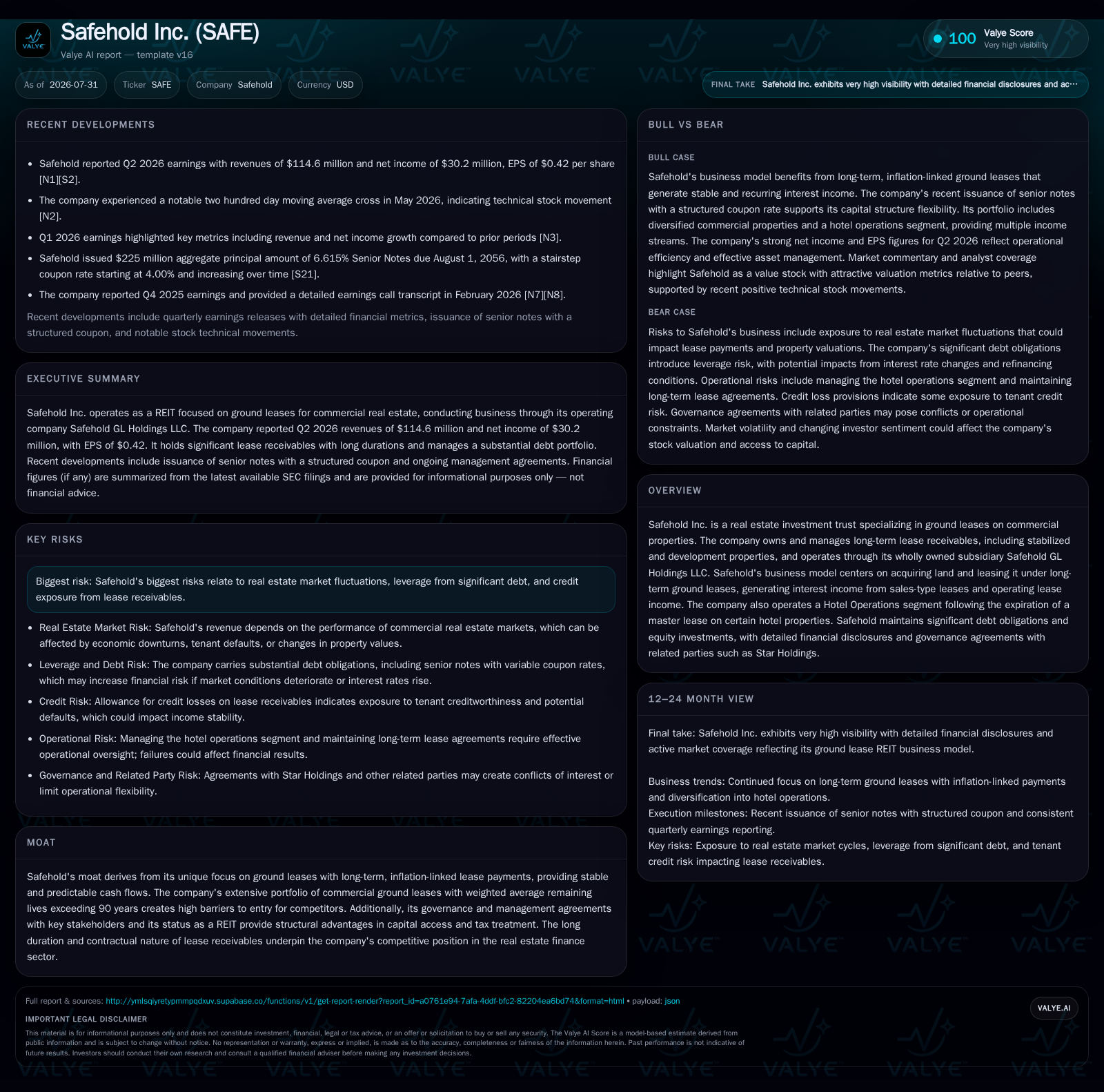
Safehold Inc., a REIT focused on long-term ground leases for commercial properties, reported steady portfolio performance in Q2 2026 with a weighted average lease term exceeding 90 years. The company’s business model centers on acquiring land assets and generating lease income largely from sales-type leases with inflation escalators, supporting predictable cash flows. However, high debt levels approaching $4.7 billion and recent issuance of senior notes with escalating coupons highlight refinancing and interest-rate risk amid a challenging macro environment. Safehold's moat is underpinned by the structural durability of its ground leases but remains sensitive to real estate valuation shifts and tenant credit exposure.
Recent Operating Update: Q2 2026 Highlights
Safehold Inc.'s latest quarterly filing dated July 31, 2026 [S2] provides the clearest current view of its operational and financial dynamics. The company continues to hold a ground lease portfolio characterized by extremely long weighted average remaining lease terms that exceed 90 years, cementing the durability and predictability of its revenue stream from these leases. This extended duration creates structural value as these are low turnover assets with inflation-linked payments. Notably, Safehold classifies the fair value of its net investments in sales-type leases—its primary asset class—in Level 3 of the fair value hierarchy, acknowledging significant estimation inputs due to infrequent market transactions for such specialized assets.
On July 30, 2026, Safehold issued senior notes totaling $225 million maturing in 2056 with an innovative stairstep coupon starting at 4%, escalating to over 6.6% in year 21 [S22]. This transaction reflects both appetite among institutional fixed income investors for long-duration credit and the company’s need to manage refinancing risk during an evolving interest rate environment. The note’s terms place covenants around maintaining certain unsecured-to-total asset ratios evidencing disciplined leverage control expectations by lenders.
Safehold Management Services Inc., a wholly owned subsidiary, operates under a management agreement with Star Holdings aimed at orderly asset monetization [S2]. This highlights ongoing governance complexities as well as associated-party transaction exposures that can impact strategic outcomes.
Business Model Analysis
Safehold operates as a real estate investment trust (REIT) uniquely specializing in ground leases—leasing land parcels under long-term contracts rather than owning or operating the buildings erected thereon. Its core revenue arises from contractual interest income generated by sales-type leases supplemented by operating lease income mainly from stabilized properties [S1]. These ground leases typically embed inflation escalators protecting cash flows against purchasing power erosion.
Clients are primarily commercial real estate developers or building owners who seek capital-efficient land ownership alternatives while retaining the responsibility for property operations. The monetization mechanics revolve around acquiring land parcels or existing ground lease interests and leasing them out under contracts running multiple decades.
An important diversification facet involves Safehold’s Hotel Operations segment initiated after expiry of a prior master lease arrangement allowing direct operation of certain hotel properties. Yet this segment remains subordinate compared to its foundational financial asset model.
Margins benefit from limited operational overhead since Safehold does not undertake typical property maintenance or leasing functions for buildings; instead returns flow from contractual payments based on agreed escalations tied often to Consumer Price Index measures.
Industry Structure & Competitive Positioning
Within the broader REIT industry focused on commercial real estate finance, Safehold's concentration on ground leases establishes a defensible niche difficult for peers to replicate due to long contractual durations (often >90 years) creating high entry barriers. Competitors may exist among other specialized REITs or real estate finance firms such as W.P. Carey or Realty Income; however, those peers often possess more traditional equity REIT portfolios with exposure to operational real estate risks.
Safehold’s capital structure is heavily leveraged relative to equity given the nature of financing long-lived leased land assets which generate steady fixed income streams but require substantial upfront investment [S22]. As such, Safehold must carefully navigate interest coverage ratios and refinancing risks especially in rising rate environments as evidenced by recent senior notes issuance featuring stepping coupons over decades
Tenant credit risk is another competitive differentiator: customers’ ability to fulfill lease obligations significantly influences net operating income stability and portfolio fair value adjustments.
Growth Drivers
Growth prospects stem primarily from increased adoption of flexible capital solutions in commercial real estate markets favoring ground leases over outright property ownership—a trend amplified by institutional investors’ desire for predictable cash flow instruments amid inflationary pressure.
Additionally, Safehold benefits from ongoing development activity on its leased lands whereby new constructions enhance underlying land value and can potentially drive incremental lease receivables via contract renewals or expansions.
Portfolio acquisitions remain an organic pathway to scale while asset monetization helps optimize the capital base. Favorable tax treatment inherent to REIT status underpins investor appetite driving equity raise opportunities enabling further growth.
Macro factors like sustained inflation bolster escalation rates thereby supporting durable revenue growth ensuring funds from operations (FFO) consistency—a critical metric in evaluating REIT sustainability.
Risks & Watchpoints
Safehold faces several noteworthy risks:
- Market Valuation Sensitivity: Fluctuations in commercial real estate valuations could materially affect fair value accounting of ground lease receivables classified under Level 3 hierarchy increasing earnings volatility.
- Interest Rate Exposure: Rising borrowing costs driven by new debt issuances with floating or escalated coupons pose debt servicing challenges particularly given total net debt approximating $4.7 billion against limited cash reserves [$15.9 million cash end Q2] [F1][S2].
- Tenant Credit Risk: Defaults or delayed payments undermine cash flow reliability impacting distributions and potentially triggering impairment charges.
- Concentration & Related Party Exposures: Governance dependencies on related party agreements such as those with Star Holdings introduce counterparty risk and possible conflicts affecting operational decisions [S2].
- Regulatory Changes: Any shifts in REIT tax rules or accounting standards governing long-duration leases could alter profitability profiles or dividend policies.
Monitoring quarterly updates on weighted average remaining lease term trends alongside occupancy/utilization ratios will provide early insight into portfolio health amidst evolving economic conditions.
What To Watch Next
Key milestones include periodic updates on:
- Portfolio composition changes especially additions or disposals impacting WALT.
- Refinancing activity around maturing debt tranches or incremental note offerings indicating capital cost trends.
- Tenant credit performance metrics signaling payment stability or emerging distress.
- Progress on asset monetization efforts managed via related parties per governance arrangements.
- Inflation escalation impacts quantified through adjusted rental income profiles.
- Quarterly Funds From Operations (FFO) releases tracking profitability consistency relative to expense growth including interest costs.
Guidance updates remain sparse but will be instrumental should market volatility warrant revisions to financial outlooks.
Financial Profile Discussion
As of June 30, 2026, Safehold reported approximately $4.71 billion in total debt against roughly $16 million in cash equivalents resulting in net debt near $4.69 billion highlighting substantial leverage reflective of the long-duration nature of its asset base [F1][S2]. The company’s balance sheet supports ongoing acquisition activity yet exposes it to refinancing risk particularly amidst an environment evidenced by recent issuance of senior notes bearing escalated coupon steps over decades (starting at 4% rising to ~6.6%) [S22].
Operating cash flow remains supported by contractual interest income derived from sales-type ground leases; however, any deterioration in tenant payments or fair value declines may pressure future earnings consistency. Dividend payout policies will hinge on sustained funds from operations complementary to liquidity management amidst ongoing capital market issuance requirements.
Overall, while Safehold enjoys structural advantages via long-term inflation-linked leases offering predictable revenue streams, its elevated leverage profile and exposure to interest rate movements necessitate vigilant financial stewardship going forward.
Disclaimer: This is research-only, informational analysis and not investment advice. It may include AI-generated interpretation and general industry context. Always verify important details using primary sources.

Comments