
JAKKS Pacific’s Licensing Mix and Retail Concentration Shape Growth and Risk in Q2 2026
JAKKS Pacific’s Q2 2026 reveals steady revenue with persistent retail concentration and licensing costs in a competitive toy market.
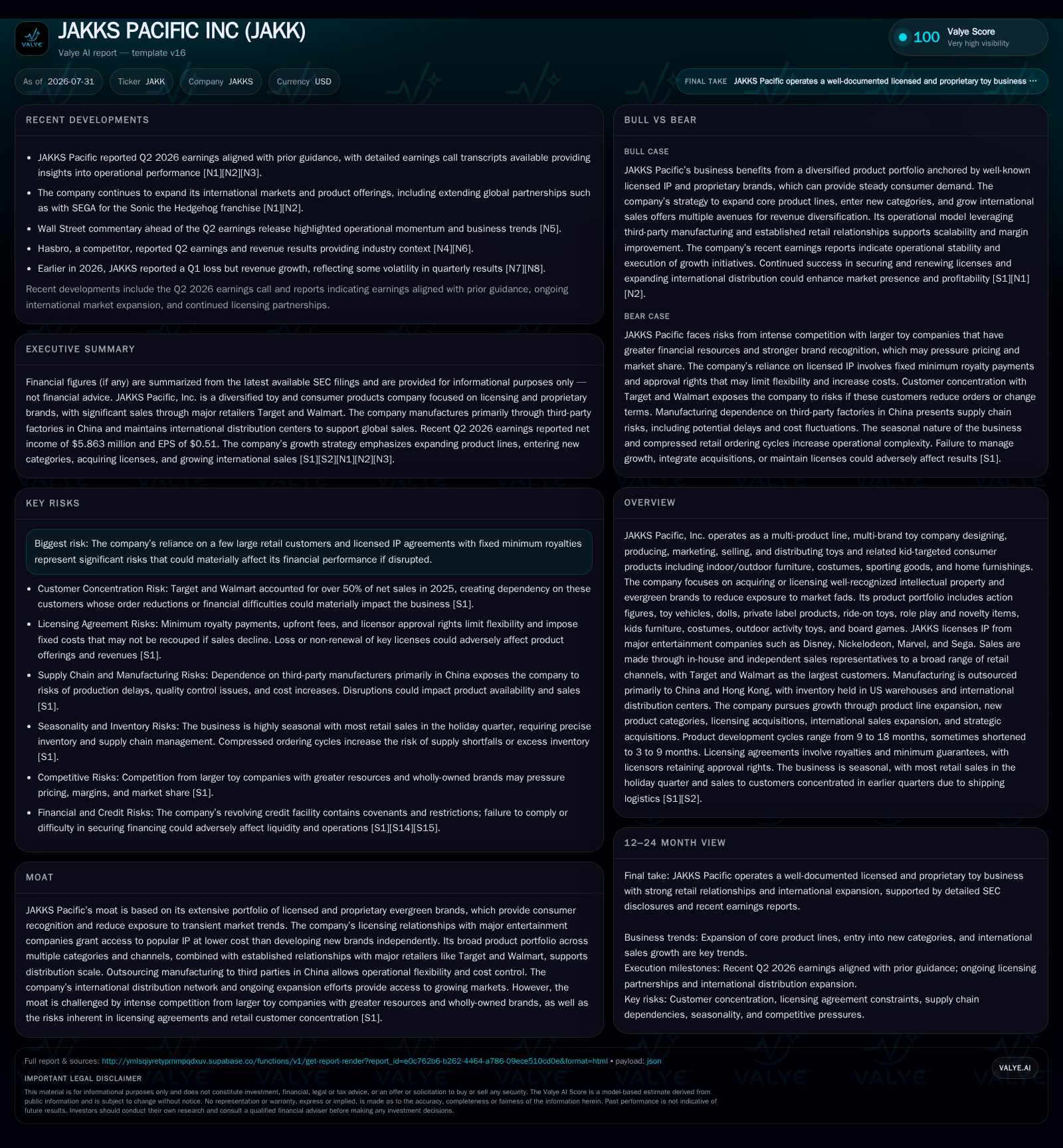
In its latest quarterly filing, JAKKS Pacific maintained stable sales with a strong focus on licensed intellectual property amid retail customer concentration risks. The company leverages evergreen brands and licensing partnerships with entertainment giants like Disney and Nickelodeon, balancing product innovation with outsourced manufacturing primarily in China. JAKKS faces industry-wide challenges including shifting consumer preferences toward digital play, high royalty expenses, and competition from larger peers. Growth remains tied to expanding licensed portfolios, international distribution, and e-commerce penetration, while watchpoints include maintaining retailer relations and managing inventory through seasonality.
Recent Operating Update
JAKKS Pacific’s Q2 2026 financial disclosures confirm stability in operations amid an unchanged risk profile relative to prior filings [S2]. The company continues to rely heavily on its two largest retail customers—Target and Walmart—which together accounted for over half of net sales in recent years (26.6% and 26.1% respectively in 2025), underscoring concentrated single-customer exposure that could materially affect performance if disrupted [S4][S15]. Notably, the Board declared a quarterly dividend of $0.25 per share payable August 28, signaling management's confidence in ongoing free cash flow generation [S3].
Business Model Specifics
JAKKS operates as a multi-product line manufacturer focused on kid-targeted toys and consumer products inclusive of indoor/outdoor furniture, costumes, sporting goods, and related categories [S1]. Its business model centers on acquiring or licensing well-recognized intellectual properties (IPs) mainly from entertainment giants such as Disney®, Nickelodeon®, Marvel®, Sega®, which provides an 'evergreen' brand base insulated partly from volatile fads [S7][S9]. Revenue is generated by designing, marketing, selling to mass-market retailers through its internal sales force and independent representatives. The monetization mechanics link wholesale product sales—ranging across action figures to ride-on toys—with fixed royalty expenses paid against net sales under license agreements [S7][S22].
Manufacturing is fully outsourced primarily to third-party vendors in China, including significant spend with Hong Kong Meisheng Cultural Company Limited; this model reduces capital intensity but embeds supply chain dependencies [S4][S22]. The company retains ownership of tooling assets enabling flexible manufacturer shifts but remains vulnerable to delivery disruptions or rising raw material costs that could compress margins.
Sales channels encompass broad domestic mass market retailers like Target and Walmart—as well as e-commerce giants Amazon.com and Walmart.com—while international expansion is growing via distributors and new warehouse infrastructure across Europe and Mexico [S6][S9]. Seasonal demand is pronounced with nearly 58% of sales concentrated in Q2-Q3 periods aligned with holiday or event-driven purchase cycles making inventory turnover a critical operational KPI [S16].
Industry Structure and Competitive Position
As part of the consumer toys & games sector dominated by large incumbents such as Hasbro (HAS) and Mattel (MAT), JAKKS lacks comparable scale but leverages licensing partnerships to mitigate brand building risks inherent in the fragmented toy market. Competition focuses strongly on securing popular media licenses while delivering products meeting increasingly sophisticated consumer expectations for quality, functionality, pricing value, safety compliance, and environmental considerations [S14]. Larger peers benefit from deeper resources allowing broader international reach and integrated content-to-toy ecosystems.
JAKKS must consistently innovate within licensed properties while managing elevated royalty expenses—sometimes up to 22% of net sales—which limits margin upside but ensures access to high-profile content driving retail shelf space [S7][S22]. The company's multi-brand strategy spanning proprietary lines like Creepy Crawlers® adds diversification yet the reliance on licensed IP exposes it to contract renewals risks.
Supply chain reliance on Chinese manufacturers demands vigilant quality control programs conducted by internal inspectors alongside third-party testing referenced by some key retailers—a necessity given stringent U.S. Consumer Product Safety regulations administered by the CPSC which could trigger costly recalls or reputational damage if violated [S17][S22].
Growth Drivers
Key growth levers include expanding licensed IP partnerships aimed at current popular franchises and classic evergreen marks that help smooth product life cycle disruptions [S9][S18]. International revenue increased notably to represent roughly 27% of net sales recently versus about 21% previously—a sign that geographic diversification is progressing via additional European warehouses opened as recently as 2025 [S6][S9].
E-commerce is an increasingly important channel complementing traditional brick-and-mortar retail; JAKKS leverages online platforms including Walmart.com and Amazon.com which align with changing consumer shopping habits favoring online discovery though offline remains substantial for newer product launches requiring tactile evaluation [S4].
Product innovation incorporating technology features tailored for today’s children’s preferences plays a role but must be balanced against shorter product life cycles and higher upfront development costs bounding return potential [S1]. Strategic acquisitions supplement organic growth by broadening category exposure adding novel product concepts or license rights acquired from third parties over the past two decades [S9]. The company also focuses on operational efficiency gains at fixed overhead levels supporting margin expansion as volumes grow without proportionate SG&A increase [S9].
Risks and Watchpoints
Retail customer concentration presents a material risk given lack of binding long-term contracts outside outstanding purchase orders subject to cancellation; either Target or Walmart reducing order volumes could materially depress revenues or force promotional markdowns impacting gross margin [S15][S19]. Royalty agreements often include minimum payment guarantees imposing fixed cost burdens irrespective of sales performance adding leverage risk especially if certain IP licenses fail renewal or lose popularity.
Competition exerts pressure not only on pricing but also shelf space allocation; dominant players like Hasbro enjoy stronger brand loyalty with proprietary franchises alongside licensed offerings placing JAKKS at a strategic disadvantage despite cost discipline measures [S19]. Shift towards technology-based interactive play challenges traditional toy categories where JAKKS competes necessitating continuous adaptation that may raise development expense ratios without guaranteed return.
Supply chain disruptions—still fresh from pandemic-era shocks—remain a latent threat given concentrated manufacturing base overseas. Rising labor costs or raw material inflation in China could squeeze margins further absent pricing power [S17]. Regulatory compliance standards around safety require constant monitoring; any failure can result in costly recalls damaging reputation beyond direct financial loss
Inventory management complexity rises due to highly seasonal demand patterns risking markdowns or lost sales from stockouts. Consumer preference fragmentation across multiple media channels raises uncertainty about future winning IP licenses potentially increasing research expense without corresponding commercial success.
What to Watch Next
Upcoming milestones include monitoring H2 product launch reception reflecting success rate of new SKUs particularly those infused with relevant technology features that align with evolving child entertainment trends. Retail sell-through rates at major customers will be crucial leading into peak holiday buying windows determining inventory replenishment needs. Continued progress on international market penetration evidenced by distributor performance metrics and expanding warehouse utilization will indicate sustainable global growth.
Financial updates concerning working capital turnover relative to escalating royalty payables will signal operational leverage capabilities. Any announcements regarding acquisition activity or new licensing contracts will impact medium-term portfolio breadth. Management commentary during earnings calls post-Q3 will be insightful around navigating competitive pressures amidst shifts toward e-commerce dominance.
Financial Profile Discussion
As of June 30, 2026, JAKKS holds approximately $59.5 million in cash & equivalents against current liabilities totaling about $162 million resulting in a current ratio near 1.72—a modest liquidity buffer supportive of ongoing operating commitments excluding long-term debt implications [F1][S2]. The absence of updated total debt figures since end-2020 precludes precise leverage analysis at this time, though historically reported total debt stood near $34.1 million offset by net cash positions then [F1].
The quarterly dividend payment indicates stable free cash flow generation consistent with conservative capital return policies albeit with caution warranted given industry cyclicality and concentration risks highlighted above.
This analysis synthesizes the latest publicly available filings from JAKKS Pacific up to July 31, 2026 focusing on operating realities within the consumer toys sector driven heavily by licensed IP dynamics against an evolving competitive landscape shaped by retail client dependence and shifting consumption patterns. All data cited reflects disclosed information; projections or investment research views are explicitly excluded.
Disclaimer: This is research-only, informational analysis and not investment advice. It may include AI-generated interpretation and general industry context. Always verify important details using primary sources.

Comments