
Silvercrest Asset Management's Q2 Setback Highlights Market Sensitivity and Liquidity Strength
Q2 earnings reveal fee income volatility amid market swings, while a robust liquidity position supports operational stability.
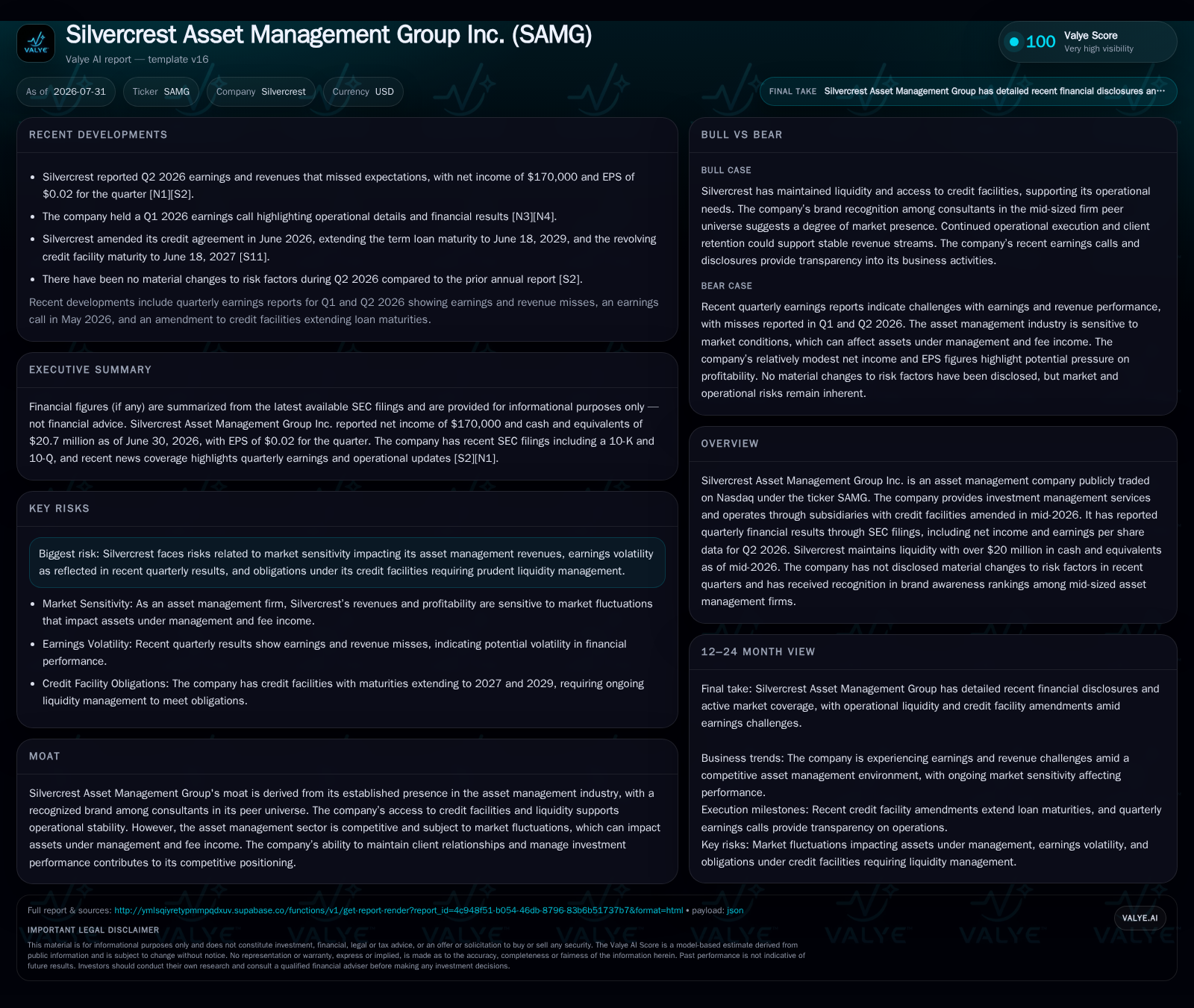
Silvercrest Asset Management Group Inc. reported a disappointing second quarter marked by earnings and revenue shortfalls driven by declines in assets under management amid volatile market conditions. Despite these setbacks, the firm's liquidity remains strong with over $20 million in cash and equivalents as of June 2026, underscoring resilience in navigating fee income pressures common in asset management. The company's differentiated brand recognition among mid-sized peers and access to amended credit facilities serve as strategic buffers amidst competitive industry dynamics and fee revenue sensitivity.
As a direct consequence, the firm reported revenues and net income figures falling short of consensus expectations according to its July 30, 2026 10-Q filing and concurrent disclosures [S2], [N1]. This outcome underscores the inherent market sensitivity embedded within Silvercrest’s revenue base, reflecting typical asset manager reliance on fluctuating portfolio valuations and client activity.
Despite these setbacks, Silvercrest maintained a notably strong liquidity posture with approximately $20.7 million held in cash and cash equivalents at the close of Q2 2026 [F1]. This liquidity position serves as a critical stabilizer enabling Silvercrest to continue managing expenses and invest selectively without immediate refinancing pressures.
The firm's ability to negotiate amendments to its existing credit facilities by mid-2026 further attests to its prudent capital management approach. These amendments extended term loan maturity dates into late 2029 with incremental extension options and prolonged revolving credit availability through 2027 [S27]. Such enhancements improve financial runway essential during periods of AUM contraction where fee income volatility is elevated.
Silvercrest’s Business Model: Revenue Tied Closely to Fleeting Fee Income Fluctuations
Silvercrest operates predominantly as an asset management intermediary focused on delivering investment management services that generate revenues largely from fees tied to AUM. The company earns recurring management fees based on the size of assets it oversees on behalf of clients, supplemented by performance fees contingent on surpassing predefined investment benchmarks or targets [S1]. This standard industry archetype intensifies exposure to market valuation swings; when equity markets or fixed income valuations decline or clients redeem capital, AUM shrinks directly eroding both management fee yield dollars and incentive compensation streams.
The extent of this fee sensitivity manifested clearly in Q2 results where industry headwinds triggered negative impacts not only on topline fee accruals but also distorted earnings consistency quarter-to-quarter [S2]. The dependence on AUM implies that sustaining revenue growth requires either positive net new flows or favorable portfolio appreciation—both highly susceptible to market cycle dynamics beyond the firm’s control.
To mitigate these risks, Silvercrest leverages ancillary capabilities such as access to extended credit lines facilitating tactical liquidity injections during downturns alongside ongoing client relationship efforts aimed at retention—a vital defense against client attrition which compounds revenue erosion.
Competitive Landscape: Brand Recognition Amidst Intensifying Industry Rivalry
Positioned as a mid-sized player within the asset management ecosystem, Silvercrest faces structural challenges common among firms lacking scale advantages enjoyed by industry giants like BlackRock or Franklin Templeton. These large diversified entities benefit from broad product suites, global distribution networks, and pricing power derived from scale economies absent at Silvercrest's level.
Nevertheless, Silvercrest commands meaningful brand awareness within a niche peer set targeting selectively curated institutional and high-net-worth clientele. This brand equity bolsters client retention patterns which are crucial given the industry-wide competition for mandates increasingly pressured by fee compression trends driven by passive investing alternatives.
Comparatively speaking, wealth-focused advisors such as Ameriprise Financial Services showcase alternative business models emphasizing advisory fees over pure asset-based fees—a dimension where Silvercrest's more traditional asset management setup might encounter margin constraints if it cannot diversify product offerings or innovate fee structures [S1]
Growth Drivers: Client Retention, Investment Performance, and Strategic Credit Flexibility
Promoting stable growth trajectories hinges significantly on maintaining superior investment performance relative to benchmark indices and peers—a key determinant influencing client loyalty and fresh mandate acquisition. Positive investment outcomes tend to attract net inflows thereby growing AUM which directly scales management fee income.
In parallel, enhancing client retention mitigates cyclicality inherent in market-driven outflows [S1]. Silvercrest's emphasis on brand positioning among consultants in its peer universe underlines strategic intent to deepen relationships holding potential for sticky asset pools less vulnerable to swift redemptions
Operationally, smart deployment of amended credit facilities provides additional maneuverability enabling short-term capital usage aligned with discretionary spend or opportunistic investments enhancing service capabilities during volatile cycles without triggering covenant breaches or liquidity stress [S27], [S3].
Risks Loom Large: Market Sensitivity, Fee Pressure, and Operational Challenges Ahead
Silvercrest’s risk profile remains closely tied to external macro-financial environment factors including sustained market downturns which exacerbate declines in AUM thus compressing fee revenues unpredictably—raising earnings volatility issues noted in recent quarterly disclosures [S2], [S5].
Further complicating execution are regulatory compliance demands that impose continuous operational rigor often increasing administrative overheads without commensurate top-line growth benefits.
Additionally, operational risks around technology infrastructure or cybersecurity also reside latent per filings though no recent material events have arisen [S1], [S2].
What To Watch—Upcoming Milestones and Performance Indicators in Key KPIs
Investors and analysts monitoring Silvercrest should focus keenly on subsequent quarterly releases expected around Q3 for signs of stabilization or improvement in key indicators:
- Trends in total AUM levels signaling net flow directionality coupled with market valuation effects,
- Changes in management fee yields reflecting portfolio mix shifts or pricing adaptations,
- Variations in performance fee revenue evidencing investment success premiums,
- Updates on credit facility drawdowns or repayments illustrating balance sheet strategy,
- Client retention statistics potentially revealing franchise durability amidst competition. This constellation of data points will clarify whether short-term episodic pressures translate into longer-lasting structural headwinds or if recovery momentum is building behind renewed inflows or investment outperformance signals [S3], [N1].
Financial Profile Discussion: Balance Sheet Strength Supports Operating Resilience
The financial snapshot as of June 30, 2026 confirms Silvercrest's solid liquidity foundation essential for weathering episodic earnings disruptions characteristic of asset managers reliant on fluctuating AUM metrics [F1]. With cash plus equivalents totaling approximately $20.7 million, the company holds ample flexibility absent immediate leverage strain or refinancing urgency—an advantage over less liquid peers during periods of heightened market stress.
The timely amendment of credit agreements extends maturity horizons for term loans into mid-2029 with optional extensions enhancing optionality while maintaining access to revolver capacity through mid-2027 underpinning near-to-medium term financial robustness [S27]. This strategic financial posture affords operating leeway allowing leadership discretion on capital deployment particularly critical when navigating volatile revenue environments influenced by factors largely outside firm control.
The unfolding quarters will be pivotal for evaluating resilience against cyclical headwinds confronting mid-sized asset managers today.
Disclaimer: This is research-only, informational analysis and not investment advice. It may include AI-generated interpretation and general industry context. Always verify important details using primary sources.

Comments