
MasTec Leverages Strategic Acquisitions and Diversified Infrastructure Projects to Sustain Growth
MasTec’s Q2 2026 performance underscores operational resilience amid active acquisition integration and evolving infrastructure demand.
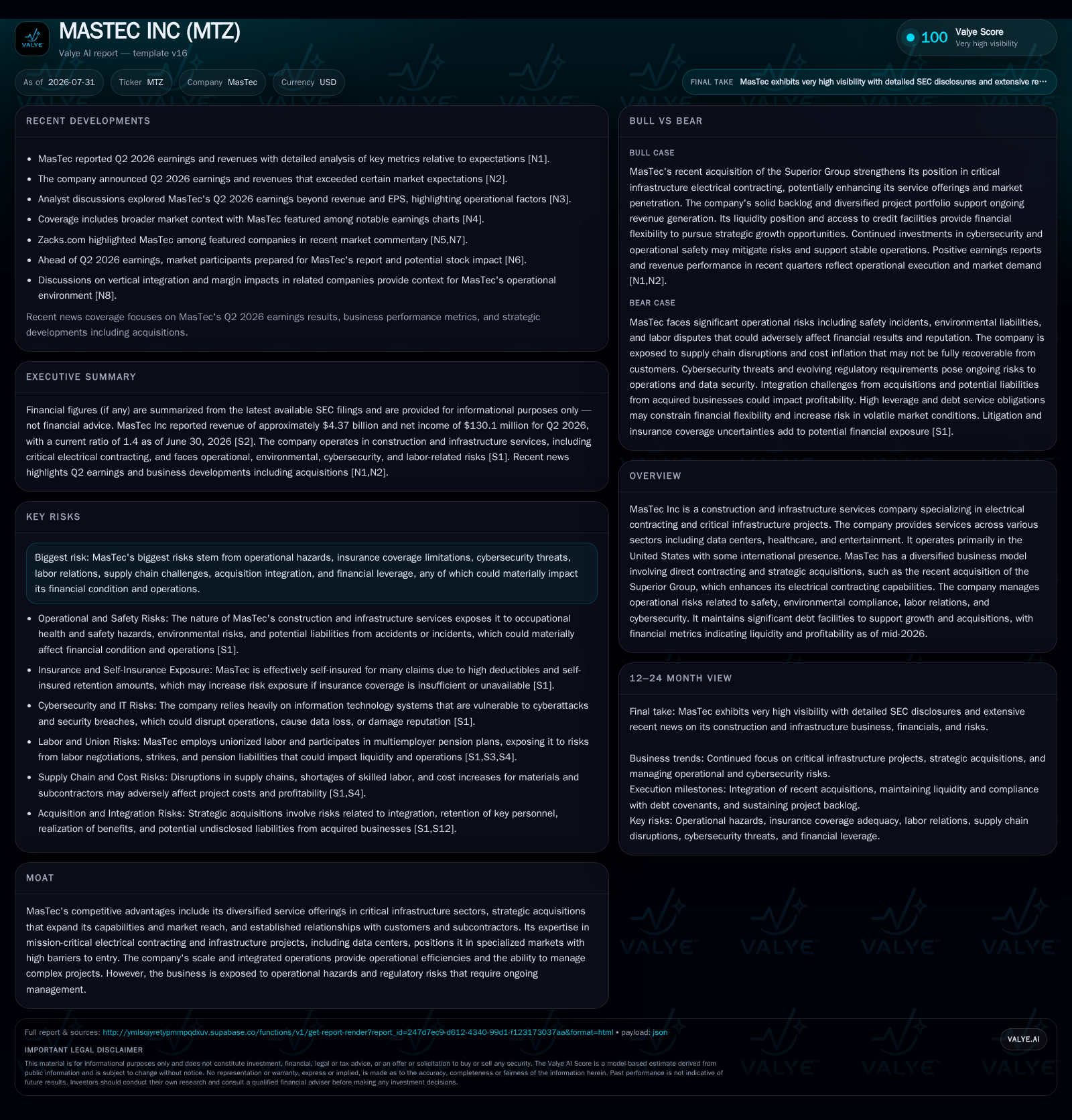
In its latest quarterly filing, MasTec reported solid operating income alongside continued investments in critical infrastructure sectors including data centers and healthcare. The company's strategic acquisition of the Superior Group enhances its electrical contracting capabilities, complementing its diversified service model that blends fixed-price and cost-plus contracts. While operational hazards, labor relations, supply chain dynamics, and regulatory compliance remain ongoing risks, MasTec's scale and integrated operations sustain competitive advantages in a capital-intensive and cyclical industry. Financially, the firm maintains healthy liquidity with a current ratio of 1.4 and modest net debt levels.
Recent Operating Update
MasTec’s second quarter of fiscal 2026 demonstrated steady progress in executing its core business strategy amidst expanding demand for critical infrastructure projects. The company reported operating income of approximately $226 million for the quarter ending June 30, 2026 [F1][S2], highlighting effective cost control despite industry-wide inflationary pressures. This period also saw the near completion of the Superior Group acquisition—a premier electrical contractor focused on mission-critical data center, healthcare, entertainment, and industrial infrastructure —which is expected to close in Q3 2026 [S21][S26]. This transaction represents a strategic extension of MasTec's electrical contracting portfolio and positions the company more favorably in high-growth sectors demanding specialized expertise.
Management appointed new board members during this quarter to strengthen governance amid ongoing expansion initiatives [S3][S16]. Though no material operational disruptions were disclosed, safety remains a focal point given the construction industry's inherent physical hazards.
Business Model Dynamics
MasTec generates revenue primarily through specialized construction services encompassing electrical contracting and broader critical infrastructure projects [S1]. Its customer base spans private sector clients investing heavily in data centers and healthcare facilities alongside select government contracts. The company operates predominantly in the United States with limited international presence concentrated in Canada
Revenue recognition depends on project backlog management encompassing both fixed-price contracts—where MasTec bears greater risk around cost overruns—and cost-plus arrangements offering more predictable margins but requiring vigilant contract oversight to secure allowable costs [S1][S23]. The firm relies extensively on subcontractors to supplement internal workforce capacity for delivering complex projects. Therefore, subcontractor performance directly impacts project timelines, quality standards, and profitability
Capital expenditures support fleet maintenance essential for timely project delivery while investments in technology aim to enhance project management systems. MasTec actively pursues acquisitions not only to access new customer segments but also to integrate complementary technical capabilities—demonstrated by the imminent Superior Group merger. However, acquisitions bring integration challenges including alignment of accounting systems, retention of key personnel, realization of revenue synergies, and potential legacy liabilities sourced from acquired entities [S7][S8]. These factors necessitate disciplined risk mitigation during due diligence stages.
Industry Structure and Competitive Position
Operating within the infrastructure construction and electrical contracting industry situates MasTec among several peer categories including general contractors (e.g., Tutor Perini), specialty electrical contractors (e.g., Superior Group pre-acquisition), engineering design firms (e.g., AECOM), and equipment leasing companies. The sector is marked by high capital intensity with sizable upfront investments in labor force development, compliance programs, equipment fleets, and bonding requirements.
MasTec’s competitive moat stems from its diversified service offerings across multiple critical infrastructure markets coupled with economies of scale enabling cost efficiencies unseen among smaller specialty contractors [S1]. Strategic acquisitions advance this moat by broadening technical expertise particularly in mission-critical facilities such as data centers—complex builds demanding strict uptime guarantees where entry barriers are substantial due to technical risk.
Other players like Quanta Services emphasize similar niche infrastructure markets but differ geographically or focus predominantly on energy infrastructure rather than diversified commercial sectors. Sterling Construction’s vertical integration ambitions contrast with MasTec’s hybrid model balancing organic growth with targeted acquisitions [N13][N11].
Growth Drivers
Key growth catalysts reside in increasing capital expenditures toward modernizing data centers fueled by cloud computing demands and expanding healthcare infrastructure aging replacement needs. Urbanization trends bolster long-term construction volume while regulatory mandates encouraging renewable energy grid upgrades spur demand for specialized electrical contracting services [S1]
MasTec’s enlarged footprint post-Superior Group acquisition enables cross-selling opportunities across existing customer relationships enhancing contract win rates. Technological adoption—especially digital project management platforms augmented by AI—and refined labor utilization further underpin productivity gains critical amidst skilled labor shortages.
Government infrastructure packages aimed at upgrading power grids and public facilities also contribute incremental project opportunities that align with MasTec's integrated service model offering end-to-end solutions from design through construction completion.
Risks and Watchpoints
Operational hazards remain significant given exposure to electrical lines, heavy machinery operation, transportation incidents, weather-induced delays, environmental contamination risks, and crowded urban job sites elevating accident potentials [S1][S25]. Despite comprehensive occupational health and safety initiatives, any deterioration in safety records could restrict bidding eligibility or provoke contract terminations impacting revenue.
Insurance coverage limitations exacerbate financial exposure especially as carriers tighten wildfire risk policies leading to increased reliance on self-insurance. Additionally, cybersecurity threats targeting operational technology systems require vigilant IT controls lest they disrupt business-critical workflows or invite reputational damage [S25][S23].
Labor market tightness paired with evolving union negotiations could pressure wage costs or reduce labor availability constraining project throughput. Supply chain bottlenecks for crucial materials like wiring or specialized equipment also pose margin compression risks amid pricing volatility.
Acquisition integration risks persist including failure to realize projected synergies or inherited contingent liabilities that may affect cash flow predictability [S7][S8]. Financial leverage remains manageable with recent credit facility expansions designed to fund acquisitions; interest rate fluctuations could impact debt servicing costs although total debt was reported as zero as recently as end-2022 [F1][S20].
What to Watch Next
Upcoming milestones include final close of the Superior Group acquisition expected in Q3 2026; subsequent quarterly reporting will clarify initial integration success measures including retention of key personnel and realized revenue enhancements. Monitoring shifts in project backlog composition will reveal demand sustainability amid economic uncertainties.
Safety metrics such as incident frequency rates will be critical signals given their direct influence on operational continuity. Cash flow generation relative to capital expenditure outlays provides insight on liquidity health especially against backdrop of expanded revolving credit line.
Lastly, regulatory developments around environmental compliance or emerging cybersecurity mandates could materially affect operating costs or contractual terms; hence management commentary on preparedness will be instructive.
Financial Profile Discussion
MasTec maintains a solid liquidity position evidenced by a current ratio of approximately 1.4 as of June 30, 2026 indicating adequate short-term asset coverage over liabilities [F1]. Cash plus equivalents stood near $316 million supporting working capital demands during an active acquisition phase.
Notably, total debt was reported as zero as recently as end-2022, with no more recent confirmed figures available [F1]. The company has expanded revolving credit commitments by $350 million to $2.25 billion, providing financial flexibility for strategic investments including the Superior Group deal [S20][S21]. This capacity aligns with typical leveraged profiles within capital-intensive contractors balancing growth financing against margin preservation.
Operating income trajectories suggest disciplined cost management although net income should be contextualized against non-cash charges linked to acquisition-related expenses. Free cash flow trends will be a key measure going forward as sustaining organic growth while absorbing acquisition costs requires efficient capital allocation.
This analysis synthesizes publicly filed SEC documents covering the latest quarterly reporting cycle supplemented by strategic event disclosures up through July 2026 combined with Valye News' sector-level expertise within infrastructure construction services. It does not constitute investment advice or research views.
Disclaimer: This is research-only, informational analysis and not investment advice. It may include AI-generated interpretation and general industry context. Always verify important details using primary sources.

Comments