
ADT Inc. Accelerates Platform Transition Despite Mounting Debt and Attrition Risks
ADT’s Q2 2026 results highlight strategic progress in its platform-centric SaaS evolution amid ongoing churn and leverage challenges.
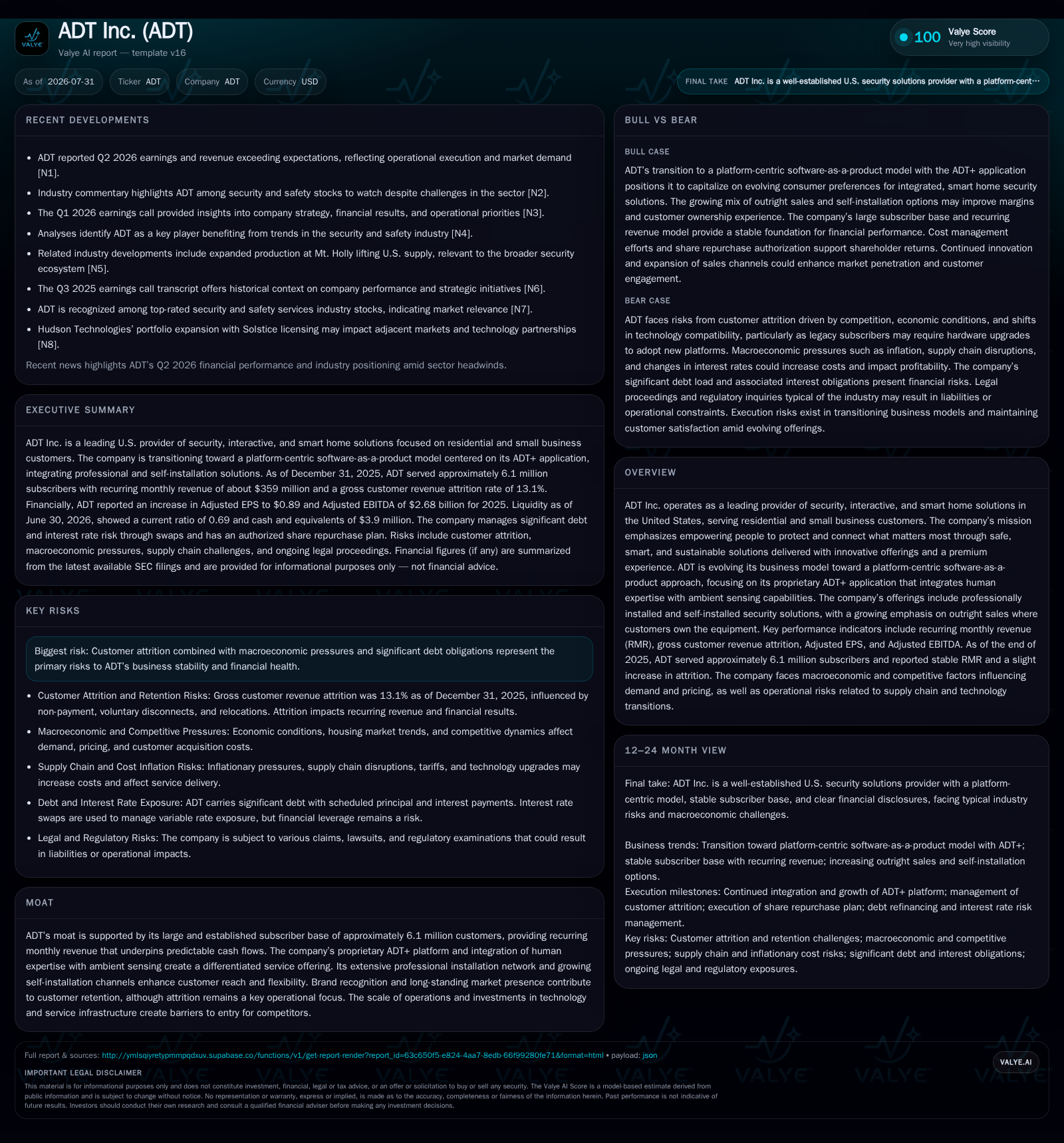
In its latest quarterly filing, ADT Inc. reported stable Recurring Monthly Revenue (RMR) with marginal net subscriber losses, reflecting persistent attrition pressures despite pricing increases. The company continues pivoting toward a software-driven platform model via its proprietary ADT+ application, aiming to enhance customer retention and expand the self-installation segment. However, elevated customer churn and a significant $7.45 billion net debt position constrain financial flexibility. ADT’s execution on cross-selling smart home solutions and managing installation economics will be critical for sustainable growth.
Q2 Update: Subscriber Dynamics and Recurring Revenue Trajectory
stability.
Average Revenue Per User (ARPU) benefitted from price adjustments which partially compensated volume softness, illustrating residual pricing power amid inflationary cost pass-through efforts [S19]. The flat RMR combined with rising attrition suggests that sustaining long-term revenue growth will require enhanced retention strategies alongside more aggressive new subscriber acquisition.
Platform-Centric Shift: Leveraging ADT+ for Competitive Differentiation
Anchoring its strategic transformation is ADT’s proprietary ADT+ platform—an integrated ecosystem blending ambient sensing technologies acquired from the February 2026 Origin AI acquisition with expert human monitoring capabilities [S1, S28]. This platform-as-a-service approach aims to elevate alarm verification quality through artificial intelligence-powered presence detection without invasive cameras or wearables, reducing false alarms and improving actionable response times.
This software-centric evolution marks a clear shift away from legacy hardware-dominated models towards a more sticky subscription payload bolstered by data-driven services and continuous feature enhancements delivered through the ADT+ app [S1]. The platform facilitates personalized service experiences that adapt across life stages and use cases for homes and small businesses alike.
Industry context underscores this as a vital moat driver given competitors like Alarm.com are similarly investing heavily in technology integration to temper churn and build deeper user engagement metrics [S2]. For ADT, successful cadence of software rollouts coupled with proactive feature adoption will serve as key indicators of moat durability and incremental ARPU uplift prospects
Installation Channel Economics: Balancing Professional Vs. Self-Install Tradeoffs
ADT's revenue model mixes upfront equipment sales made possible through both professional installation and expanding self-install channels—a dual approach designed to address diverse customer preferences while optimizing acquisition costs [S1]. The outright sales model increasingly leverages professional installers for complex systems contributing to higher average install revenues but at greater initial cost. Conversely, self-install options reduce upfront expenses and accelerate customer onboarding but potentially elevate churn due to diminished hands-on onboarding quality.
This tradeoff impacts new subscriber contribution margins and extends the revenue break-even period per customer beyond the circa two-year norm historically cited by management [S1]. Managing this balance is pivotal especially as DIY solutions gain traction in the broader security services market sector. Maintaining a differentiated value proposition via platform-enabled services alongside installation flexibility supports sustained price points and incremental ARPU gains essential for recovering acquisition economics efficiently.
Competitive Position: Navigating Customer Attrition Amid Industry Peer Benchmarks
ADT operates within a competitive landscape characterized by pressures from emerging do-it-yourself brands offering lower-cost alternatives and tech-savvy entrants emphasizing seamless smart home integration. The gross customer revenue attrition rate above 13% highlights the intensity of churn relative to peers such as Alarm.com where similar retention challenges exist but are sometimes mitigated through advanced platform engagement strategies.
Despite this attrition backdrop, ADT’s scale—serving over 6 million subscribers as of late 2025—is a key structural advantage providing predictable cash flows underpinned by extensive professionally installed networks coupled with growing self-install penetration [S1]. Brand recognition also yields high switching costs in certain segments.
Nonetheless, mitigating attrition through innovation-led differentiation using ambient sensing capabilities integrated into ADT+ remains imperative to sustain subscription longevity given macroeconomic headwinds dampening discretionary budgets among small business and residential customers alike.
Growth Enablers: Innovation Adoption, Cross-Selling, and Smart Home Adoption Trends
Growth levers rest heavily on advancing IoT sophistication within residential and small business environments—including smart locks, environmental sensing, automation integration—which complement core security offerings while driving new value streams beyond traditional monitoring fees [N3]. ADT's platform architecture encourages cross-selling of upgrades and additional SaaS modules fostering higher wallet share from existing subscribers.
Demographic trends favoring smart home adoption further extend TAM opportunities as consumers seek integrated ecosystems beyond standalone security systems. Strategic partnerships or acquisitions targeting complementary technologies can accelerate capability breadth enhancing competitive positioning.
Successful scaling of these innovation adoption vectors alongside expanded self-install volumes could reduce unit CAC markedly while shortening payback cycles—metrics vital for healthy capital allocation amid current leverage constraints [S1,N3].
Risk Amplifiers: Debt Burden, Macroeconomic Headwinds, and Attrition Costs
A prominent risk factor is ADT’s substantial leverage profile—with net debt around $7.44 billion as of June 30, 2026—and liquidity tightness signaled by a current ratio near 0.69—implying limited short-term financial flexibility in absorbing shocks or funding significant new capex beyond ongoing maintenance investments [F1]. Interest expense remains elevated impacting net income generation capacity despite operational earnings growth.
This capital structure intensifies exposure to macroeconomic fluctuations such as reduced consumer discretionary spending impacting new subscriber acquisition or accelerating voluntary cancellations amid inflationary pressures [S4,S18]. Elevated customer attrition translates into higher reinvestment needs penalizing adjusted EBITDA margins unless offset by successful upsell or price increases—a delicate balancing act under current conditions.
Looking Ahead: Milestones in Platform Integration and Subscriber Expansion
Key near-term execution milestones include broader rollout of advanced ADT+ functionalities aimed at deepening user engagement metrics essential for lowering churn rates sustainably while expanding ARPU—as well as scaling installation volumes particularly within the lower-cost self-install segment which influences CAC efficiency directly [S2,N1]
Management commentary emphasizes closely monitoring gross revenue attrition trends aligned with software adoption rates as leading indicators of platform efficacy. Any evidence of ARPU acceleration or reduced churn would validate investment choices supporting long-term margin improvement.
Simultaneously maintaining disciplined balance sheet management amidst these growth investments will be crucial given leverage levels restricting financial maneuverability.
Financial Profile Discussion: Leverage Constraints Amid Growth Investments
As of June 30, 2026, ADT held roughly $3.9 million in cash and equivalents against total debt nearing $7.45 billion resulting in a net debt position exceeding $7.44 billion—a significant leverage factor relative to operating income generation capacity [F1]. Current assets of approximately $764 million compared with current liabilities of about $1.11 billion yield a current ratio near 0.69, indicating short-term liquidity constraints that require careful working capital management [F1].
Prudent cash flow stewardship alongside incremental deleveraging progress will be essential prerequisites enabling continued strategic investment pacing required for digital evolution within highly competitive security services verticals.
Disclaimer: This report is for informational purposes only and does not constitute investment advice or research views. All analyses are based on available public filings up to July 30, 2026.
Disclaimer: This is research-only, informational analysis and not investment advice. It may include AI-generated interpretation and general industry context. Always verify important details using primary sources.

Comments