
Cactus Strengthens Market Reach Despite Middle East Risks and Cost Pressures
Q2 2026 results highlight diversified revenue streams amid geopolitical and supply chain challenges in oilfield services.
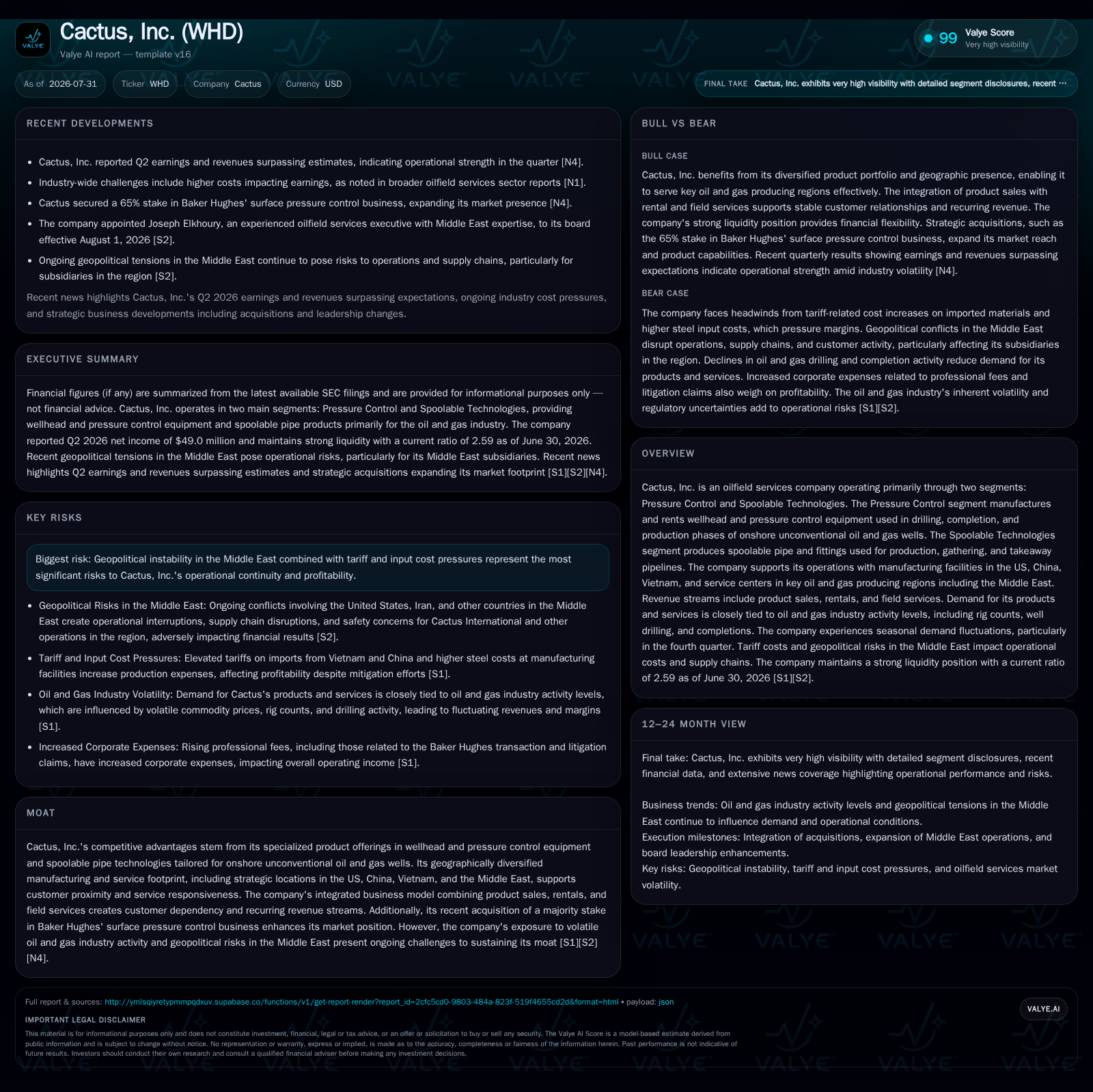
Cactus, Inc. reported strong second-quarter 2026 revenues driven by its Pressure Control and Spoolable Technologies segments, supported by integrated product sales, rentals, and field services. The company’s strategic geographic diversification including recent international expansions partially mitigates ongoing operational risks tied to geopolitical tensions in the Middle East. However, cost inflation from tariffs and raw material increases, combined with cyclical upstream activity fluctuations, continue to pressure margins. Key growth drivers remain linked to rig count and well completion activity, but the uncertain geopolitical environment warrants monitoring operational continuity and supply chain stability.
Recent Operating Update
In Q2 2026 (quarter ended June 30), Cactus, Inc. continued to deliver revenues above estimates driven by its two primary segments: Pressure Control and Spoolable Technologies [S2][S3][N4]. This reflects a stable demand environment in its core segments supported by both product sales and recurring rental activity, alongside related field services. Despite external headwinds including geopolitical uncertainties in the Middle East where it operates significant plants via its 65% owned subsidiary Cactus International, the company managed ongoing integration efforts of its recently acquired Baker Hughes surface pressure control assets with limited immediate disruption [S2]. Notably, the firm repurchased shares consistent with its announced buyback program during the quarter [S2].
Business Model Overview
Cactus operates as an integrated oilfield services equipment provider focused on highly engineered products tailored for onshore unconventional oil and gas wells—a segment characterized by its technical complexity and capital intensity. It monetizes through three main revenue streams: direct product sales of wellhead systems, production trees, spoolable pipe and fittings; equipment rental primarily used during well completions such as frac trees; and field services encompassing installation, maintenance, repair, and refurbishment activities correlated with products sold or rented [S1]
The Pressure Control segment’s emphasis on wellhead equipment addresses critical stages from drilling through production phases. Demand for these products is tightly coupled to the number of new wells drilled since each requires unique wellhead configurations. Rentals hinge on well completion activity where hydraulic fracturing demands specialized frac trees rented largely rather than purchased by operators seeking CAPEX flexibility [S1]. The Spoolable Technologies segment complements this by supplying spoolable pipeline products under the FlexSteel brand for gathering and takeaway pipelines essential to produced hydrocarbons transportation. This segment's revenues benefit structurally from ongoing infrastructure buildouts in producing basins [S1].
Integrated service centers strategically located across key regions—including the US basins (Permian, Eagle Ford), Canada, Australia, China, Vietnam (new plant opening), and extended Middle East facilities—facilitate proximity-based service delivery enhancing responsiveness critical for downtime-sensitive E&P operators [S1][S17]. This geographic dispersion helps hedge regional downturns but also introduces complexity amid geopolitical frictions.
Industry Structure and Competitive Position
Operating within the broader oilfield services equipment industry—dominated by midstream manufacturers/renters servicing upstream operators—Cactus competes against peers like Baker Hughes (integrated equipment/services), National Oilwell Varco (drilling/completion tools), Weatherford International (pressure control), Halliburton/Schlumberger (field services/rentals), and FlexSteel (spoolable pipe). Its niche focus on pressure control combined with spoolable pipe technologies creates differentiation by offering end-to-end solutions important for unconventional well designs.
The recent acquisition enhancing its portfolio with Baker Hughes’ surface pressure control assets not only raises scale but also augments technological capabilities—important factors given technological innovation’s role in improving safety standards and operational uptime amidst rigorous hydraulic fracturing cycles. Customer relationships built through rentals and associated field services form a recurring revenue base that fosters customer dependency amid high switching costs caused by equipment specificity.
However, industry cyclicality remains pronounced as customer E&P capital investments fluctuate with macro oil/gas prices impacting rig counts and well completions—the primary demand levers. Moreover, geopolitical exposure especially in the Middle East injects operational risk through potential interruptions or supply delays affecting service reliability.
Growth Drivers
Key growth drivers pivot on upstream oilfield activity trends:
- Increasing rig counts directly raise demand for Pressure Control product sales (new wellheads) while boosting rental tool utilization during completions phases.
- Infrastructure expansion for gathering/takeaway pipelines supports spoolable pipe product volume growth.
- Technological advancements in spoolable pipe durability/flexibility improve market share against traditional rigid piping solutions.
- Geographic expansion initiatives particularly in emerging basins or low-cost manufacturing hubs like Vietnam aim to capture new demand while optimizing cost structures [S4][S17].
- Rental offerings enable operators’ capex flexibility promoting market share gains as operators lean toward renting sophisticated frac trees/tools instead of outright purchases.
These drivers are measurable via monitoring rig counts data published by energy industry trackers, rental utilization percentages reported by management per quarter, as well as backlog/order intake sourced from company disclosures.
Risks, Watchpoints, and Growth Constraints
Primary risks cluster around geopolitical instability notably US-Iran tensions disrupting Middle East operations including plant throughput interruptions at UAE/Saudi Arabia facilities which can delay deliveries or reduce order volumes as customer operations curtail activity or face logistic bottlenecks through contested shipping lanes like the Strait of Hormuz [S2]. Employee safety concerns further complicate operational continuity.
Supply chain risks have intensified due to tariffs (US Section 232 steel tariffs) on raw materials sourced primarily from China/Vietnam impacting input cost inflation evident at the company’s Bossier City manufacturing site. Although pricing power offsets some margin erosion, volatility remains a threat especially if customer activity weakens amid commodity price downturns reducing upstream CAPEX budgets [S22]
Seasonality also imposes fluctuations tied to natural variations in rig deployment cycles plus weather-driven logistical constraints.
Financial leverage is minimal with no long-term debt outstanding as per latest annual disclosures; strong liquidity buffers shrink refinance risks but capital intensity means capital expenditure commitments must be managed prudently around cyclical revenue swings [F1][S4]. Customer concentration could pose risks if major customers reduce spend suddenly; however broad customer spread across private independents to majors mitigates this somewhat.
Technological obsolescence risks remain moderate given industry incumbents actively advancing pressure control design safety features alongside spoolable pipe innovation requiring continuous R&D investment.
What to Watch Next
- Sequential quarterly updates on rig counts or well completion numbers from US EIA or industry sources will be pivotal indicators of underlying demand strength driving product sales & rental utilization.
- Progress updates on integration timelines for Baker Hughes pressure control asset acquisition impacts on synergies & operating margins.
- Management commentary addressing ongoing Middle East conflict resolution prospects or contingency plans impacting operational adjustments.
- Pricing trends amid raw material inflation pressures; any signs of margin recovery post tariff pass-through or cost mitigation efforts.
- Capital expenditure pacing relative to $40–50 million plans focusing on capacity expansion vs international footprint enhancements.
- Rental fleet size changes signaling confidence in sustained completion activity levels.
- Share repurchase execution velocity as a signal of financial health confidence alongside dividend policy expressions.
Financial Profile Discussion
Although detailed quarterly earnings figures were not fully disclosed here beyond qualitative operating commentary [S2][S3], Cactus maintains a robust balance sheet with cash & cash equivalents totaling approximately $366 million as of June 30, 2026 supporting liquidity needs comfortably. Current assets stood at roughly $1.28 billion against current liabilities near $496 million yielding a healthy current ratio around 2.59 indicative of solid short-term financial flexibility [F1].
Total debt remains minimal or absent post recent financing amendments affirming low leverage risk enhancing resilience against upstream market shocks [F1][S4]. Capital expenditures guidance between $40 million to $50 million suggests moderate reinvestment designed to support manufacturing capability upgrades especially focusing on new international production sites like Vietnam while continuing to diversify supplier bases reducing tariff impacts [S4].
Overall operating profitability is challenged moderately due to cost inflation pressures but partially offset by pricing adjustments aligned with industry practice reflecting the commodity-linked dynamics central to oilfield equipment supply chains.
Disclaimer: This analysis is provided for informational purposes based solely on publicly available filings and news sources as cited. It does not constitute investment advice or research views.
Disclaimer: This is research-only, informational analysis and not investment advice. It may include AI-generated interpretation and general industry context. Always verify important details using primary sources.

Comments