
Federal Realty’s Coastal Retail Portfolio Navigates Inflation and Leasing Momentum in Q2 2026
Strong occupancy and selective asset sales support Federal Realty's retail REIT growth despite macroeconomic uncertainties.
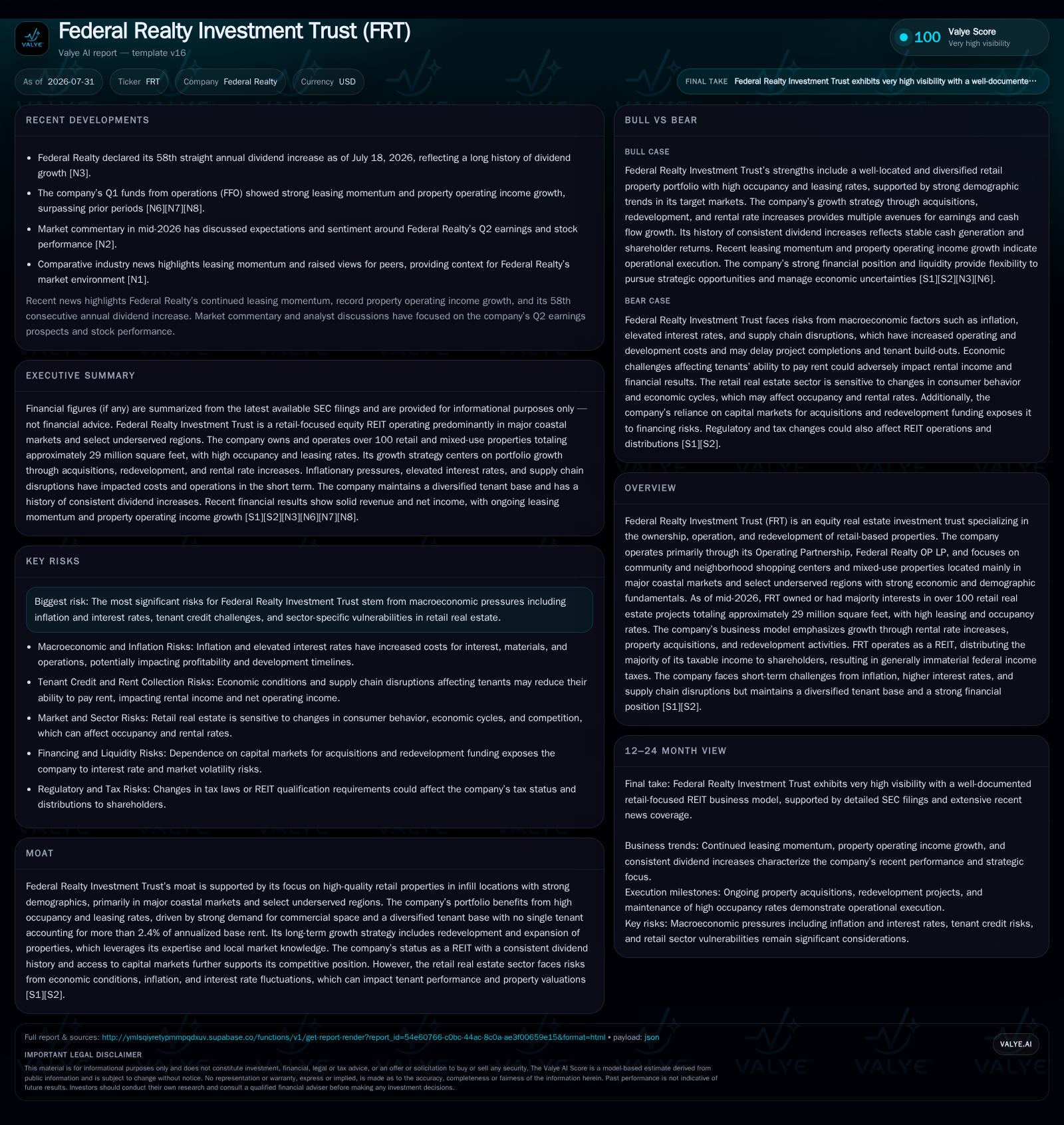
Federal Realty Investment Trust (FRT) reported stable operational metrics and proactive capital management in Q2 2026, maintaining high occupancy across predominantly coastal retail properties. The company’s focus on community and neighborhood shopping centers in infill markets sustains tenant demand amid inflationary pressures and interest rate volatility, while strategic property sales bolster liquidity. Redevelopment and acquisitions remain core drivers of growth, complemented by a well-laddered debt profile with manageable leverage, positioning FRT to withstand sector-specific risks. Investors should monitor leasing velocity, rental rate trends, and redevelopment execution as key indicators of future performance.
Recent Operating Update
Federal Realty Investment Trust's latest quarterly filing for Q2 ended June 30, 2026 reveals steady operating performance anchored by its rental income growth and disciplined portfolio management. The company holds interests in over 100 predominantly retail real estate projects totaling about 29 million square feet focused primarily on coastal infill markets known for their favorable economic and demographic attributes [S2][S8]. Mid-year operating results confirm that occupancy levels remain high despite macroeconomic uncertainties such as inflationary pressures and tightening monetary policy [S2][S8].
During the first half of 2026, FRT boosted liquidity through the disposition of several non-core assets, including residential buildings within mixed-use developments like Santana Row and Barcroft Plaza. These sales generated net proceeds exceeding $220 million (gross proceeds reported at approximately $225 million), resulting in recognized gains above $110 million that underpin capital recycling efforts aimed at redevelopments and selective acquisitions aligned with their long-term strategy [S5][S22]. This move reflects effective portfolio optimization within an industry where retail formats continue evolving under consumer behavior shifts.
Capital expenditure patterns highlight a forward-looking posture: redevelopment spending reached nearly $79 million for H1 2026 versus around $69 million during the prior comparable period [S5]. Such investments focus on repositioning assets to better serve contemporary retail models—blending experiential elements with traditional shopping—to maintain relevance against rising e-commerce penetration. Additionally, leasing costs slightly declined compared to prior periods, implying efficiencies from renewal activity or negotiated tenant improvements consistent with their business model emphasizing stabilization post-acquisition or redevelopment
Business Model
Federal Realty functions as an equity real estate investment trust (REIT), deriving the bulk of revenues from retail leasing contracts operated through its Federal Realty OP LP partnership vehicle. Rent structures generally comprise fixed base rents supplemented by percentage rents tied to tenant sales performance, creating a hybrid revenue stream sensitive to both occupancy metrics and consumer spending trends.
Their target assets typically include community and neighborhood shopping centers augmented by mixed-use developments that combine residential or office space alongside retail tenants. This diversification supports diversified cash flows while catering to urban/suburban infill locations where land scarcity bolsters property valuation durability. Critical revenue drivers entail maintaining high occupancy rates through proactive lease renewals and optimizing rental rates via escalations reflective of market conditions.
Analytically important KPIs are: occupancy rate stability (which remains elevated as per recent disclosures), same-property net operating income growth fueled by rental rate hikes on lease renewals or turnover leases, leasing velocity particularly for newly redeveloped space, average rental rate per square foot improvements achieved via repositioning strategies, and tenant concentration risk which FRT manages prudently by avoiding overreliance on any single tenant (<2.4% annual base rent exposure) thus cushioning against idiosyncratic credit risk shock [S1][S2]. Lease expiration schedules are structurally staggered given this mix strategy which helps smooth tenancy churn impact.
Industry Structure and Competitive Position
Operating within the Retail Real Estate Investment Trust sector places Federal Realty amid peers such as Realty Income (O) and Regency Centers (REG). Compared to these peers who often emphasize suburban centers or broader geographic footprints including secondary markets, FRT distinguishes itself through concentrated coastal urban infill holdings supported by demographic tailwinds from population density growth, affluent catchment areas, and limited new supply due to zoning constraints.
This geographic specialization translates into higher-quality tenant demand supporting stronger lease renewal spreads relative to more commoditized asset classes. Their focus on mixed-use development also positions them advantageously atop emerging retail trends blending lifestyle experience centers that are less substitutable by e-commerce alternatives. However, this premium location strategy entails exposure to higher capital intensity risks including redevelopment costs escalated by inflationary inputs.
FRT’s capital markets access remains robust evidenced by successful issuance of low-cost exchangeable senior notes at a coupon of just 3.25% in early 2024—a significant advantage relative to other retailers contending with historically higher borrowing costs amid rising interest rate cycles [S4]. Such financial engineering improves long-term leverage sustainability amid market volatility.
Growth Drivers
Population growth coupled with increasing disposable income concentrations along U.S. coastal metros fuels underlying retail demand supporting Federal Realty’s occupancy profiles. Furthermore, continuous rental rate escalations achievable through timed lease renewals provide a recurring organic growth channel critical under inflationary cost environments.
Strategic acquisitions focused on high-barrier-to-entry locations supplement organic NOI growth by expanding the portfolio with quality assets poised for rent normalization or redevelopment upside. FRT continues capitalizing on expansion opportunities via redevelopment projects aimed at reimagining existing centers with enhanced amenities attractive to next-generation retailers.
Tenant mix improvements further reinforce growth potential as the Trust actively replaces weaker credit tenants or obsolete uses with contemporary concepts better aligned with modern consumer preferences.
Risks and Constraints
Key risks remain heavily influenced by macroeconomic factors: inflation can pressure tenant profitability reducing renewals or rent collections; meanwhile rising interest rates tend to compress capitalization rates negatively affecting asset valuations despite stable cash flows.
Retail sector disruption from e-commerce adoption mandates sustained innovation in property offerings; failure here risks obsolescence particularly for lower-tier centers outside FRT’s premium urban focus. Tenant credit risk persists given ongoing challenges faced by specialty retail segments subject to shifting consumer habits.
Redevelopment activities carry inherent execution risks related to cost overruns or delays especially amid supply chain constraints affecting materials pricing dynamics prevailing through mid-2026 [S8]. Regulatory changes impacting zoning or REIT tax compliance could also affect operations though currently judged immaterial.
What to Watch Next
Upcoming milestones worthy of attention include updates on leasing spreads for major upcoming renewals as they will signal pricing power resilience under inflation; progression of redevelopment projects toward completion which could unlock new NOI streams; quarterly leasing velocity reports indicating momentum or slack in demand; updates on occupancy trends particularly within mixed-use developments; potential acquisition announcements consistent with stated growth ambitions.
Additionally monitoring adjustments in key credit metrics such as debt coverage ratios following recent borrowings under the expanded revolving facility will provide insights into financial flexibility amid cost pressures [S21]. Dividend declarations continuing the historical streak offer clues on confidence regarding near-term cash flow stability [S1].
Financial Profile Discussion
Federal Realty’s financial position as of Q2 2026 reflects prudent liquidity management reinforced by cash reserves approximating $116 million as of March-end coupled with an accessible revolving credit facility sized at $1.4 billion (upgraded from $1.25 billion earlier), featuring two six-month extension options extending maturity effectively into late decade [S4][F1]. By June-end, approximately $286 million was drawn under this facility. Total debt was near $4.96 billion as of December 31, 2025, with net debt around $4.85 billion, consistent with typical leverage levels for large-scale equity REIT operators managing substantial urban portfolios [F1].
Interest expense benefits from low fixed rate instruments such as the January 2024 issuance of exchangeable senior notes at a coupon near 3.25%, lowering funding costs relative to peers facing incremental refinancing risk amid higher benchmark rates [S4]. This is reflected in consistent semiannual interest payments approximating $4.6 million per quarter related explicitly to those notes.
This analysis synthesizes Federal Realty Investment Trust's public disclosures up to July 31, 2026 without extending forecasts beyond evident guidance or implying any investment research view or advice.
Disclaimer: This is research-only, informational analysis and not investment advice. It may include AI-generated interpretation and general industry context. Always verify important details using primary sources.

Comments