
Enbridge Advances Capital Growth Amid Trade Policy Uncertainty and Regulatory Challenges
Q2 2026 results highlight Enbridge's resilient fee-based midstream model supported by regulatory approvals and strategic partnerships.
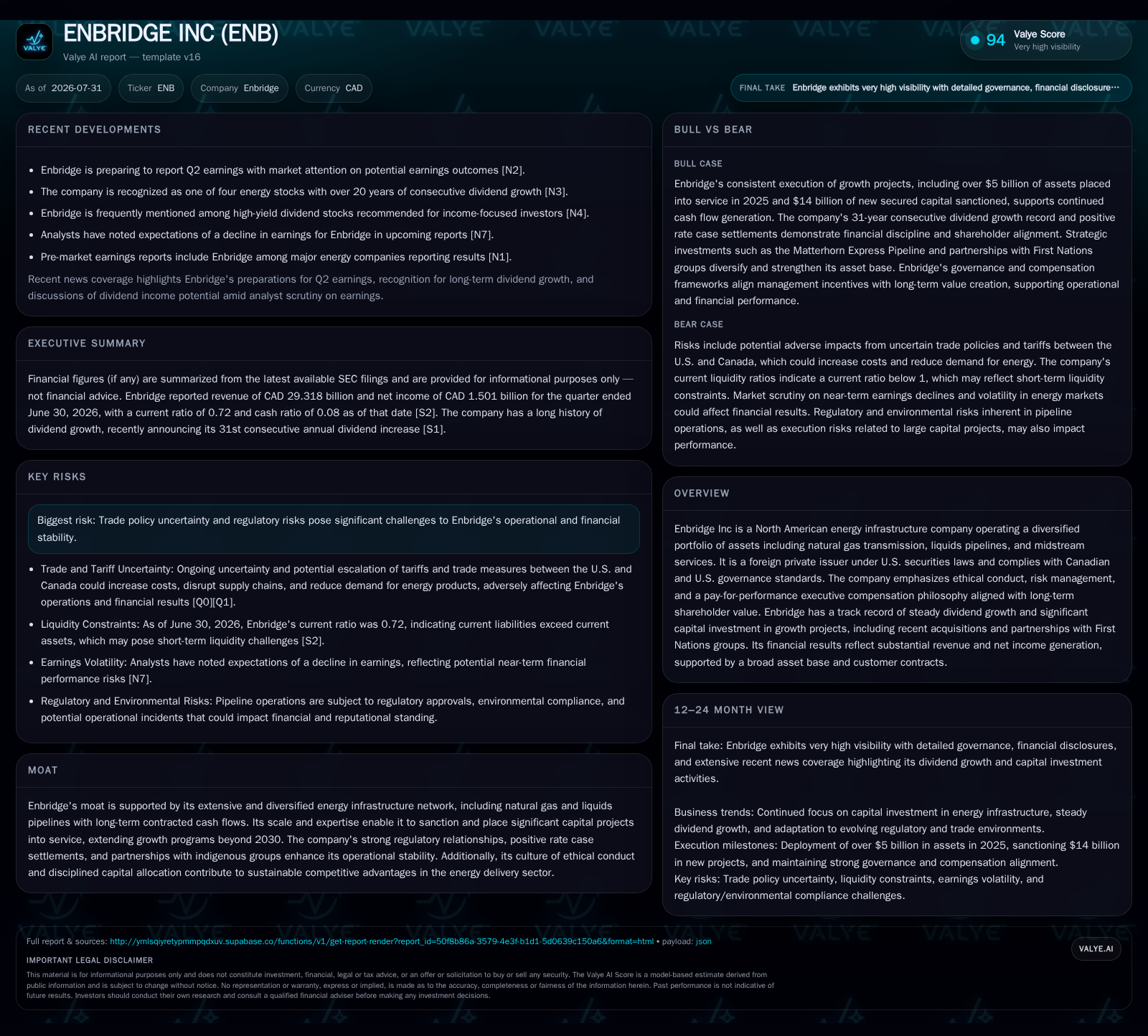
Enbridge Inc reported its second-quarter fiscal 2026 update emphasizing continued investment in expanding its North American energy infrastructure network. The company’s diversified asset base, including liquids pipelines and natural gas transmission, generates stable revenue streams backed by long-term contracts and regulated tariff rates. Despite ongoing trade policy uncertainties surrounding US-Canada agreements and tariffs that increase cost pressures, Enbridge remains focused on disciplined capital allocation and partnership-driven growth, notably with indigenous groups. Key risks include potential regulatory delays and tariff escalations, but steady dividend growth and operational reliability sustain its competitive position in the midstream sector.
Recent Operating Update: Q2 2026 Highlights
Enbridge's latest quarterly report filed July 31, 2026 [S2], supplemented by a contemporaneous earnings press release [S3], underscores the company's continued execution on its strategic growth plan within North America’s midstream energy infrastructure sector. The firm reported steady operational performance despite a backdrop of tariff uncertainties affecting input costs such as steel and aluminum—key materials for capital projects. Management acknowledged the risk of escalating trade disputes linked to the non-renewal discussions of the United States-Mexico-Canada Agreement (USMCA) which began formal review on July 1, 2026. These factors introduce near-term cost inflation pressures and market volatility but have not yet materially disrupted ongoing project schedules or throughput volumes.
The company highlighted its diversified asset base comprising natural gas transmission lines, liquids pipelines, and storage terminals—assets predominantly generating fee-based revenue under long-term contracts or regulated tariff frameworks [S1]. This business model buffers Enbridge against commodity price volatility, with revenues driven chiefly by contracted volumes transported (pipeline throughput) and periodic tariff rate adjustments approved through rate cases.
Enbridge’s Business Model: Fee-Based Infrastructure with Contractual Stability
As a leading North American energy infrastructure player, Enbridge occupies a critical midstream role connecting upstream producers and downstream refiners/utilities. Its revenue streams reflect fees charged for pipeline transportation, storage services, and processing facilities. These fees are largely governed by long-duration contracts with creditworthy counterparties or regulated tariff structures sanctioned by governmental agencies.
Capital-intensive investments dominate this model as Enbridge commits substantial CapEx to maintain and expand its extensive network. Success hinges on efficient capital deployment ensuring projects meet budgets and timelines while securing regulatory approvals necessary for tariff increases that enable returns on invested capital. Operational KPIs such as system reliability, safety incident frequency, throughput volume utilization rates, and contract renewal rates directly impact financial health by sustaining stable cash flows.
Management’s pay-for-performance philosophy aligns with shareholder value creation targets emphasizing steady dividend growth—a hallmark of infrastructure operators like Enbridge. The recent announced dividend increase of approximately 3% effective March 1, 2026 [S1] illustrates confidence in the resilience of underlying cash flows despite external uncertainties.
Industry Structure and Competitive Position
The midstream energy infrastructure industry is characterized by high barriers to entry due to capital requirements, regulatory complexity, and established network effects. Enbridge operates alongside peers such as Kinder Morgan, Williams Companies, and TC Energy who similarly rely on extensive pipeline footprints backed by regulated or contractually stable earnings.
Competitive differentiation is increasingly tied to geographic scale across key North American basins, diversity in asset mix spanning gas to liquids segments, stakeholder relationships including indigenous partnerships, and proven track records navigating regulatory environments. Enbridge's robust governance practices coupled with its culture of ethical conduct strengthen stakeholder trust—a crucial intangible in securing project approvals while managing environmental compliance obligations.
Operational excellence remains essential; maintaining low safety incidents supports reputational capital critical for community acceptance. Similarly, success in rate case negotiations affects allowed returns thus influencing profitability margins relative to peers.
Growth Drivers: Project Pipeline and Market Demand
Enbridge's growth outlook rests on several pillars:
- Capacity Expansion: Ongoing investments to enlarge pipeline throughput capabilities reflect anticipated increases in natural gas demand owing to utility fuel-switching trends as well as continued crude oil transportation needs [S1].
- Contract Renewal & Customer Agreements: Retaining long-term fee-based contracts mitigates volume risk; new customer agreements in developing basins augment contracted revenue backlog.
- Regulatory Rate Cases: Favorable settlements enhance tariff structures enabling improved returns on existing regulated assets.
- Strategic Acquisitions & Partnerships: Collaborations with indigenous groups not only secure social license but facilitate co-investment opportunities expanding asset base sustainably.
- Infrastructure Modernization: Technology upgrades aimed at enhancing system reliability contribute to operational efficiency gains while meeting stricter environmental standards.
Collectively these drivers underpin a growth trajectory extending beyond 2030 in line with management guidance [S1]
Risks and Watchpoints: Trade Policy Uncertainty & Regulatory Delays
Potential adverse impacts stem primarily from unresolved trade relations between the U.S. and Canada evidenced by formal USMCA review proceedings that could alter tariff regimes or impose additional costs on key inputs like steel products used in construction and maintenance activities [S2]. Escalation of such measures could cascade into inflationary pressures undermining project economics or introducing supply chain disruptions.
Regulatory hurdles remain an ever-present risk; permitting delays or unfavorable rulings could defer expansions or limit ability to recover costs through tariffs. Additionally, fluctuations in North American energy demand affect throughput volumes—a core KPI influencing fee-based revenues.
Environmental incidents or safety lapses present reputational damage potential along with possible fines further impacting operational reliability metrics. Counterparty credit risk inherent in long-term contract counterparties requires ongoing monitoring though historically has been low given customer credit profiles.
What to Watch Next: Milestones & Indicators
Key upcoming developments include:
- Outcomes of ongoing USMCA negotiations impacting tariff certainty timelines beyond current expiration horizon.
- Progress updates on major sanctioned capital projects including construction milestones that confirm timely delivery within budgeted CapEx envelopes.
- Results from pending or future regulatory rate cases influencing allowable tariff escalations on existing systems.
- Contract renewal announcements signaling customer retention strength amid evolving market dynamics.
- Quarterly operating metrics around system availability/reliability reflecting execution quality versus peer benchmarks.
- Dividend declarations affirming sustainability amid evolving macroeconomic conditions.
Monitoring these indicators will clarify trajectory of Enbridge’s medium-term cash flows supporting valuation fundamentals.
Financial Profile Discussion
As of June 30, 2026, Enbridge held cash and equivalents approximating CAD 2.0 billion while current assets stood at CAD 17.7 billion against current liabilities totaling CAD 24.6 billion resulting in a current ratio near 0.72 consistent with industry norms given substantial long-lived assets funded through long-term debt facilities [F1]. Total debt was about USD 45 billion end-of-year 2025 reflecting typical leverage levels combined with strong investment-grade credit ratings prevalent among Canadian midstream operators.
Operating income reached CAD 2.7 billion on trailing twelve-month basis indicating robust profitability supported by regulated tariffs and contractual stability [F1]. Net income was CAD 2.06 billion last reported year-end underscoring solid bottom-line generation amidst capex-intensive environment.
Capital expenditure commitments remain substantial but targeted toward high-return projects aligned with strategic growth imperatives described earlier [S1]. Free cash flow generation adequate to support ongoing dividend growth signals financial discipline paired with sustainable earnings quality fundamental for midstream infrastructure investors.
Conclusion
Enbridge continues to consolidate its footprint as a cornerstone North American energy infrastructure provider benefiting from a diversified mix of regulated assets producing stable fee-based revenues underpinned by disciplined investment programs and strong stakeholder engagement strategies. While trade-related policy uncertainties inject near-term cost risks alongside evolving regulatory landscapes requiring vigilance, the company’s overarching franchise durability supported by long-term contracts and rate case successes preserves cash flow visibility necessary for sustained dividend increases demonstrated recently.
Future developments around trade negotiations outcome resolution alongside execution progress on key capital projects will serve as pivotal monitorables shaping the medium-to-long-term investment thesis within this capital-intensive yet strategically essential sector.
Disclaimer: This analysis is based solely on publicly available information including SEC filings dated through July 31, 2026; it does not constitute investment advice or research views.
Disclaimer: This is research-only, informational analysis and not investment advice. It may include AI-generated interpretation and general industry context. Always verify important details using primary sources.

Comments