
RedCloud Holdings Faces Liquidity Strains While Scaling AI-Enabled FMCG Supply Chain Platform
RedCloud continues to grow revenue through its AI-driven RedAI platform connecting FMCG brands, distributors, and retailers but struggles with cash flow and operating losses.
RedCloud Holdings plc operates an AI-enabled digital commerce platform, RedAI, focused on fast-moving consumer goods (FMCG) supply chains across emerging markets since its April 2022 launch. The company’s transaction-based revenue model demonstrates low double-digit growth but remains unprofitable amid heavy investments in expanding registered users and geographic reach. Liquidity challenges are acute, with only $478,000 cash on hand at year-end 2025 and a working capital deficit driven by significant shareholder loans and marketing expenditures. While RedCloud leverages network effects and AI differentiators, maintaining competitive advantage against larger SaaS vendors and managing execution risks amid capital constraints will be critical going forward.
Recent Operating Update: CFO Appointment and Capital Market Activity
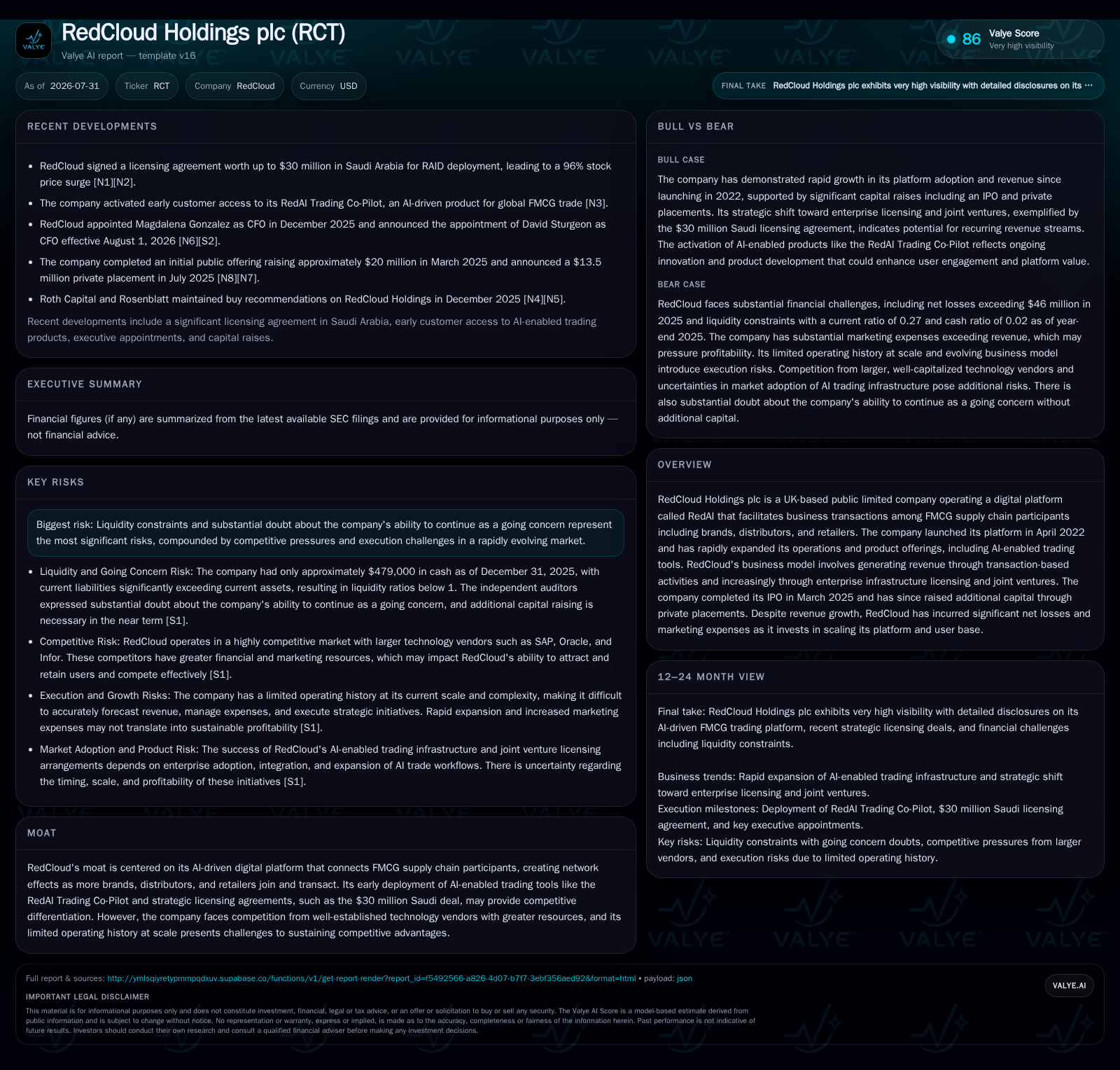
RedCloud Holdings plc announced the appointment of David Sturgeon as Chief Financial Officer effective August 1, 2026 [S2]. This leadership change follows a prior CFO transition earlier in the year aligned with the company's capital-raising strategy [S16]. Additionally, on July 21, 2026, RedCloud entered an ATM Offering Agreement with H.C. Wainwright for up to approximately $6.7 million of ordinary shares sales under a controlled equity issuance program [S3]. These developments signal ongoing efforts by management to address liquidity constraints while supporting operational expansion.
Business Model: Transaction-Driven SaaS Platform with AI Enhancements
RedCloud operates RedAI, an intelligent commerce infrastructure launched commercially in April 2022 that facilitates transactions among fast-moving consumer goods (FMCG) brands, distributors, and small-to-medium merchants serving as buyers through its Red101 and TradeX trading networks [S7]. The platform monetizes primarily via transaction-based commissions levied on the value of goods sold across these networks. Supplementary revenue streams include enterprise platform licensing and joint ventures which leverage the core infrastructure.
This business model embraces SaaS-like recurring elements but relies heavily on volume-driven transaction fees sensitive to user activity levels across multiple emerging market geographies including Nigeria, South Africa, Brazil, Peru, and Argentina [S7]. Integration of AI-enabled trading tools such as the RedAI Trading Co-Pilot aims to deepen engagement by providing actionable analytics and decision support drawn from extensive real-time data points (over 50,000 market data sources). Successfully embedding these tools could bolster average revenue per user (ARPU) while enhancing retention.
Industry Structure and Competitive Position
Enterprise software platforms targeting supply chain digitization represent a vibrant sector combining cloud infrastructure with machine learning to optimize procurement and commerce. RedCloud sits at the nexus of software development and FMCG supply chains across developing markets—a niche that imposes both opportunity and risk vis-à-vis established players like Coupa Software (procurement focused), Shopify (ecommerce-oriented), or Blue Yonder (supply chain analytics).
While RedCloud’s early emphasis on AI trading tools promotes differentiation within these fragmented local markets via network effects—whereby increased participation enhances value for all parties—the company remains challenged by limited operating history at scale and significantly smaller resources relative to global SaaS leaders. Network effects could become a durable moat if product quality and marketplace depth continue improving alongside user engagement metrics such as gross/net retention rates; however, competition from incumbent technology vendors with broader product breadth may pressure pricing power.
Growth Drivers
Persistent digitization trends across FMCG supply chains represent an accelerating tailwind for RedCloud’s proposition internationally. Key growth drivers include:
- Expansion into emerging markets already demonstrating growing ecommerce penetration.
- Adoption of sophisticated AI/ML tools embedded into trading workflows that increase operational efficiency for brands and distributors.
- Network effects as more participants—across brands, distributors, retailers—join RedAI’s ecosystem fostering stickier usage patterns.
- Strategic partnerships and joint ventures that introduce new licensing revenue streams supplementing transaction fee income.
These drivers imply that tracking KPIs like transaction volume/value growth alongside registered user counts will be crucial demand markers over coming quarters.
Risks and Growth Constraints
Additional risks stem from competitive pressures from larger incumbents capable of leveraging economies of scale; foreign exchange exposure given international footprint; regulatory compliance demands; potential churn of registered users; platform security imperatives; and execution complexity during rapid scaling phases.
Capital raising is uncertain given prevailing macroeconomic conditions that may dampen investor appetite or inflate cost of financing [S22]. Failure to secure adequate funding could force steep cutbacks curtailing growth initiatives or jeopardizing continuity.
What to Watch Next
Near-term milestones to monitor include:
- Progression of ATM share sale program execution which will indicate management’s ability to bridge liquidity gaps.
- Updates on operating cash flow trends particularly any signs of narrowing loss or stabilizing marketing spell costs relative to incremental revenue.
- User registration growth rates alongside transaction volume/value expansion within key territories acting as leading activity indicators.
- Further announcements around joint ventures or strategic licensing arrangements that diversify revenue beyond transactional commissions.
- Management commentary addressing cost controls post-CFO transition reporting clarity on capital runway duration.
Closer scrutiny of quarterly earnings filings for updated operating metrics—ARR equivalents or net retention proxies—and adjusted EBITDA progression will be fundamental to assessing financial health restoration trajectory.
Financial Profile Discussion
As reported in the most recent audited annual financials for the year ended December 31, 2025:
Subsequent events disclosed include senior convertible notes issuance raising ~$4 million plus initial drawdowns under a $30 million equity line of credit facilitating approx. $1.4 million liquidity infusion early in 2026 plus additional short-term shareholder loans totaling roughly £1m GBP providing cushioning for near-term obligations [S12], [S16]. These steps are critical stopgaps absent which going concern doubts flagged by independent auditors could crystallize materially impairing capital access prospects.
In conclusion, while RedCloud Holdings shows promise via its innovative AI-enabled platform addressing significant structural shifts in emerging market FMCG supply chains—with tangible network effect potential—its precarious liquidity position paired with persistent losses underscores an urgent need for financial stabilization amid continued scaling investments.
Disclaimer: This is research-only, informational analysis and not investment advice. It may include AI-generated interpretation and general industry context. Always verify important details using primary sources.

Comments