
DXC Technology Faces Margin Pressure Despite AI-Driven Consulting Growth
Latest DXC quarterly results reveal mixed segment trends amid intensified industry competition and strategic leadership changes.
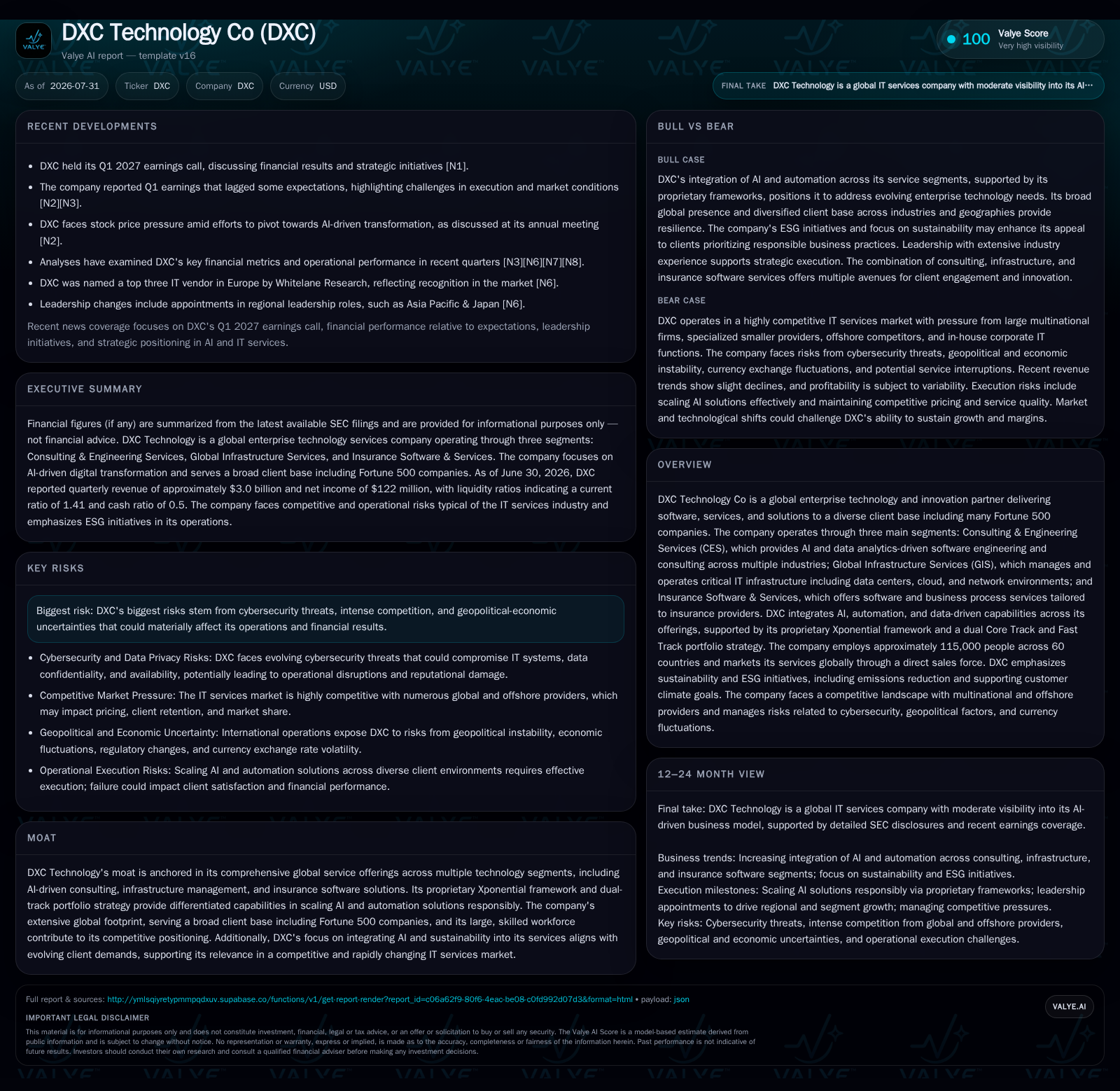
DXC Technology's Q1 fiscal 2027 report highlights modest revenue declines overall, with growth in its Insurance Software segment offset by softness in consulting and infrastructure services. The company’s AI-embedded Xponential framework and portfolio restructuring efforts strive to enhance competitive positioning but face margin compression and book-to-bill challenges. Recent executive turnover in its Global Infrastructure Services unit adds uncertainty to operational stability. DXC's indebtedness and liquidity remain manageable, supporting continued investment in AI and automation capabilities while navigating cyber risks and market pressures.
Recent Operating Update
DXC Technology’s latest quarterly filing for Q1 fiscal 2027 (ending June 30, 2026) underscores a mixed performance dynamic across its major segments amid the ongoing industry shift toward AI and automation-led IT services. Total revenues for fiscal year 2026 stood at approximately $12.64 billion, marking a slight decline of 1.8% year-over-year, with organic revenues falling more sharply by 4.8% after stripping out currency effects and portfolio adjustments [S2], [F1]. Adjusted EBIT contracted nearly 5% to $970 million with margins compressing to around 7.7%, reflecting challenging operating leverage caused by competitive pressures and investments in digital transformation capabilities.
Among the three key reporting segments aligned with DXC’s operational strategy — Consulting & Engineering Services (CES), Global Infrastructure Services (GIS), and Insurance Software & Services — only the insurance-focused software solutions business delivered top-line growth (5.4%), signaling escalating demand for industry-specific modernization solutions despite its profit margin sliding by over twenty percentage points to approximately 10% [S2]. CES experienced a modest revenue contraction of about 0.8% on a reported basis but demonstrated a slightly improved book-to-bill ratio of 1.10x versus prior periods, indicating cautious but ongoing new client acquisition and contract renewal success within consulting services fueled by AI-driven analytics and modernization initiatives [S2].
Conversely, GIS, responsible for roughly half the company's revenues, showed a more pronounced earnings softness with revenues down nearly 4% organically and profitability holding flat at a lower margin of ~6.8%. The Book-to-Bill ratio declined below parity at approximately 0.94x, suggesting challenges replenishing or expanding managed infrastructure contracts amidst macroeconomic or budgetary constraints from clients [S2]. This segment also recently saw leadership disruption with the resignation effective July 30, 2026, of President Chris Drumgoole who led GIS operations—an event that lacks specifics on underlying causes but could affect continuity during an important period of digital infrastructure transformation [S3].
Business Model Analysis
DXC operates as a global technology integrator delivering end-to-end IT products and services predominantly to large enterprises including multiple Fortune 500 clients, across North America, Europe, Asia, Australia, and emerging international markets [S1]. Its monetization relies largely on long-term service contracts combining Managed Infrastructure Services under GIS, project-based consulting fees through CES augmented by recurring application modernization engagements, and subscription/license plus BPO-oriented fees within Insurance Software & Services.
The company emphasizes incorporation of Artificial Intelligence (AI), automation, and data analytics embedded throughout its offerings via the proprietary Xponential framework — designed to scale client adoption from pilot projects to broad production deployments responsibly with oversight governance embedded [S1]. This framework supports DXC’s bifurcated portfolio strategy featuring Core Track enhancements that optimize traditional assets with AI tools alongside Fast Track initiatives pioneering AI-native solutions; both tracks aim to elevate client digital transformation velocity while preserving operational reliability.
Revenue drivers include expansion in cloud migration services within GIS leveraging Intelligent Operations that integrate human expertise with AI insights for secure data center management; growing demand for AI-powered application modernization in CES to expedite product innovation cycles; plus rising adoption of Industry-Specific Software Solutions tailored for life insurance, property & casualty insurers embracing digital-first technologies [S1], [S17]. Margins depend notably on mix dynamics between higher-margin consulting versus capital-intensive infrastructure management plus the ability to negotiate favorable Service Level Agreements (SLAs).
Industry Structure and Competitive Position
DXC competes within the Enterprise IT Services landscape alongside established global integrators such as Accenture, IBM Global Services, Cognizant, Infosys, and Tata Consultancy Services—companies that vary in specialization between consulting-led digital transformation versus cloud infrastructure management or BPO offerings.
The sector is characterized by rapid technological evolution with increased adoption of cloud platforms, growing emphasis on automation-driven efficiency gains, stringent cybersecurity requirements, and increasingly complex regulatory compliance demands—especially impacting industry-tailored providers servicing financial services like insurance.
DXC's moat derives from its comprehensive service breadth crossing consulting-engineering disciplines through managed infrastructure and insurance software niches supported by extensive global delivery capability (~115,000 employees across about 60 countries). The Xponential strategy seeks differentiation through systematic scaling of AI adoption balanced against governance risk management—a crucial factor as clients prioritize security alongside innovation.
However, pricing pressure remains acute due to offshore low-cost competition particularly from Indian-origin firms providing commodity IT outsourcing; furthermore, large incumbents retain advantage via broader ecosystems or proprietary cloud partnerships leading some clients toward vendor consolidation strategies that may challenge DXC’s midscale positioning [S9], [S13]. Leadership transitions within key units like GIS create execution risks in maintaining service quality amid this competitive flux.
Growth Drivers
Key structural growth catalysts center around sustained enterprise investments in digital transformation programs emphasizing:
- Accelerated adoption of AI-infused consulting engagements driving operational efficiencies,
- Migration toward hybrid multi-cloud environments demanding scalable infrastructure services aligned with security compliance,
- Expansion in industry-specific software penetration especially within regulated sectors requiring tailored technology upgrades (e.g., insurance),
- Rising uptake of intelligent automation reducing manual processes thus enhancing margins if implemented effectively,
- Regulatory mandates prompting IT modernization investments ensuring data privacy and cyber resilience,
- Geographic expansion leveraging global delivery centers tapping emerging economies’ talent pools while providing localized support.
Tracking KPIs such as organic revenue growth rates per segment, book-to-bill ratios signifying pipeline health relative to revenue base, adjusted EBIT margins reflecting operational leverage amidst tech investments, customer retention rates illustrating stickiness in managed services contracts, utilization rates evidencing skilled workforce productivity—all serve as insightful markers into DXC’s trajectory amidst evolving corporate buying patterns emphasizing outcomes rather than capacity alone.
Risks and Growth Constraints
Operational risks manifest primarily from intense competition pressuring pricing power potentially eroding margins over time; cybersecurity vulnerabilities threatening client trust or triggering costly remediation efforts; geopolitical uncertainties influencing client IT budgets especially in Europe and Asia; talent retention challenges complicating delivery consistency amid tight labor markets; ongoing tax litigation exposure possibly affecting net income volatility; plus integration complexity surrounding ongoing portfolio reshaping including divestitures or acquisitions [S13], [S26], [S29].
Furthermore, execution risks linked to embedding advanced AI into legacy service models pose potential cost overruns or time lags before realizing efficiency gains envisaged by the Xponential framework rollout.
Contract execution challenges related to timeline forecasting inaccuracies can impair profitability under fixed-price agreements common in managed infrastructure domains.
Regulatory compliance costs associated with evolving environmental standards or data privacy laws may increase operational expenditures unexpectedly.
Leadership changes such as the recent departure of the GIS president inject organizational uncertainty complicating strategic coherence during pivotal platform upgrades.
What to Watch Next
Upcoming milestones include monitoring quarterly bookings updates vis-à-vis trailing revenue trends for signals on book-to-bill recovery particularly within GIS; tracking margin progression quarterly across segments especially Insurance Software where profitability has suffered despite growth; actionable progress reports on deployment scale-up under the Xponential framework revealing success or friction points in AI integration; talent acquisition/attrition rates reflecting workforce health critical to consulting delivery;
cash flow generation sustaining capital investments required for technology platform modernization; and any disclosures clarifying GIS leadership succession plans impacting client retention or contract fulfillment capabilities.
Financial guidance if provided will offer directional cues though DXC traditionally emphasizes steady investment balanced against operating discipline rather than aggressive forecasts.
Financial Profile Discussion
At quarter-end June 30, 2026, DXC held approximately $1.96 billion in cash and equivalents against total debt nearing $3 billion resulting in net debt around $1.05 billion—a leverage ratio that remains manageable given the company’s operating cash flows estimated above $1 billion annually supporting discretionary capital spend alongside debt repayments without liquidity strain [F1]
Current assets exceed current liabilities yielding a healthy current ratio near 1.41x providing short-term solvency comfort.
Though diluted EPS fell significantly from the prior year ($0.10 vs. $2.10) due primarily to actuarial pension losses combined with restructuring and amortization costs obscuring core earnings trends,[F1] adjusted earnings per share remain consistent reflecting operational resilience.
Operating cash flows generated ($1.25 billion) exceed capital expenditures ($535 million), enabling positive free cash flow (~$713 million) indicating decent cash conversion albeit requiring continued attention amid investments into growth initiatives such as Fast Track AI solution development.[S14], [F1]
DXC carries investment-grade credit ratings affirmed with stable outlooks which bolster access to capital markets facilitating potential issuance flexibility for opportunistic acquisitions or liquidity buffers [S4]
Overall liquidity positions support strategic plans though disciplined cost control coupled with successful service mix rebalancing remain critical drivers for restoring higher profitability levels over subsequent periods.
Disclaimer: This analysis is based solely on disclosed company filings from SEC Forms including recent quarterly reports dated July 31, 2026 ([S2]) and other public information as cited without projecting forward-looking estimates or investment research views.
Disclaimer: This is research-only, informational analysis and not investment advice. It may include AI-generated interpretation and general industry context. Always verify important details using primary sources.

Comments