
Waton Financial Advances AI Trading Amid Margin and Geopolitical Challenges
Waton Financial’s 2026 quarterly update signals progress in fintech AI integration but highlights continuing competitive and currency pressures.
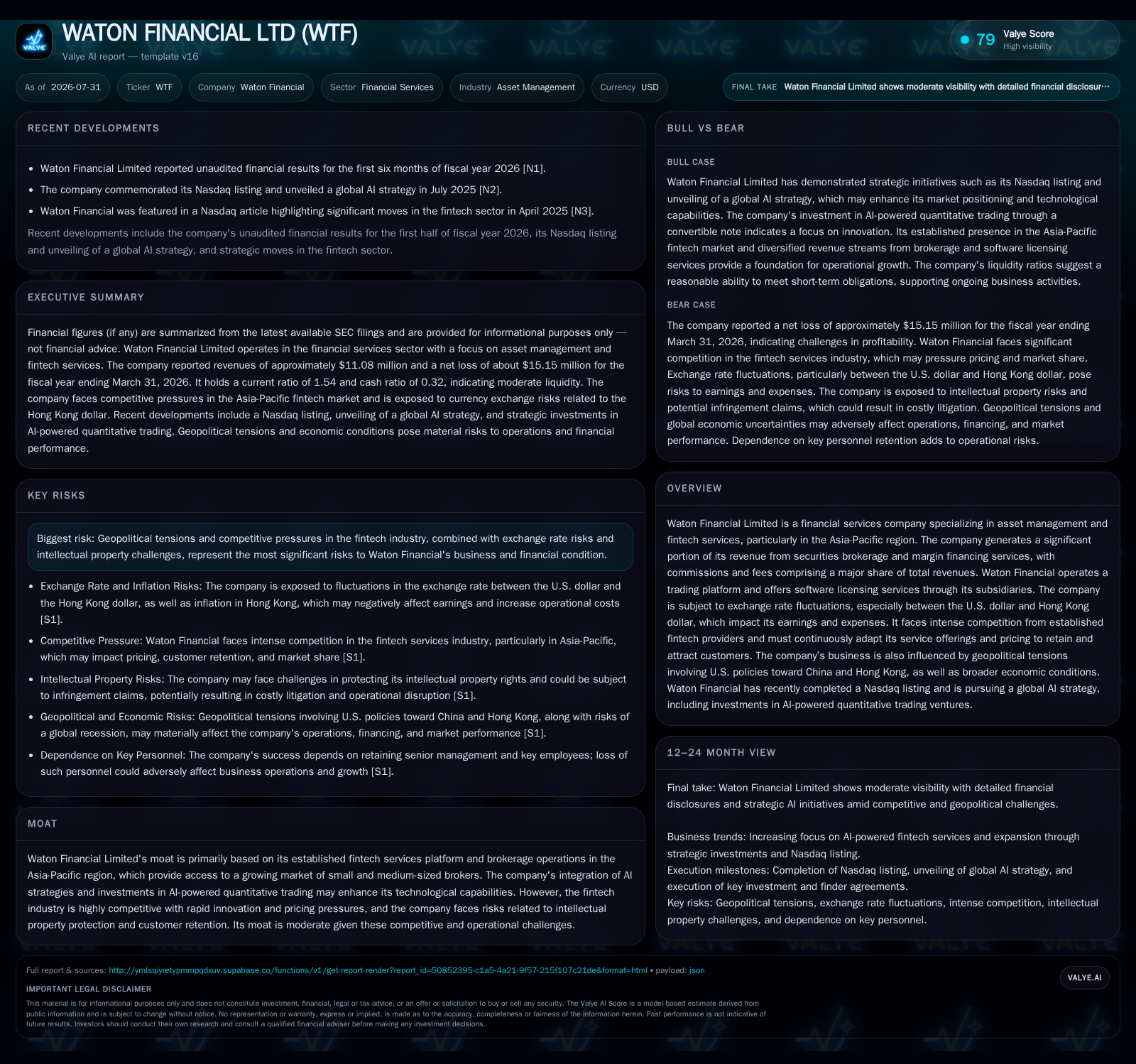
Waton Financial Limited reported a substantial increase in total revenue for fiscal year 2026 driven by brokerage commissions, margin financing interest, and software licensing gains. The company recently converted a $2.8 million convertible note into preferred shares to deepen its cooperation in AI-powered quantitative trading. Despite growth in revenue, Waton Financial recorded significant net losses attributable to operating expenses, share-based compensation, and working capital changes. The firm operates largely in Asia-Pacific fintech brokerage markets exposed to exchange rate volatility and geopolitical risks, especially around the U.S.-Hong Kong dollar linkage. Competitive pressures necessitate nimble pricing strategy and robust customer retention to sustain profitability amid rapid fintech innovation.
Recent Operating Update: AI Investment and Revenue Growth
Waton Financial's latest quarterly 6-K filing dated April 21, 2026, disclosed a key strategic move—conversion of a $2.8 million convertible note into 7.5 million preferred shares of PandaAI Quantum Holdings Limited at a conversion price just under $0.38 per share [S2]. This transaction marks the establishment of a business cooperation vehicle focused on AI-powered quantitative trading initiatives between Waton AI (a wholly owned subsidiary) and the PD Founders group. The note conversion reflects an intent to embed advanced algorithmic trading capabilities as part of Waton Financial’s fintech platform offerings.
This development signals the company’s strategic pivot toward integrating artificial intelligence techniques within its brokerage and trading ecosystem—a response to industry-wide adoption of quantitative trading as a competitive differentiator among fintech peers like Interactive Brokers or TradeStation.
Financially, Waton reported fiscal year revenues of $11.1 million for the year ended March 31, 2026—a notable increase of nearly 49% compared to the prior year’s $7.4 million [F1], [S1]. The increase was broad-based: core brokerage and commission income grew substantially alongside a sharp rise in interest income from margin financing activities (+1105%), which is crucial since margin loan balances directly influence this revenue stream in asset management-related brokerage firms.
Software licensing fees also rose by over 53%, evidencing deliberate expansion into technology service revenues that complement transactional brokerage earnings [S1]. This mix suggests efforts to diversify away from commoditized brokerage fees toward higher-margin SaaS-like revenue around fintech software.
Business Model: Brokerage-Fintech Hybrid with AI Focus
Waton operates primarily as an intermediary providing securities brokerage services combined with margin financing—a high-leverage product attractive to retail and small institutional investors seeking amplified exposure.
Revenue mechanics are typical: customers pay commissions on transactions executed via Waton’s platform; margin financing generates recurring interest based on loan balances; additionally, software licensing fees stem from proprietary fintech platform services offered mainly to brokers or related party clients for algorithmic trading or risk management solutions.
The integration of AI-powered quantitative trading through equity interests and convertible note investments in PandaAI Quantum Holdings indicates the company is pursuing technology-enabled enhancements designed to improve trade execution quality, proprietary trading returns, or client advisory offerings.
However, mounting operating costs—particularly share-based compensation expenses reaching $7.1 million—and increased commissions expense highlight the challenge of balancing investment in growth areas with cost discipline [S8]
Customer retention hinges on pricing agility amid competitive pressures from established players such as Charles Schwab or Robinhood in fintech and interactive brokerage segments; Waton must calibrate its fee structures carefully to maintain both volume-driven commission income and healthy margins [S1], [S12].
Industry Structure and Competitive Positioning
The financial services asset management industry encompassing brokerage and fintech platforms is characterized by rapid innovation cycles, regulatory scrutiny (especially concerning margin lending), and sensitivity to geopolitical factors—particularly relevant given Waton’s operational footprint largely centered in Hong Kong and broader Asia-Pacific markets.
Exchange rate volatility between the U.S. dollar (the company's reporting currency) and the Hong Kong dollar materially influences reported earnings due to significant Hong Kong dollar-denominated expenses such as personnel costs and facilities rent incurred locally [S1]. While HKD has historically been pegged at ~7.80 per USD under Hong Kong's fixed exchange rate regime since 1983, increasing geopolitical tensions—including potential U.S.-led sanctions—pose risks to this arrangement potentially exacerbating currency risk exposures.
Competition is intensifying as incumbent financial service providers diversify their offerings while new entrants emerge leveraging cloud-native technologies or embedded finance models that erode traditional commission pools. Key competitors blend highly scalable technology platforms with extensive liquidity access (e.g., Interactive Brokers) or consumer brand reach (e.g., Robinhood), setting high bars for customer acquisition cost efficiency, user experience, and price transparency.
Growth Drivers
Risks and Growth Constraints
Waton faces pronounced risks that could temper growth prospects:
- Exchange rate fluctuations present an ongoing earnings volatility factor given cost-revenue currency mismatches coupled with geopolitical uncertainty impacting HKD stability against USD benchmarks.
- Intense competition heightens pressure on commission rates; inability to achieve timely price resets while sustaining service quality could erode customer loyalty.
- Intellectual property protection remains uncertain—with current limitations on app-level IP registrations raising concerns over unauthorized use undermining market position [S1].
- Market volatility directly impacts margin loan demand; downturns can reduce financing balances and thus interest income materially.
- Negative operating cash flow ($7.1 million net cash used) driven by working capital changes signals funding needs which if unmet could constrain investing capacity or operational agility [S8].
- Regulatory compliance costs may escalate especially if new frameworks target margin lending practices or cross-border fintech operations tightly.
- Share-based compensation expenses weigh heavily on profitability reflecting ongoing investment in talent acquisition necessary for competitive tech development.
What To Watch Next
Monitoring several key indicators will illuminate Waton Financial’s trajectory:
- Updates on PandaAI collaboration outcomes including deployment milestones of AI-powered quantitative trading modules integrated into Waton's platform.
- Quarterly trends in brokerage transaction volumes and average revenue per user (ARPU) indicating customer engagement strength amid evolving pricing strategies.
- Margin loan balances evolution signaling financing segment health.
- Software licensing contract renewals or new client additions reflecting SaaS growth sustainability.
- Exchange rate movements between USD/HKD with management commentary on hedging approaches or geographic cost shifts.
- Operating expense control measures attempting to contain share-based compensation growth impact validity.
- Regulatory environment developments (including potential Hong Kong monetary policies affecting financial service licensing).
Financial Profile Discussion
As of March 31, 2026, Waton Financial held $10.4 million in cash and equivalents, with current assets totaling approximately $50.1 million and current liabilities near $32.5 million, resulting in a current ratio of about 1.54x, indicating adequate short-term asset coverage over liabilities [F1]. Sustained negative operating cash flows driven by working capital movements may warrant attention to future financing strategies.
Disclaimer: This is research-only, informational analysis and not investment advice. It may include AI-generated interpretation and general industry context. Always verify important details using primary sources.

Comments