
Essex Property Trust’s Strategic Edge in West Coast Multifamily Amid Q2 Strength
Essex leverages supply-constrained West Coast markets and disciplined portfolio management to deliver strong second-quarter rental income growth and occupancy.
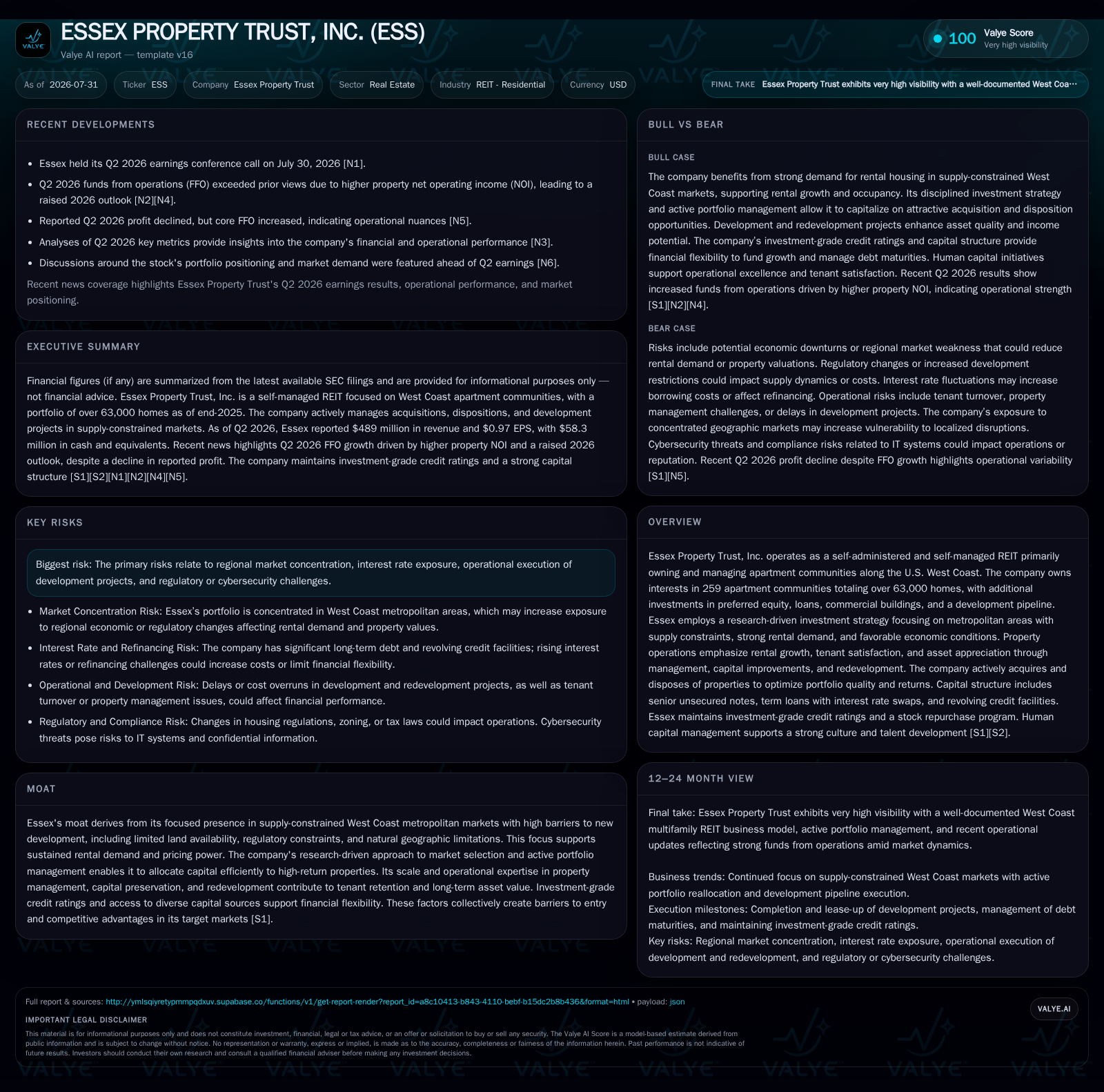
In its latest quarter, Essex Property Trust posted better-than-expected funds from operations (FFO) and net operating income (NOI), driven by robust same-store rent growth and stable occupancy amid persistent supply constraints in core West Coast markets. The company's focused investment strategy on high-barrier metros like California and Seattle underpins durable pricing power, supported by active portfolio optimization through targeted acquisitions, dispositions, and redevelopment projects. While interest rate exposure and regional concentration remain risks, Essex’s solid capital structure with investment-grade ratings provides financial flexibility to pursue growth.
Q2 Operating Update Reflects Resilient Rental Income Growth and Occupancy Trends
Essex Property Trust’s latest quarterly report shows sustained momentum despite a challenging macro backdrop. For the three months ended June 30, 2026, the company reported funds from operations (FFO) above consensus estimates alongside net operating income (NOI) gains driven by effective rental rate increases and steady occupancy across its portfolio of 259 apartment communities comprising approximately 63,000 homes [S2][N3]. This outperformance stems from disciplined leasing practices that maintain high occupancy levels—an industry-critical KPI directly correlating with rental income stability—and strategic rent escalations enabled by supply shortages in core West Coast markets.
The company emphasized tenant retention efforts supporting lease renewal rates that mitigate turnover expenses while sustaining pricing power. Operating efficiencies combined with moderate capital expenditure programs aimed at capital preservation helped contain margin pressures typically associated with inflationary cost environments [S2]. These operational dynamics underpin both short-term revenue strength and longer-term property value appreciation potential.
West Coast Market Focus Enables Sustainable Pricing Power and Rent Growth
A defining element of Essex’s strategy is its concentrated presence in supply-constrained West Coast metropolitan areas—including Southern California, Northern California, and the Seattle region—which collectively face stringent land-use restrictions, zoning limitations, environmental regulations, and natural geographic barriers like mountains or waterways [S1]. Such constraints significantly limit new multifamily housing supply growth relative to robust population expansion and job creation trends.
This specialization translates into a durable economic moat: sustained demand against restricted supply supports robust rent growth trajectories compared to peers with broader but less constrained geographic footprints. Regulatory hurdles add complexity for competitors seeking rapid expansion in these markets while enabling Essex to leverage its deep regional knowledge for strategic acquisitions and redevelopments with favorable cap rates. The company's research-driven investment approach focuses on markets exceeding one million population where affordability gaps between for-sale housing prices and rents amplify ongoing rental demand [S1].
Disciplined Portfolio Management Balances Development, Acquisition, and Disposition Activity
Essex actively manages its asset base through a balanced allocation of capital towards development pipeline execution—consisting of one consolidated project of 543 units with estimated remaining spend of $201 million—and selective acquisitions/dispositions aimed at portfolio optimization [S14][S15]. During fiscal year 2025 alone, the company invested approximately $830 million acquiring six properties totaling over 1,500 apartment homes while divesting roughly $564 million in communities falling outside strategic parameters or where valuations peaked [S14][S15].
Capital expenditures emphasize value-add renovations that justify rent premiums while preserving asset quality for tenant satisfaction. The company seeks development delivery timelines that coincide with market absorption capacity to prevent supply-side shocks that could depress rental yields or occupancy.
Competitive Context: How Essex Compares Within Coastal Multifamily REIT Peers
Among residential REITs concentrated in coastal urban markets—such as AvalonBay Communities (AVB) and Equity Residential (EQR)—Essex distinguishes itself through tighter geographic concentration on Western metropolitan corridors with some of the highest barriers to entry nationally [N5][N8]. Comparable peers report similar same-store NOI growth patterns; however, Essex’s focused presence bolsters pricing leverage absent in more geographically dispersed portfolios.
Operationally, Essex maintains competitive leasing velocity metrics consistent with peer norms but benefits from enhanced tenant retention initiatives tailored for long-term coastal renters facing housing affordability shortages.
Growth Pathways Fueled by Supply Constraints, Demographics, and Redevelopment Potential
Looking ahead, underlying population growth combined with urbanization trends sustains multifamily rental demand. This is augmented by economic fundamentals that favor renting due to escalating homeownership costs especially within target metro regions where wage growth supports rental affordability ratios conducive to continued tenancy.
The development pipeline coupled with ongoing redevelopment projects creates opportunities to expand unit count incrementally or reposition existing assets for higher cash flow yield profiles [S1]. This dynamic contributes not only via direct incremental NOI improvements but also indirectly through enhancing community desirability thereby boosting lease renewal rates.
Technological enhancements improving resident experience—from maintenance responsiveness to digital leasing platforms—further underpin competitive differentiation amid evolving renter preferences favoring convenience and amenity-rich living spaces.
Risks on Watch Include Interest Rate Exposure and Regional Concentration Dynamics
Primary risks entail vulnerability to rising interest rates which elevate borrowing costs despite partial mitigation via interest rate swaps fixing financing costs on a substantial portion of the term loan facility at around 4.1% fixed all-in rates [S4]. Any material hikes beyond hedged exposure could compress margins or deter new investment activity if capital market conditions tighten.
Additionally, regional concentration heightens dependence on the economic health and regulatory environment specific to the West Coast corridor. Potential expansions of rent control statutes or changes in eviction policies could materially impact rental income stability or community operational costs [S1]. Operational execution risk persists around timely completion of redevelopment initiatives which if delayed might defer expected accretive contributions.
What to Monitor Next for Early Signs of Demand or Cost Pressure Shifts in Key Markets
Key indicators include quarterly leasing velocity fluctuations reflecting demand elasticity as macroeconomic conditions evolve. Submarket-level occupancy rate tracking will reveal localized shifts unseen from broad averages. Redevelopment project milestone completions will signal progression towards anticipated cash flow inflections.
Financial indicators such as utilization rates on the revolving credit facilities or engagement in commercial paper issuances will provide insight into liquidity management effectiveness supporting both day-to-day operations and opportunistic investments [S2][S3]
Regulatory developments at state or municipal levels regarding tenant protection laws warrant close scrutiny given direct implications for revenue recognition timing and potential compliance expenses.
Financial Profile Discussion Underscores Capital Flexibility Supporting Strategic Execution
Essex maintains a conservative capital structure evidenced by a $1.5 billion unsecured revolving credit facility extended through January 2030 with options extending maturity further [S4]. The Company’s recent issuance of $350 million senior unsecured notes due 2036 at a coupon rate under 5% reflects favorable long-term fixed-rate funding availability essential for managing refinancing risk profile.
Cash reserves stood at approximately $58 million as of June 2026 providing operational liquidity cushions amid variable working capital requirements [F1]
The company's capital allocation strategy also maintains flexibility allowing it to opportunistically adjust equity offerings or share repurchases aligned with market conditions though no new equity was issued under the current ATM program during FY25 [S7]. Dividend distributions remain contingent on actual cash flow generated from operations balanced against required ongoing capital commitments ensuring payout sustainability amid variable earnings cycles.
This analysis is based exclusively on information available through public SEC filings and recent news reports as cited. All financial data reflect disclosed figures without speculative adjustments or forecasts. Market risks remain subject to evolving macroeconomic factors beyond company control.
Disclaimer: This is research-only, informational analysis and not investment advice. It may include AI-generated interpretation and general industry context. Always verify important details using primary sources.

Comments