
CareDx Advances Its Transplant Care Franchise After Robust Q2 Performance
Strong test volume growth and reimbursement milestones highlight accelerating adoption of CareDx’s integrated molecular diagnostics and digital solutions for transplant care.
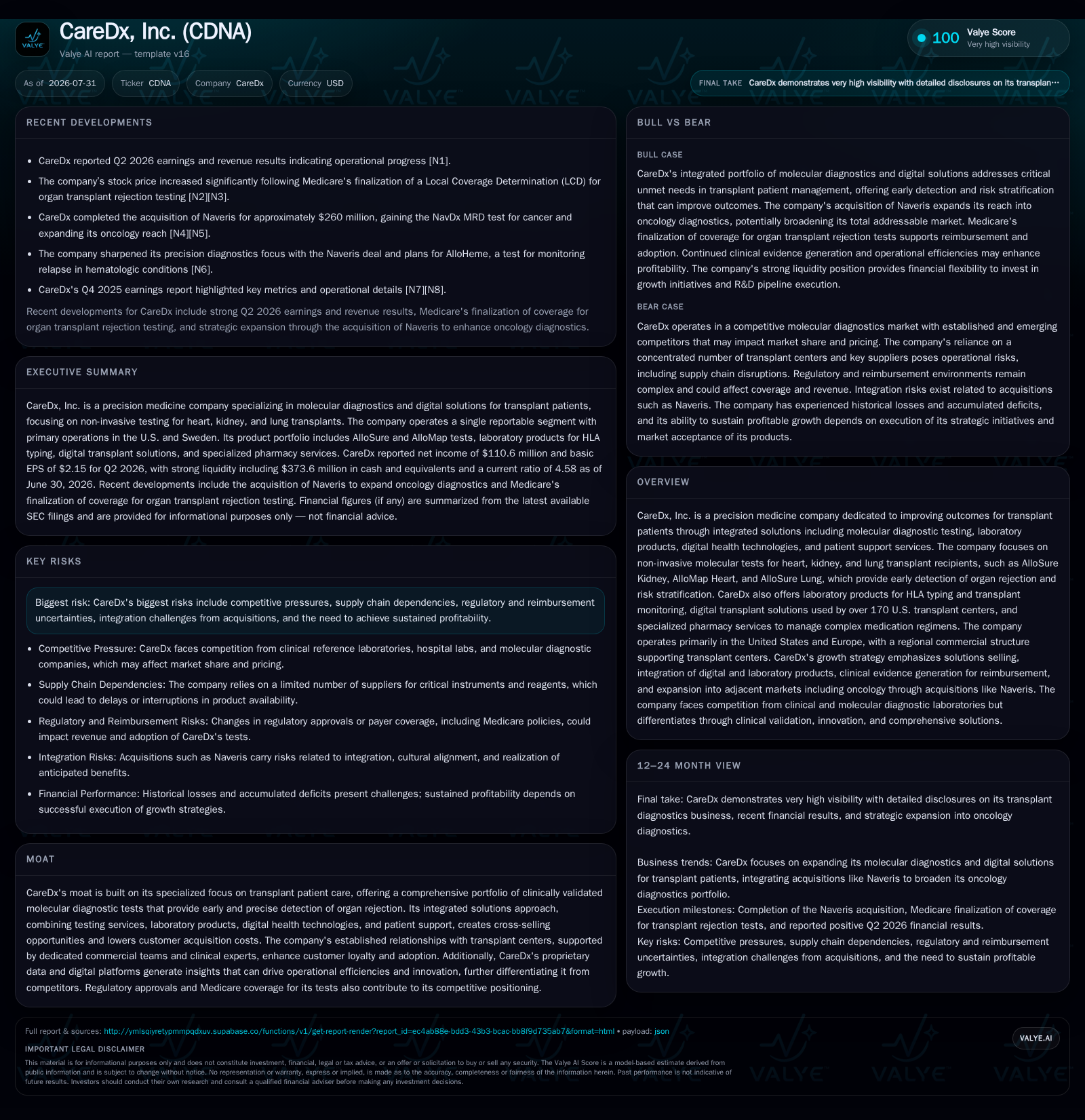
In its Q2 2026 filing, CareDx demonstrated robust operational momentum driven by growing test volumes and expanded reimbursement coverage, notably Medicare's final local coverage determination (LCD) for organ transplant rejection monitoring. The company's multi-product strategy, spanning non-invasive molecular diagnostics and SaaS-based digital platforms, is fostering higher cross-selling penetration in transplant centers, strengthening customer retention. Despite persistent regulatory uncertainties and competitive pressures common in molecular diagnostics, CareDx's strong liquidity position supports ongoing investments in R&D and commercial expansion.
Q2 Operational Acceleration Reflects Uptake of Integrated Diagnostic Solutions
CareDx’s 10-Q for Q2 2026 reveals a continuation of strong operational execution characterized by significant growth in the number of molecular diagnostic tests performed across its core organ transplant markets. Test volumes accelerated beyond prior guidance levels compared to previous quarters, driven by increasing utilization of AlloSure Kidney (donor-derived cell-free DNA dd-cfDNA), AlloMap Heart (gene expression profiling), AlloSure Heart (dd-cfDNA), HeartCare combined testing, and AlloSure Lung assays [S2]. Notably, the average revenue per test also improved during this period—a trend closely linked to recent reimbursement wins including Medicare’s final local coverage determination (LCD) endorsing broader coverage for molecular assays detecting transplant organ rejection [N5]. This policy development materially lowers barriers to adoption by clinicians and payers alike.
The revenue base remains diversified with steady contributions from patient support pharmacy services and digital health platforms designed for transplant center workflow optimization. Patient and digital solutions revenue showed an upswing consistent with increased SaaS subscription volumes from over 170 U.S. transplant center customers leveraging these platforms for patient management [S3]. The combination of non-invasive testing alongside software-enabled solutions highlights CareDx’s integrated approach to precision transplant monitoring.
"Cross-Selling Transforms Product Mix and Customer Engagement Economics"
A defining characteristic of CareDx’s model lies in its concentrated focus on serving a relatively limited number of specialized transplant centers with an expanding portfolio of diagnostic and digital tools. This multi-product engagement strategy enables efficient cross-selling that reduces incremental customer acquisition costs over time—an advantage rare among laboratory-developed test (LDT) companies facing selective clinician adoption challenges [S1]. As new tests like AlloSure Lung gain traction alongside existing kidney and heart offerings, centers deepen their relationship with CareDx’s ecosystem.
Supplementing testing services are patient support offerings including specialized pharmacy services managing complex immunosuppressive regimens post-transplantation. These ancillary revenues fuel stickiness within client accounts while broadening care continuum value [S26]. The comprehensive service suite further differentiates CareDx from competitors who often focus solely on isolated diagnostic tests or software platforms.
"Industry Dynamics: Competitive Benchmarks and Reimbursement Catalysts"
Within the molecular diagnostics landscape—where peers such as Guardant Health and Natera operate—CareDx distinguishes itself through the breadth and clinical validation of its organ-specific test portfolios tailored exclusively for transplantation. While the space faces ongoing competitive pressures from emerging diagnostic modalities and alternative assay providers, CareDx benefits from entrenched relationships with transplant centers sustained by data-driven evidence supporting clinical utility.
Reimbursement coverage remains a pivotal industry enabler; CareDx’s recent Medicare LCD finalization represents a crucial catalyst that legitimizes molecular rejection testing as part of standard care protocols [N5], [N11]. This foundational payer endorsement fosters volume growth potential but navigating fluctuating payer policies requires vigilance given continuing regulatory uncertainty flagged in risk disclosures [S6], [S27].
"Growth Levers in Precision Molecular Diagnostics and Digital Platforms"
Key structural drivers underpinning growth encompass demographic expansion in the transplant patient pool necessitating ongoing monitoring—as well as broader geographic market expansion plans centered on Europe alongside the U.S. [S1]. Research-and-development investments remain heavily directed towards enhancing existing assays’ analytical performance and generating new diagnostic modalities tailored to unmet needs identified through clinical partnerships. Notably, collaborations with pharmaceutical companies seeking biomarker-driven patient stratification within clinical trials present additional incremental revenue streams leveraging CareDx’s validated genomic platforms [S11], [S26].
"Risks Loom in Regulatory Uncertainty, Adoption Curve, and Supply Chain Dependencies"
While operational momentum is evident, persistent risks outlined include evolving reimbursement landscapes where any adverse policy shifts may negatively impact access or pricing structures [S6], [S27]. The company depends heavily on a limited set of suppliers that provide reagents and specialized instruments vital for high-complexity molecular testing—introducing vulnerability to supply chain disruption which could delay result turnaround times or impede scaling capacity [S23]. Continuing competitive innovation may pressure pricing or require intensified R&D investments to protect leadership against newer entrants offering potentially disruptive technology [S21]. Finally, successful integration of acquisitions such as Naveris added oncology-focused minimal residual disease testing but integrating these assets without distracting core operations presents execution risk [N7].
"Key Milestones To Watch: Test Volumes, Digital Platform Expansion, Reimbursement Trends"
Careful attention should be paid to forthcoming quarterly disclosures reporting test volume trajectories which will indicate whether current adoption rates can be maintained or accelerated further beyond Q2 gains [S2], [N3]. Monitoring renewals within SaaS subscriptions will be insightful since these recurring revenues underpin long-term margin improvement. Tracking updates on reimbursement policy changes beyond Medicare LCD—in different payers or regions—will help gauge breadth of financial access supporting future volume expansion [N5]. Additionally, announcements regarding progress or outcomes from pipeline clinical studies scheduled internally or via pharma collaborations may alter market expectations on new product approval timings.
Financial Profile Discussion: Solid Liquidity Supports Strategic Investment Pace
As of June 30, 2026, CareDx reported cash and cash equivalents totaling approximately $374 million against no outstanding debt—a strong liquidity buffer enabling sustained investment in research and commercial activities without near-term refinancing pressure [F1], [S2]. Current assets exceed current liabilities substantially resulting in a healthy current ratio around 4.6x indicating substantial short-term financial flexibility to navigate working capital demands or opportunistic spending needs [F1]. Despite net losses in recent years due principally to scaling costs related to R&D efforts and commercial expansion initiatives ([F1]), free cash flow has progressively strengthened providing operational runway. This financial foundation is essential given ongoing requirements for clinical studies validating novel LDT products alongside expansion of digital platforms requiring upfront development expense [S11].
This analysis synthesizes the latest quarter’s operating results with longer-term strategic positioning within the molecular diagnostics industry focused on transplantation. CareDx leverages differentiated non-invasive assays combined with digital health technologies delivered through established clinical relationships—a model that introduces recurring revenue potential through cross-selling while mitigating typical LDT commercialization challenges. Key near-term indicators include sustaining test volume ramp rates alongside successful integration of complementary services such as specialty pharmacy support. Remaining risks from reimbursement volatility, supplier dependency, competition intensity, and acquisition execution must be carefully managed to translate operational gains into sustainable profitability.
Disclaimer: This analysis does not constitute investment advice or research views. It is based solely on publicly available information as cited.
Disclaimer: This is research-only, informational analysis and not investment advice. It may include AI-generated interpretation and general industry context. Always verify important details using primary sources.

Comments