
Penske Automotive’s Acquisition Proposal Shapes Q2 Outlook Amid Regulatory and Market Challenges
Recent offer from major shareholders highlights strategic uncertainty as Penske Automotive navigates evolving EV regulations and complex financing dynamics.
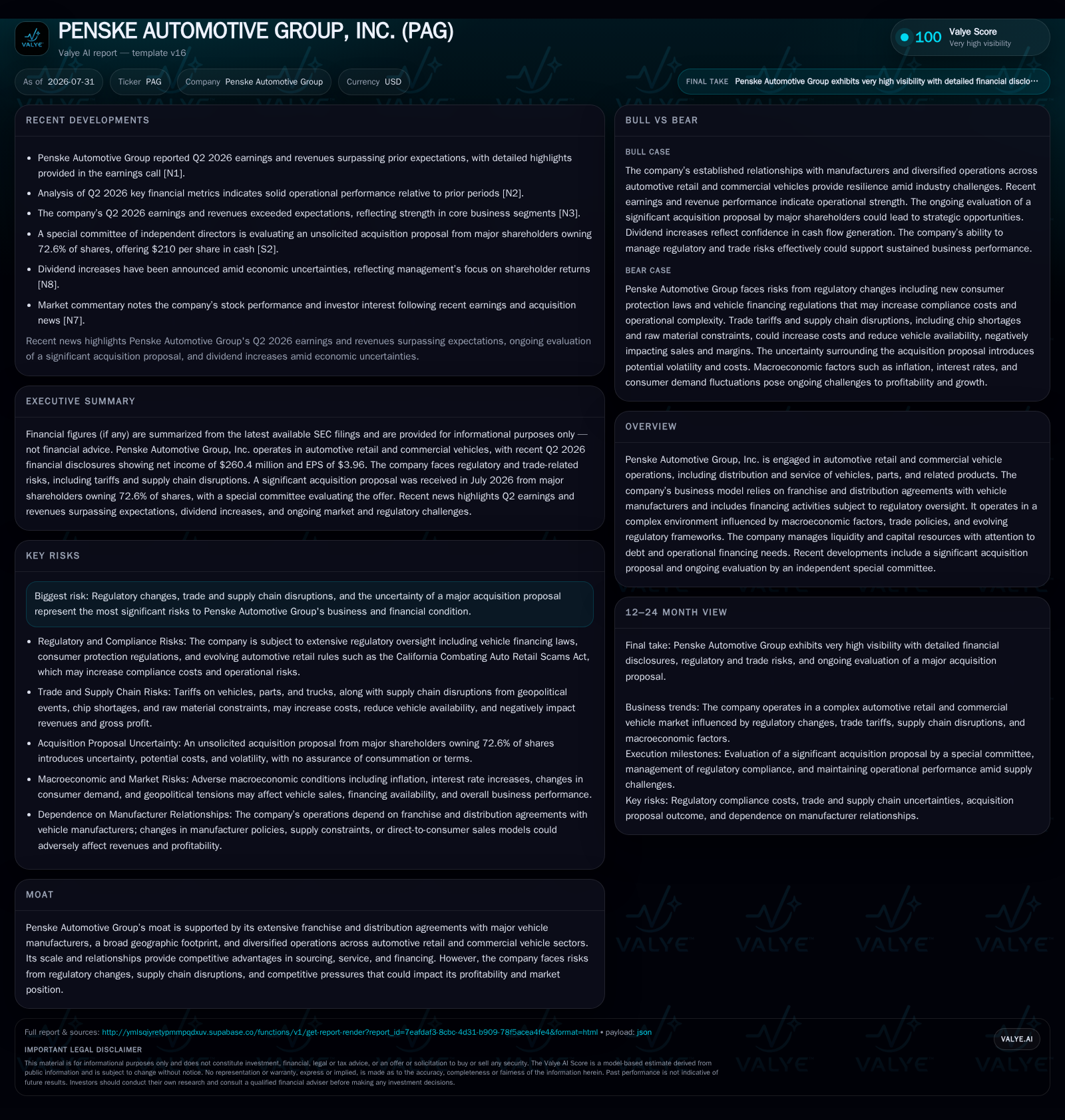
Penske Automotive Group reported second quarter 2026 results in a complex operational environment influenced by stringent emissions regulations, shifting EV incentives, and floor plan financing pressures. The company faces a notable takeover proposal from its largest shareholders, prompting the formation of an independent committee to assess the offer. Penske’s broad geographic footprint and portfolio of premium franchises support resilience, but regulatory shifts in the U.S. and U.K. are reshaping vehicle mix and margins. The firm's integrated service and parts operations remain key margin stabilizers amid volatile new vehicle demand. Financially, Penske maintains robust liquidity with approximately $69.5 million in cash against net debt near $780 million, reflecting disciplined capital management despite capital-intensive inventory requirements.
Latest Quarter Developments and Strategic Uncertainty
In its July 30, 2026 Form 10-Q filing, Penske Automotive Group disclosed receiving an unsolicited preliminary acquisition proposal from its major stockholders Penske Corporation and Mitsui Co., collectively owning roughly 72.6% of outstanding shares [S2]. The proposal offers $210 per share for the remainder of common stock not owned by these investors—a valuation level that has introduced market uncertainty prompting the creation of an independent special committee mandated to review the offer thoroughly [S2][S3]. This development is material as it places strategic considerations at the forefront during evolving operational challenges.
No firm transaction agreement is currently in place, and management cautions on potential volatility linked to the proposal’s uncertain outcome. While this external event does not alter operating fundamentals directly, it introduces execution risk and potential distraction regarding capital allocation decisions or dealership network investments.
Business Model Overview: Scale and Franchise Strength
Penske Automotive operates globally across automotive retail and commercial vehicle distribution sectors, generating $31.8 billion revenue in 2025 from diversified sources: approximately $27.5 billion from retail automotive dealerships including premium brands (Audi, BMW, Land Rover, Lexus, Mercedes-Benz, Porsche) constituting about 71% of this segment’s revenue; $3.4 billion from commercial truck dealerships; and $922.6 million from commercial vehicle distribution primarily in Australia and New Zealand [S1]
The company uniquely benefits from an extensive footprint spanning the U.S., U.K., Canada, Germany, Italy, Japan, and Australia with 365 retail automotive franchised dealerships including agency sales models in Europe that enable fee-based revenue without inventory risk. This comprehensive geographic diversification mitigates localized market cycles but also exposes Penske to regional regulatory divergences in emissions standards and EV mandates.
Vehicle sales volume achieved scale with over 583,000 new and used vehicles retailed or wholesaled in 2025 globally—a critical KPI demonstrating expansive consumer reach that supports favorable manufacturer franchise agreements due to volume thresholds [S1]
Revenue is augmented beyond vehicle sales through lucrative aftermarket channels such as maintenance/repair services, parts sales (both original equipment manufacturer and aftermarket), collision repair services at select sites, third-party finance/insurance product placement, and extended service contracts—all of which stabilize margins despite new vehicle sales cyclicality inherent to macroeconomic trends [S1]
Industry Context: Regulatory Pressures Shape Vehicle Mix
The automotive retail industry faces pronounced pressure from evolving electric vehicle (EV) mandates and emissions regulations affecting both passenger vehicles and commercial trucks across key markets served by Penske. Notably:
- The U.S. terminated the $7,500 federal EV tax credit effective September 30, 2025—prompting manufacturers to temporarily shift focus back towards internal combustion engine (ICE) vehicles due to reduced consumer subsidies that negatively influenced EV sales volumes late last year [S1].
- Contrastingly, the U.K.’s regulatory regime intensifies EV penetration requirements requiring at least 33% of new cars sold to be electric vehicles in 2026 with escalating penalties for non-compliance alongside phased bans on ICE vehicles by 2030–2035 horizon—this more aggressive stance creates regional margin pressure while altering dealership vehicle mix dynamics significantly [S1].
- Similar emissions standards tightening extend into commercial trucking sectors serviced by PTG (Premier Truck Group) in North America with model-year 2027 impending adoption of stricter heavy-duty emission norms—these rules may increase upfront truck costs as well as maintenance expense uncertainty thereby influencing wholesale demand patterns for replacement vehicles or fleet renewal plans [S1].
Such regulatory frameworks necessitate persistent inventory realignment toward EVs or low-emission models at Penske’s dealerships while potentially compressing gross profit per unit through transitional cost burdens or supply constraints—monitoring vehicle mix data per region will be essential to gauge margin recovery progress.
Financial Mechanics: Inventory Investment & Floor Plan Financing
Given the physically intensive nature of vehicle retailing encompassing substantial inventory holdings (new cars typically held on consignment or under floor plan financing arrangements), working capital dynamics pivot heavily on inventory turnover velocity moderated by pricing power.
Penske clarifies that floor plan financing forms an integral capital source whereby manufacturers or third-party captive financiers provide short-term loans secured by unsold vehicles held in dealership inventories; operating cash flows reported align closely with changes in floor plan liabilities as these represent a revolving form of working capital linked directly to stock levels [S1]. The majority of floor plan financing derives from manufacturer captive lenders though Penske retains flexibility among providers.
As of mid-2026 quarter-end balance sheet data from companyfacts indicate approximately $6.51 billion in current assets versus $6.67 billion current liabilities yielding a near-unity current ratio of circa 0.98 reflecting carefully calibrated short-term liquidity management despite sizable inventory commitments [F1]. Cash balances stood at roughly $69.5 million supporting routine operations while estimated net debt was around $780 million—consistent with prior periods—underscoring prudent leverage utilization within industry norms characterized by capital intensity but predictable dealer network cash flow profiles [F1][S2].
Furthermore, no material disruption has been reported regarding availability or cost escalation of floor plan financing even amid broader market interest rate volatility evidencing resiliency in this crucial financing line underpinning dealership inventory stocking capabilities.
Growth Drivers: Premium Brand Focus & Service-Aftermarket Expansion
Penske leverages several structural growth levers that enhance competitive positioning:
- Strong presence in premium brand franchises that command higher average selling prices and more robust margin profiles relative to volume-focused brands sustains better profitability under fluctuating volume environments typical of macroeconomic cyclicality [S1].
- Geographic expansion through dealership acquisitions and openings continues selectively—for example recent additions include two Lexus locations in Florida earlier this year augmenting market reach [S1][N1].
- Aftermarket parts/service operations constitute high-margin businesses relatively insulated from new vehicle demand swings; these channels also benefit from rising aftermarket complexity associated with EV servicing requirements creating opportunities for differentiated customer offerings and extended warranty placements [S1][N1].
- Incremental penetration of third-party finance & insurance products enhances revenue per sale through brokered commissions occurring outside direct vehicle transaction price sensitivity factors.
- Commercial truck operations benefit from ongoing fleet turnover cycles driven by regulatory-driven replacement needs coupled with advancements toward cleaner engine technologies incentivized by government schemes.
Digital retailing platforms remain an emergent channel enhancing consumer convenience though regulatory uncertainty regarding online sales compliance persists especially across different jurisdictions increasing operational complexity.
Risks & Watchpoints: Regulatory Compliance & Market Transition Uncertainty
Key risks identified include:
- Regulatory evolution could intensify compliance costs or restrict certain franchise models especially as governments tighten emissions limits or modify dealer-vehicle manufacturer relationship regulations.
- Supply chain disruptions impacting timely availability of newly mandated low-emissions vehicles could delay deliveries forcing unwanted inventory aging thus eroding margins.
- A strategic overhang exists related to acquisition proposal execution risk which could divert management focus or institute deal-related expenses irrespective of transaction completion outcome [S2][N2].
- Floor plan financing terms might tighten if credit markets deteriorate—although current disclosures report no such limitation yet this remains a critical vulnerability given dependency on this revolving credit facility for daily stocking needs.
- Competitive pressure intensifies as agency sales models expand particularly in European operations where franchise dealership inventory carrying is supplanted by fee-for-service arrangements reducing revenue transparency but potential cost exposure too [. S1].
What to Watch Next
Key milestones include updates from the special committee evaluating the acquisition proposal whose actions may affect Penske’s public market valuation trajectory over coming quarters. Operationally monitoring same-store sales performance segmented by geography (U.S. vs U.K.), premium vs volume brand unit mix shifts towards EV penetration rates will illuminate adaptation effectiveness against regulatory headwinds. Margin trajectories within service/parts divisions provide additional insight into earnings quality amid new vehicle revenue volatility. Evolving floor plan financing rates or terms under changing interest rate environments should be tracked closely given their impact on liquidity cost structure. Potential further consolidation actions either accretive acquisitions or disposals are anticipated given prior activity pace announcements.
Financial Profile Discussion
Penske Automotive reported maintaining approximately $69.5 million in cash equivalents as of June 30, 2026 against current liabilities totaling about $6.67 billion resulting in a slightly sub-par current ratio (~0.98), typical for automotive retailers richly invested in inventory secured by floor plan notes payable [F1][S2]. Total net debt approximated $780 million indicating disciplined leverage use relative to capital structure norms for companies anchored on dealer network assets supported by predictable cash flows generated from high-margin service segments.
While capital expenditures remain elevated given ongoing facility investments—including upgrades required for EV-ready infrastructure—they are funded principally through operating cash flows augmented by occasional borrowings within existing credit capacity parameters ensuring sound liquidity preservation during uncertain market conditions [S1][S2]
In summary, Penske's financial profile reflects a mature company's leveraging its diversified retail platform and service ecosystem with prudent financial management balancing significant working capital needs inherent in automotive franchising amid emerging transformation driven primarily by regulatory mandates affecting fleet composition going forward.
Disclaimer: This analysis is intended solely for informational purposes based on publicly available filings through July 31, 2026. It does not constitute investment advice or research views.
Disclaimer: This is research-only, informational analysis and not investment advice. It may include AI-generated interpretation and general industry context. Always verify important details using primary sources.

Comments