
La-Z-Boy's Strategic Store Acquisitions Reshape Retail Footprint and Margin Profile
Recent acquisitions of independent La-Z-Boy stores have materially shifted the company’s channel mix towards owned retail, influencing revenue growth and margin dynamics amid integration costs.
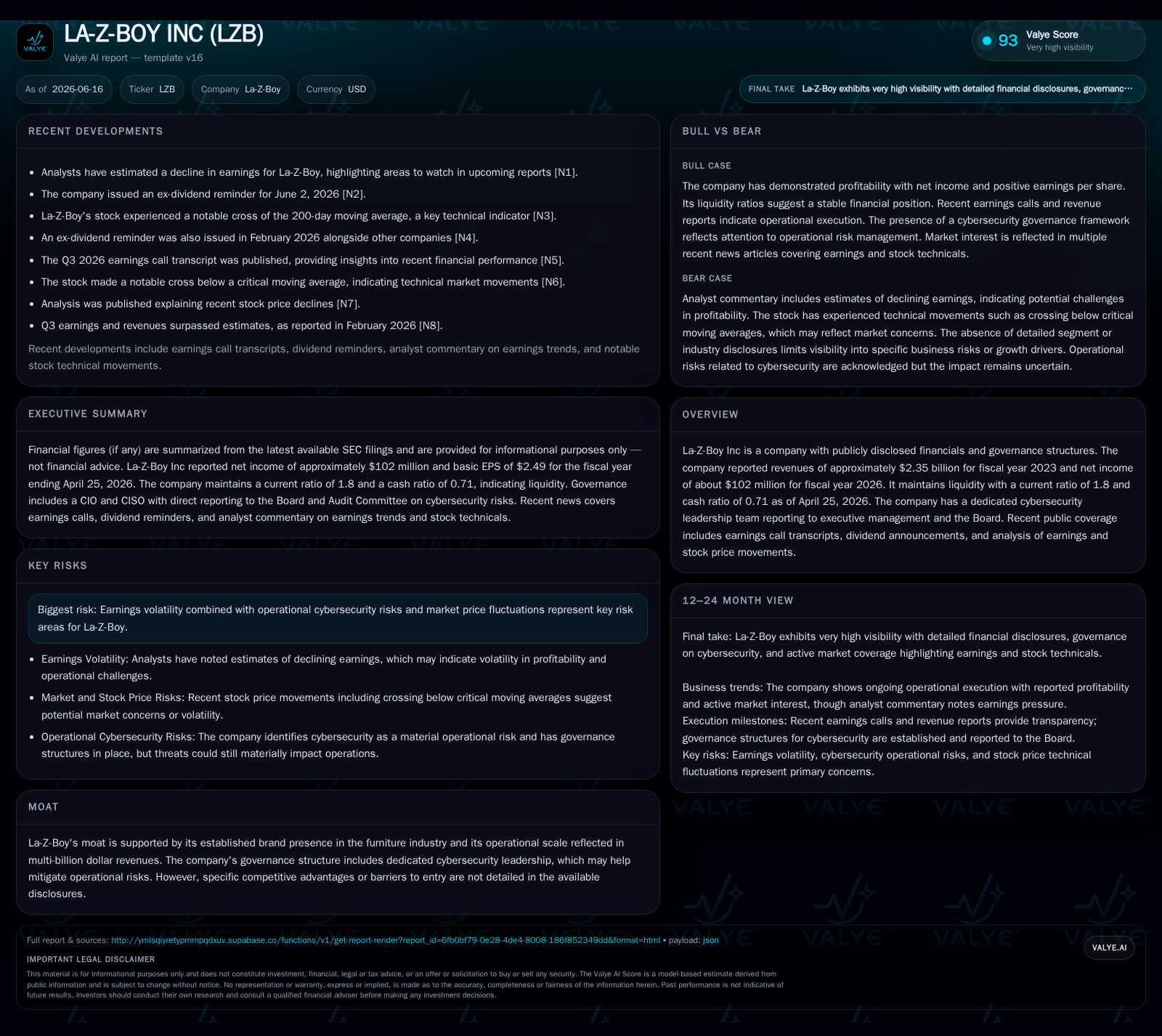
In its latest quarterly 10-Q filing for Q3 fiscal 2026, La-Z-Boy disclosed significant acquisitions completed in late 2025 that expanded its owned retail store base by adding 15 independent stores and four distribution centers in the Atlanta, Florida, and Tennessee regions. This shift towards increased direct retail operations accelerated top-line revenue but introduced margin pressure from goodwill amortization and integration expenses. The company maintains a strong liquidity position with no outstanding debt and cash reserves exceeding $300 million, enabling it to invest in these expansions. Going forward, key growth drivers include the expanded retail footprint, product customization, and supply chain improvements, while risks encompass margin compression, inventory management challenges owing to bulky furniture products, cybersecurity governance demands, and economic sensitivity in discretionary consumer spending.
Latest Quarterly Update: Acquisition-Led Growth Surge with Integration Costs
La-Z-Boy’s latest quarterly filing dated February 17, 2026 (Q3 fiscal year 2026) reveals a transformative shift in its retail footprint arising from the October 28, 2025 acquisition of an Atlanta-region business comprising 15 independently owned La-Z-Boy Stores along with four distribution centers servicing central/northeast Florida and Knoxville, Tennessee. The acquisition was executed for $90.2 million inclusive of customary adjustments [S2]. This transaction marked a strategic push to convert formerly independent dealer-operated stores into company-owned outlets.
The impact on operating metrics is significant: it enhanced total owned retail store count substantially, lifting revenue via higher direct sales exposure instead of relying exclusively on wholesale partners. However, this acceleration comes at a cost. Goodwill recognized primarily reflects anticipated future growth opportunities alongside estimated synergies achievable through operational integration. Integration expenses as well as amortization of intangible assets tied to goodwill have exerted notable downward pressure on gross margin percentage and operating income in the near term.
Further preceding acquisitions such as the Davenport, Iowa store acquisition finalized mid-2024 foreshadowed this pattern but at a smaller scale; the recent multi-store deal represents a step-change in channel expansion strategy [S2]. Early June disclosures confirmed continued integration efforts with updated profitability figures reflecting both revenues lifted and margin headwinds from acquisition-related costs [S3], [N2].
Business Model: Balancing Retail Control and Wholesale Reach for Competitive Advantage
La-Z-Boy generates revenue through a multilayered model spanning direct retail sales via company-owned stores, wholesale distribution partnerships with independent dealers, tangible product customization options driving premium sales tickets, as well as after-sales services capturing customer loyalty post-purchase [S1]. Product breadth includes upholstery furniture renowned for comfort innovation alongside complementary bedroom and casegoods segments.
The notable pivot toward increasing company control over locations—evidenced by recent acquisitions—allows La-Z-Boy stronger command over brand experience consistency and pricing strategies but concurrently increases capital intensity and operational burden linked with managing physical stores. This strategic choice contrasts with maintaining franchise or dealer models which rely more on partner execution but offer lower capital exposure.
Operating leverage benefits potential are clear; consolidating independent operators reduces channel fragmentation offering streamlined supply chain coordination. Nevertheless, this channel mix shift introduces complexity around integrating systems/processes across newly acquired outlets and balancing wholesale channel relationships without alienating dealer network stakeholders.
Industry Positioning: Brand Equity, Channel Strategy, and Peer Benchmarking Insights
Within the specialty furniture retail domain where brand recognition heavily influences consumer preference and repeat purchase loyalty, La-Z-Boy’s historically strong brand equity remains an important moat. Its blend of owned retail stores coupled with wholesale distribution places it alongside peers who negotiate a delicate balance between control and reach.
Peers typically benchmark same-store sales growth as a proxy for organic demand improvement; La-Z-Boy's recent expansion changes this dynamic by increasing overall store count through acquisition rather than solely organic store growth. Gross margin pressures are not unusual across the industry where promotional discounting campaigns often attract customers but compress profitability.
Additionally, inventory turnover is challenging given furniture’s bulky nature requiring adept supply chain management; peer companies emphasize resilience in logistics capacity to prevent stockouts or excessive holding costs. The evolving channel mix also impacts margin profile since company-owned store sales inherently bear different cost structures compared to wholesale partner transactions.
Growth Drivers: Expansion, Customization Offerings, and Supply Chain Efficiency Improvements
Key growth vectors anchored in La-Z-Boy’s filings include leveraging macroeconomic tailwinds such as housing market expansion which sustains durable demand for home furnishings. Store acquisition-driven increases expand physical touchpoints generating incremental revenue streams beyond organic sales lift.
Product innovation especially in customization—allowing consumers to personalize upholstery fabrics or configurations—supports higher average transaction values while differentiating La-Z-Boy within an increasingly crowded competitive landscape. This strategic focus on customization aligns with evolving consumer preferences favoring individualized home décor solutions.
Supply chain initiatives aim at improving efficiency metrics such as lead times from order to delivery—a critical factor given furniture’s typically long fulfillment cycles—and reducing operating expense ratios via scale economies post-acquisition. Rationalizing distribution center operations following new acquisitions is expected to enhance logistical cost structures over time.
Risk Factors: Margin Pressure, Inventory Challenges, Cybersecurity Governance, and Economic Sensitivities
The operational risks embedded in the company's growth narrative include margin erosion risks amplified by increased promotional discounting necessary to attract foot traffic amid intensifying competition. Integration expenses related to acquisitions—both one-time charges and ongoing amortization—pressure near-term profitability.
Inventory management remains a delicate issue due to furniture’s physical bulkiness leading to elevated storage costs and markdown risk if demand forecasts falter. Disruptions along the supply chain could exacerbate stockout situations or inflate freight expenses.
La-Z-Boy distinguishes itself with dedicated cybersecurity governance highlighted in its annual filing: the CIO and CISO roles report directly into executive management and board-level Audit Committee oversight emphasizing mitigation of information security threats within increasingly technology-enabled retail operations [S1]. This focus addresses rising risks of data breaches or system disruptions which could impact customer trust or operational continuity.
Broader economic factors pose sensitivity given discretionary nature of furniture purchases; downturns could depress consumer spending despite otherwise favorable housing trends.
Outlook: Key Upcoming Milestones in Integration and Market Demand Signals
Investors should monitor forthcoming earnings releases for updates on realization of synergy targets from acquired store integrations including improvements in operating expense ratios reflecting efficiency gains. Same-store sales growth will serve as a pivotal metric distinguishing organic demand recovery versus strength derived solely from added locations.
Supply chain normalization signals such as shortened lead times or reduced freight cost volatility will inform margin trajectory expectations moving forward. Pricing discipline effectiveness amid competitive pressures indicated by gross margin stabilization will be another focal point.
Macroeconomic markers like consumer confidence indices impacting discretionary spending timing remain critical external demand indicators shaping sales momentum post-integration [N1], [N2], [S3].
Financial Summary: Liquidity Strength Amid Modest Earnings Volatility
As of April 25, 2026 end-of-quarter balance sheet metrics show La-Z-Boy holding approximately $303 million in cash and equivalents against zero reported debt outstanding highlighting robust liquidity availability supporting ongoing expansion initiatives without reliance on leverage [F1], [S2].
Operating income recorded at about $129 million versus net income near $102 million for latest periods reflect moderate earnings volatility consistent with investment phase expenditure accompanying acquisition integrations yet maintain profitable operations overall indicating strength in core business fundamentals [F1]
Disclaimer: This analysis is based solely on publicly available filings and verified data as of mid-2026 pursuant to internal Valye editorial policy; all financial metrics are cited accordingly without projection or investment research view.
Disclaimer: This is research-only, informational analysis and not investment advice. It may include AI-generated interpretation and general industry context. Always verify important details using primary sources.

Comments